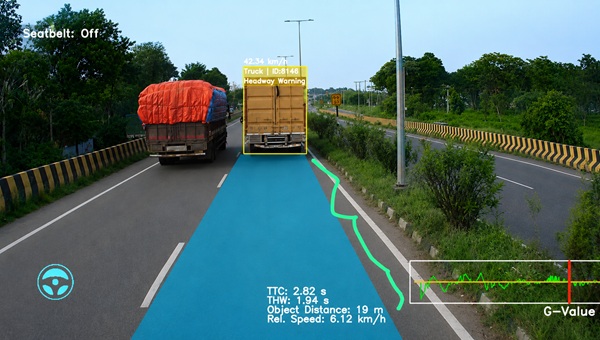
drivebuddyAI, a leading provider of AI-powered Advanced Driver Assistance Systems (ADAS) and Driver Monitoring Systems (DMS), has been granted an Indian patent for its invention “A Real-Time Automotive Assistance System and Method for Lane ROI Detection in Vehicle.”
The patented technology introduces an intelligent, automated framework for lane detection that improves the accuracy and reliability of critical ADAS functions while reducing false alerts across diverse real-world driving environments.
As ADAS adoption continues to grow globally, an accurate understanding of the vehicle’s drivable corridor remains essential for safety features such as lane departure warnings, forward collision warnings, headway monitoring, and driver assistance interventions. However, conventional systems are often affected by variations in camera installation, vehicle architecture, road geometry, environmental conditions, and sensor alignment, resulting in inaccurate estimations and inconsistent performance.
drivebuddyAI’s patented technology addresses these challenges through a self-calibrating framework that automatically optimises lane calculations during new installations, software updates, and system reboots, ensuring reliable performance without manual intervention. The new patent covers several innovations, including: ● AI-driven frame validation that selects high-confidence video frames for lane ROI computation. ● Vehicle-specific lane adaptation based on vehicle type and configuration. ● Dual-camera architecture integrating road-facing ADAS with Driver Monitoring Systems (DMS). ● Real-time safety alerts supporting lane departure warning, collision avoidance, and steering assistance. ● Compatibility with Level 2 and Level 3 autonomous driving applications, including Autonomous Emergency Braking (AEB) and advanced path planning.
Unlike conventional approaches that rely on static calibration settings, drivebuddyAI’s technology continuously validates and optimises lane ROI using real-world driving data, enabling robust performance across inconsistent lane markings, changing road conditions, adverse weather, and diverse vehicle platforms.
The technology has been trained and validated on over 6.4 billion kilometres of real-world driving data, spanning highways, urban roads, rural routes, low-light environments, adverse weather conditions, and complex mixed-traffic scenarios. This extensive dataset enables reliable lane perception in situations where traditional systems frequently underperform.
Commenting on the patent grant, Nisarg Pandya, Founder & CEO, drivebuddyAI, said: “The effectiveness of any ADAS system depends on how accurately it understands the drivable space around the vehicle. This patent is a significant step towards self-calibrating ADAS systems that deliver more reliable safety alerts with minimal manual intervention.”
The technology is particularly valuable for commercial fleets and OEMs operating across diverse geographies and vehicle platforms. By automating lane calibration and enabling continuous optimisation through cloud connectivity and over-the-air (OTA) updates, the solution simplifies deployment, reduces maintenance requirements, and ensures consistent ADAS performance throughout the vehicle lifecycle.
This latest grant further strengthens drivebuddyAI’s growing intellectual property portfolio, which now includes more than 15 patents spanning ADAS, DMS, AI perception, driver risk assessment, driver recognition, real-time safety systems, and intelligent mobility technologies. As the automotive industry transitions toward connected, software-defined, and increasingly autonomous vehicles, drivebuddyAI continues to advance AI-driven safety innovations that make mobility safer, smarter, and more reliable.
Motoring journalist and television presenter Richard Hammond has partnered with automotive diagnostics specialist Carly, to help UK drivers to improve their understanding of issues affecting modern vehicles and learn how to deal with them.
Richard Hammond – a much-loved British television presenter and journalist, well known for co-hosting motoring programmes BBC Top Gear, and The Grand Tour on Amazon Prime, both with Jeremy Clarkson and James May – has a well-regarded and popular car restoration business, The Smallest Cog. He also hosts the TV show Richard Hammond’s Workshop on Discovery+.
Rather than a traditional celebrity endorsement, the collaboration will focus on educational content, practical advice and real-world eventualities that reflect the realities of modern car ownership. Through the partnership, Richard Hammond will explore common vehicle issues, share insights from his own experience and use Carly technology to demonstrate how drivers can gain greater visibility into the health of their vehicles over the length of their ownership.
The association reflects a shared commitment to improving transparency around vehicle maintenance and reducing the uncertainty many drivers face when warning lights appear on the dashboard. By making diagnostic information more accessible and easily understood, Carly’s aim is to help motorists address issues before they lead to more serious and costly repairs.
As part of the partnership, which aims to help UK drivers understand technology behind modern cars, Carly’s compiled the top 5 car issues for a few car brands aged between 2016–2024. Carly’s data reveals that software, sensor, battery voltage and vehicle communication issues are among the most commonly detected problems across some of the UK’s most popular car brands according to the latest SMMT figures (May 2026). This dataset highlights how important it is for drivers to be able to access vehicle diagnostics quickly so they can assess any issues with their cars and take suitable action before repair costs escalate.
Modern vehicles rely on many interconnected control units, sensors and electronic systems. While these technologies improve performance, efficiency and safety, they can also make fault diagnosis much more challenging for drivers. Carly’s latest analysis of millions of diagnostic sessions shows that software-related faults, sensor malfunctions, battery voltage issues and vehicle communication errors are among the most commonly detected problems across popular modern car brands. Frequently detected issues highlighted by this Carly dataset include CAN-BUS communication errors, undervoltage and overvoltage faults, fuel pump and turbocharger sensor faults, and emissions-related issues, including particulate filter and catalyst system faults. See the table below for more detail.
The dataset suggests that while mechanical reliability remains of great importance, many of the most frequently detected issues in today’s vehicles are now linked to electronics, software and communication networks*. Using Carly’s systems to get an early diagnosis of such problems can help drivers address faults before they develop into more costly repairs and avoid unnecessary garage visits.
Carly UK Growth Manager Emma Brown said: “As vehicles continue to become more connected and technologically advanced, access to clear and understandable diagnostic information is becoming increasingly valuable for drivers seeking greater confidence and control over vehicle maintenance. We’re excited to be partnering with Richard Hammond to help bring that message to UK motorists and beyond. By helping drivers identify potential issues earlier, Carly gives them clearer insight into their car’s health, so they can make more informed repair decisions, reduce the risk of unnecessary costs and feel more in control when faults or warning lights appear.”
In response to his association with Carly, Richard Hammond said: “What made this partnership interesting to me is that it’s not really about advertising – it’s about helping drivers better understand modern cars in a practical, real-world way. Cars today are driven as much by software and data as they are by mechanics, and that’s exactly the kind of conversation we’ll be focusing on.”
The recent dataset from Carly underlines how technology in modern vehicles can make pinpointing issues increasingly tricky without help from a diagnostic system. The collaboration between Richard Hammond and Carly highlights the increasing importance of giving drivers the tools and information they need to be confident when working on their cars.
BYD has announced Full Damage Coverage for the Urban Navigate on Autopilot (NOA) function of its God’s Eye – BYD Driver Assistance System in China. The company made the landmark announcement at its Intelligence Strategy Launch Event, where it also unveiled China’s first 4nm automotive Driving System on a Chip (SoC), the XUANJI A3.
With this new offer, following its commitment to Intelligent Parking, BYD has now become the world’s first automaker to offer such dual coverage for its advanced driving assistance systems (ADAS). Furthering its “Intelligent Driving for All” strategy, BYD also announced that its entire vehicle lineup can now be optionally equipped with the God’s Eye LiDAR Version.
BYD’s vision for the era of Intelligent Driving is defined by three ambitious goals of achieving Zero Traffic Accidents, enabling the ADAS to serve as a Super Driver, and empowering AI to become a Super Personal Assistant. To realize this vision, the company will continue to invest over RMB 100 billion (£10,987,650,000) in Intelligent Driving Assistance R&D, focusing on safety technologies for every family.
BYD’s Full Damage Coverage Sets a New Industry Standard for Trust The one-year Full Damage Coverage guarantee applies to new buyers and existing owners who upgrade to God’s Eye 5.0 in the Chinese market. The policy states that if a legally-liable accident occurs while a user is operating the Urban NOA function in compliance with regulations, BYD will directly cover all resulting economic losses.
The confidence to make this industry‑leading commitment rests on three foundational pillars. The first is its massive scale, with a fleet of over 3.15 million Intelligent Driving Assistance vehicles on the road—the largest among Chinese automakers—providing an unparalleled foundation of real‑world data for continuous iteration. The second is the abundant data generated by the God’s Eye, with over 124 million miles logged daily, ensuring rapid algorithmic learning and improvement. The third pillar is a dedicated R&D team of 5,000 engineers, the largest in China’s automotive industry, powering the company’s sustained technological innovation.
AI Empowerment—BYD Integrated Vehicle Intelligence Delivers Next-Gen Performance The God’s Eye receives four major upgrades. These include a new XUANJI Architecture 2.0, an industry‑first satellite sensor architecture, an upgraded physical AI large model, and a self‑evolving data flywheel built on massive real‑world scenarios.
In the cockpit, BYD introduced the DiLink AI Intelligent Cockpit, featuring the super intelligent agent. This hyper‑realistic digital assistant offers proactive task execution and deep reasoning capabilities, delivering an all‑scene, continuously evolving in-car experience.
BYD Self-developed 4nm Driving SoC, Gearing Up for High‑Level Autonomous Driving BYD unveiled the XUANJI A3, China’s first self‑developed 4nm automotive‑grade Driving SoC. It natively supports L3 and L4 autonomous driving, and a three-chip configuration can deliver over 2,100 TOPS of computing power per vehicle. With the most advanced 4nm process and the lowest power consumption per TOPS—20% lower than comparable products—the XUANJI A3 is already in mass production. When combined with BYD’s proprietary algorithms, it doubles computing utilization, significantly raising the ceiling for both safety and performance.
From Blade Battery to Intelligent Driving, BYD’s Focus on Safety and Trust Remains Constant In the industry’s electrification phase, the Blade Battery was BYD’s answer to user concerns about safety. Now, in the era of Intelligent Driving, BYD applies the same core principle. The company’s strategy is to push the limits of ADAS capabilities with the God’s Eye, bolster user confidence through its Full Damage Coverage offer, and shape the future of mobility with self-developed technologies like the XUANJI A3 chip.
Through this strategy, BYD reaffirms its dedication to leveraging technological innovation for a better, safer drive for all.
BMW Group India has announced the launch of BMW Summer Service Campaign 2026 across its nationwide dealer network, reinforcing its commitment to proactive customer care and premium ownership experience. The campaign is designed to ensure seamless mobility during the demanding summer months through preventive maintenance, expert diagnostics and exclusive service benefits.
Mr. Hardeep Singh Brar, President and CEO, BMW Group India said, “Indian summers can be tough, both for drivers and their cars. At BMW Group India, we believe a truly premium ownership experience goes beyond the vehicles we build. It is about the confidence and peace of mind we provide throughout the ownership journey. With the BMW Summer Service Campaign 2026, we are helping customers prepare better through timely preventive maintenance and advanced vehicle diagnostics for hassle free driving through summers. Our aim is to make proactive care simple, transparent, and reliable so that customers can enjoy every drive without worry. We remain committed to delivering seamless and precise service that ensures the performance, reliability and effortless driving pleasure that define the BMW experience.
The campaign aims to ensure customers are well prepared for the summer season with a list of prescribed checks. The campaign combines preventive vehicle inspection with value-added benefits and expert guidance to support effective vehicle management and on-time maintenance. Customers can book prior appointments for servicing at their preferred workshop and may also update their personal details to receive relevant service communications and offers from their authorised BMW dealer.
Following are the complimentary services covered under BMW Summer Service Campaign 2026:
AC Filter Check
Air Filter Check
Tyre Condition Check
Complimentary Battery Check*
Up to 10% off on AC Fumigation
Up to 25% off on labour on any AC related repair
Up to 10% off on any VAS (Value Added Services)
*Complimentary Battery Check will be applicable only on non-EV vehicles.
Customers can also explore a wide range of BMW accessories to enhance the appearance and everyday functionality of their vehicles.
BMW India conducts periodic service campaigns across the country to help ensure that every BMW remains ready for the road. Cars older than five years can also benefit from special advantages under the ‘BMW Joy Rewards’ programme. Details of the offers and recommended vehicle checks will be available at participating authorised workshops during the campaign period.
BYD has unveiled a host of exciting new-model launches at the Beijing Auto Show, showcasing its latest technological advances across its brands, BYD, DENZA, FANGCHENGBAO and YANGWANG.
The rich lineup of new vehicles fully demonstrates BYD’s product diversity. The showcased models span a wide spectrum, including the OCEAN-V family mobility concept cube, the flagship SEALION 08 SUV, FORMULA X — a road-legal sports concept car — and the all-new FORMULA S and FORMULA SL sedan series from BYD’s personalized brand FANGCHENGBAO. Also unveiled are a 1,000+ PS supercar, the DENZA Z, as well as the first production-ready version of the world’s fastest production car, the YANGWANG U9 Xtreme. This comprehensive portfolio reflects how BYD delivers technological innovations to consumers across mainstream, high-end and ultra-luxury market segments.
FLASH Charging and the 2nd Generation Blade Battery both feature prominently across the show stands, as BYD continues to roll out these groundbreaking features and remove the last major barrier to new-energy vehicle adoption by customers in China and overseas.
BYD Executive Vice President Stella Li said: “The Beijing Auto Show is the perfect moment for BYD to demonstrate our innovative technologies and the difference they can make to our vehicles and our customers. On all our brands’ show stands, from BYD itself to FANGCHENGBAO, DENZA and YANGWANG, we have a line-up that shows how our commitment to research and development is leading the way not just in China, but globally. Breakthroughs like FLASH Charging will overcome the final barriers to the adoption of truly sustainable mobility, while exciting new models like our DENZA Z are ready to inspire fresh waves of customers around the world.”
DENZA ENTERS BOLD NEW ARENA WITH GROUND-BREAKING Z SUPERCAR DENZA, BYD’s premium technology-oriented brand, chooses the Beijing Auto Show for a significant global debut that takes it into an exciting segment: the DENZA Z, the world’s first intelligent electric supercar.
Displayed in production convertible form in Beijing, complete with a soft-top retractable roof, the DENZA Z is a masterpiece meticulously crafted by a global team led by BYD’s Global Design Director Wolfgang Egger. It represents the fusion of technology and perfection in design, featuring supremely pure aesthetics underpinned by a world-leading technical architecture.
The Z embraces the “Pure Emotion” design philosophy, seamlessly blending carbon fibre with aerodynamic performance to create an elegant and dynamic silhouette. Its form is led by function too, with ducts that on the bonnet that act as air channels to help boost levels of downforce at high speeds.
The revolutionary body architecture achieves a world-leading balance of rigidity, lightweight construction and packaging. And the chassis features DiSus-M, an intelligent magnetorheological (electro-magnetic) body-control system engineered specifically to cope with shattering high performance – more than 1000 horsepower and a 0-100km/h acceleration time of less than two seconds. Rewarding long drives are made possible by the 2nd Generation Blade Battery and FLASH Charging.
The Z has already commenced testing and lap-record runs at the legendary Nürburgring Nordschleife, and it will have its full global launch this summer at the prestigious Goodwood Festival of Speed in the UK. DENZA has launched a public competition to name each of the three specific editions of Z that will ultimately reach customers: Standard, Convertible and Track.
The arrival of the DENZA Z marks a watershed moment for the global auto industry, as the world’s first premium brand with a uniquely new-energy approach breaks into the core territory of million-dollar luxury supercars, a segment traditionally dominated by legacy European manufacturers.
With its globally inspired original design and disruptive technological innovations, the DENZA Z will inspire and thrill customers ready for the next-generation smart electric supercar. Further technical specifications and a comprehensive sales-rollout schedule will be issued in due course.
SEAL 08 AND SEALION 08: NEW FLAGSHIPS FOR THE OCEAN SERIES BYD’s is known for building quality cars that customers truly love, with substance and attitude – moving in sync with the younger generation. Having refreshed the entire ‘567 series’ – SEALION 05, SEAL 06, SEALION 06 and SEAL 07 – in recent months, OCEAN brings two more exciting production debuts to Beijing: the SEAL 08 and SEALION 08.
Described as ‘dual flagships’, these two models bring together BYD’s leading technologies and represent a brand-new answer to the next generation of premium family cars. The SEAL 08 sedan’s sleek exterior is now matched by a cabin that looks even better on the Beijing stand than it did in preview images released during the build-up to Beijing.
The first thing you feel is premium quality, with an iconic horizon design and no unnecessary clutter; the SEAL 08’s interior is like living in a high-end ocean-view apartment – bright, open and spacious. One example of the astounding attention to detail is the luminous mother-of-pearl inlays – a feature normally reserved for million-dollar luxury cars or the finest jewellery and watches.
The front occupants get dual zero-gravity seats with one-button recline, while in the back, there are electric leg rests, multi-angle seatback adjustment, and a centre-armrest touchscreen. All the seats come with ventilation, heating, and massage, making you feel like a VIP on every journey. And there are practical touches to accompany the refined environment, including eight magnetic mounting points where you can affix a range of items to customise the interior.
The SEALION 08 SUV is the result of more than a dozen clay design models and hundreds of revisions as the design team honed OCEAN Aesthetics 2.0 into a taller vehicle. It stands grand, solid, premium, and incredibly stylish. It measures 5115mm long, 1999mm wide and 1800mm high, with a 3003 mm wheelbase; these dimensions allow true ‘grand apartment’ accommodation, with six independent seats over three rows.
Design touches include ‘floating’ centre caps in the 21-inch ‘light-trace wave’ wheels, and the longest tail-light motif in the industry – a ‘tide gradient’ design that measures almost two metres in length.
Both new models feature BYD’s latest 2nd Generation Blade Battery, complete with FLASH Charging that can be ‘ready in 5, full in 9’, and Disus-A dual-chamber air suspension for supreme composure and comfort. The SEAL 08 and SEALION 08 are true flagships for the OCEAN Series generation – unforgettable when you’re seated, addictive when driven.
OCEAN-V CONCEPT SHOWS BYD’S VISION FOR FUTURE MOBILITY Joining the SEAL 08 and SEALION 08 at the Beijing Auto Show is the OCEAN-V, a radical exploration of the future of mobility. It’s a ‘family mobile life cube’ that breaks boundaries and refuses to fall into the usual categories of sedan, SUV or MPV.
OCEAN-V takes next gen OCEAN Aesthetics as its core philosophy, breaking free from conventional vehicle design constraints. It has both the warm, flowing nature of the ocean and the avant-garde, pioneering presence of future mobility.
Within its form lies the freedom to have multiple cabin environments focused on fun, engagement and practicality. These include: Driving mode – spacious and comfortable, with a steering wheel but no physical buttons for a futuristic experience. Cinema mode – press just one button and the seats adjust, the steering wheel retracts, the dashboard flips, and a screen rises to turn the OCEAN-V into a private movie theatre. Camping mode – the seats fold and rotate, allowing quality face-to-face time between parents and child, a picnic or even a three-person bed.
The interior is further enhanced by the ‘Glowing jellyfish kit’ – jellyfish-shaped speakers and lights, magnetically detachable and usable everywhere from the roof to a tent or on the grass. They bring atmosphere, a sense of fun, and usability, all in one.
OCEAN-V represents OCEAN Series’s original aspiration: to understand the new generation and build dreams for young families. The concept’s innovations will gradually make their way into mass-production vehicles, enhancing everyone’s future mobility.
FASTEST CAR ON THE PLANET ENTERS PRODUCTION WITH ‘THE DAWN’ EDITION YANGWANG’s U9 Xtreme hypercar made headlines globally last autumn when it became the fastest car on the planet – a benchmark of 496.22km/h that was soon followed by a record lap of the Nürburgring Nordschleife in just 6 minutes and 59 seconds. Now the U9 Xtreme – already known by car enthusiasts worldwide as the U9X – makes its production debut at the Beijing Auto Show as the Yangwang U9 Xtreme “The Dawn”.
The first production-spec U9X, “The Dawn” draws inspiration from golden rays of sunlight piercing through the clouds on the morning the vehicle broke the world production-car speed record – Yangwang’s own ‘dawn moment’.
Specific “Dawn Moment” body paint incorporates an ultra-fine gold powder, sealed by multiple layers of clear coat. Under varying light conditions, the paint surface perfectly replicates the radiant glow of the rising sun breaking through the clouds.
Matte-gold sections use a traditional Chinese lacquer-polishing technique to imprint a unique, warm texture onto every inch of the body’s surface. This heritage craftsmanship embodies the Chinese pursuit of supreme aesthetics and meticulous detail. By delving into these millennia-old traditions, YANGWANG aims to find a resonance of values between Eastern artistic craftsmanship and the discerning tastes of 30 of the world’s top collectors. The U9X “The Dawn” at Beijing Auto Show is designed to demonstrate how this approach can be explored and enjoyed by every customer.
Each example of the YANGWANG U9 Xtreme will feature a unique, fully customised design – everything from exterior paint finishes and carbon-fibre patterns to the infotainment UI, welcome-light messages, and door-closing chimes. Some owners have already finalised their personalisation plans and are beginning to enter the contract-signing and production-scheduling phases.
Every YANGWANG U9X will be a one-of-a-kind work of art, representing the R&D team’s ultimate pursuit of the ultimate dream car, as well as being a gift from YANGWANG to every car enthusiast around the world.
YANGWANG U8L RAISES THE BAR AGAIN WITH FOUR-SEAT DINGZANG EDITION The Beijing Auto Show also witnesses a new member of YANGWANG’s U8L model line-up: the YANGWANG U8L Four-Seater Dingzang Edition, featuring a spacious four-seat layout. Building on the U8L Dingshi Edition, the new model retains groundbreaking technologies such as the e4 quad-motor platform, FLASH Charging technology and the 2nd Generation Blade Battery, while delivering comprehensive upgrades in design aesthetics, cabin layout and material craftsmanship.
The YANGWANG U8L Dingzang Edition introduces an exclusive paint colour, “Ink Jade Blue,” which blends the lustre of jade with the profound depth of ink jade. The paint formula, refined through hundreds of adjustments, incorporates micron-sized aluminium-powder crystals that create a rich gradient effect as light shifts. It’s paired with 22-inch eight-spoke forged-aluminium alloy wheels, while there’s also a new colour for the interior: “Mingsha Gold”. Inspired by nature, this bright yellow and white combination is accompanied by specially customised mountain-pattern embroidery on the seats, drawing inspiration from the contours of the Qilian Mountains and infusing the design with the artistic essence of calligraphic brushwork.
The all-new four-seat layout incorporates dual zero-gravity seats – exclusive in its class – and a second-row peninsula-style centre console that offers up to seven independent storage compartments, perfectly accommodating personal valuables and creating an exclusive, supremely private and luxurious mobile lounge. The trunk offers a generous 512-litre capacity, meanwhile, easily accommodating three 47-inch golf bags.
The intricate mix of nature-inspired colours and textures reflects the fact that while YANGWANG enters its fourth year supported by a solid foundation of cutting-edge technology, it is the companions who drive its vehicles who truly bring soul and warmth to the brand.
Pioneering a “One Car, Multiple Forms” Model, the Formula S Creates a New Category of Personalized Sedan–FANGCHENGBAO BYD’s personalisation-focused brand FANGCHENGBAO has quickly established itself in the market and gained a significant following since its introduction in 2023. Now, with strong sales of the SUVs like the BAO 5 and BAO 8 secured (over 50,000 units per month by the end of 2025), FANGCHENGBAO is moving to its next phase with its first new-energy personalised sedans – the “Formula S” series and the production sports car – the “FORMULA X”.
The Formula S is positioned as a “multi-form personalized sedan for all scenarios,” creating a new category of personalized sedans. It represents FANGCHENGBAO’s “all-scenario personalized sedan solution” for users, pioneering the industry’s “one car, multiple forms” model. It offers three versions: the three-box sedan “Formula S”, the shooting brake “Formula S GT”, and the larger three-box sedan “Formula SL”. All three models boast a large presence with a length exceeding 5 meters, a wheelbase of 3 meters, and a width of 2 meters. The golden ratio body, combined with a low-slung and wide-body dynamic stance, exudes the poised stance of a cheetah. The “Cheetah Eyes” headlights and “Infinity Ring” taillights maximize recognizability, making the Formula S series stand out in terms of design.
The dynamic and sporty “Formula S” and the wildly stylish “Formula S GT” boast a dynamic and expansive stance, equipped with a front splitter, wide wheel arches, and a rear diffuser. The latter’s 21° hunting angle evokes the image of a cheetah on a long-distance sprint, leaping across the wilderness. The sexy and elegant “Formula SL” features clean, flowing side lines, a long and sharp profile, and is equipped with a horizontally integrated metal grille and an electric rear wing. All three models are expected to launch in the third quarter of this year.
The production sports car concept car “FORMULA X” is said to be over 80% identical to the real car, and is in line with the sedan series. It represents the ultimate totem of the “Formula” series in terms of aesthetics, performance and experience, and is expected to be launched next year.
THIRD-GENERATION YUAN PLUS BRINGS FLASH CHARGING & GOD’S EYE B With more than 1.1 million units sold in 116 markets around the world, the Yuan PLUS (ATTO 3) is one of BYD’s most popular global models. Beijing Auto Show sees the debut of the third generation of Yuan PLUS, with a sharp design, FLASH Charging technology, God’s Eye B and LiDAR-assisted automated driving systems, and an intelligent cabin.
The new design incorporates a longer wheelbase than the second-generation model, complete with a ‘golden ratio’ between bodywork and glass area. A character line, inspired by a city skyline, runs along with flanks, while the D-pillar creates a ‘floating roof’ effect. There are semi-concealed door handles, and the tail-lights feature a new LED design that gives a three-dimensional effect. The rear logo is also illuminated to resemble an energy emblem formed of converging starbursts.
Inside, the design mixes the strong treatment of sports equipment with a softer approach of home furnishings. A new two-spoke steering wheel design incorporates buttons with a concave profile, enhancing tactile quality and usability; it’s now possible to select gears without taking your hands off the wheel. The cabin is bathed in natural light, thanks to a huge panoramic glass roof.
There’s a total of 39 storage areas throughout the vehicle, including a 750-litre trunk and a 180-litre powered front trunk that can be opened with a simple tap when your hands are full of shopping.
The feature list includes a 16-speaker audio system, a special front passenger seat with extra reclining function for relaxing on longer journeys, an air-conditioner-powered refrigerator that can heat and cool items, 50W wireless phone charging, 60W USB Type-C charging and 256-colour ambient lighting.
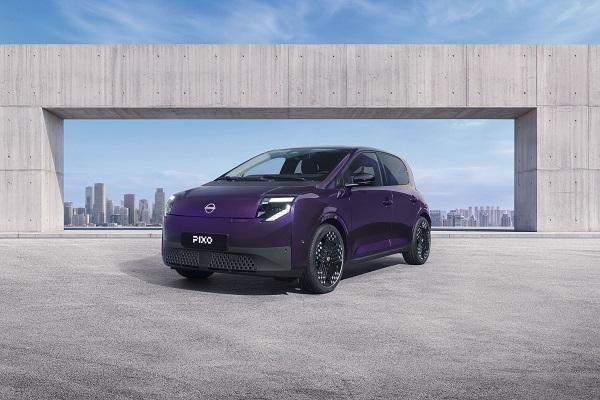
Nissan has unveiled the all-new, all-electric Juke at its Vision event at the company’s global headquarters in Japan, marking a major step forward in its electrification strategy in Europe. As the region’s electric vehicle (EV) market continues to grow, Nissan is building on its 15 years of EV leadership to meet an array of customer needs while navigating a complex and competitive market environment.
Agile, compact, and unmistakably Nissan, this first-ever EV Juke carries personality and emotion into the EV era, reimagining one of Europe’s most distinctive compact crossovers. It forms part of Nissan’s broader strategy to offer an electrified powertrain for every type of customer today.
Since its original launch in 2010, Juke has captured the imagination of 1.5M customers across Europe, reshaping the compact crossover segment with its daring and unconventional design. The new Juke retains that character while introducing a fully electric powertrain, supporting Nissan’s journey towards to zero-emission mobility.
The all-electric Juke joins a growing European EV line-up including the new Micra, third-generation Leaf, Ariya crossover and Townstar LCV, as well as a new A-segment EV to come. The Juke EV will join the third-generation Leaf in offering Vehicle-to-Grid technology, supporting the integration of EVs into the wider energy ecosystem.
Alongside its expanding EV line-up, Nissan continues to offer its e‑POWER hybrid technology, delivering an EV-like driving experience without the need to plug in. Hybrid models such as Qashqai e‑POWER and Juke HEV will remain an important part of the line-up, ensuring customers have access to technologies that suit their needs today.
“Europe is central to Nissan’s electrification strategy, and we remain firmly committed to a fully electric future,” said Massimiliano Messina, Chairman, Nissan AMIEO. “With a rapidly expanding EV line-up, we are bringing greater choice and innovation to every segment, powered by our strong design, engineering and manufacturing footprint in the region. Together, this next generation of vehicles will accelerate our transition to zero-emission mobility.”
The all-new, all-electric Juke will be built at Nissan’s Sunderland Plant in the UK, reinforcing the site’s central role in the company’s global EV strategy. Already home to Leaf and with the first trial phase of Juke production starting in the coming weeks, Sunderland Plant remains the cornerstone of Nissan’s electrified manufacturing footprint in Europe.
The commitment is supported by Nissan’s broader regional capabilities, including its design, engineering and development network across the UK, Spain and Germany. Together, these operations underline Nissan’s long-term investment in Europe as both a production and innovation hub – designing, engineering and manufacturing vehicles in Europe, for European customers.
“JUKE has always stood for bold design and a willingness to challenge convention. With this third generation, we are bringing that spirit into the electric age,” said Clíodhna Lyons, Region Vice President, Product, Brand & Marketing Strategy, Nissan AMIEO. “As our first fully electric JUKE, it will help us reach new customers while expanding choice across our electrified range.”
In a historic multi-city retail expansion initiative, Nissan Motor India Pvt. Ltd. (NMIPL) today announced the opening of 54 new customer touchpoints across the country in CY Q1 2026, marking a significant milestone in the company’s growth journey in India.
This Network expansion is a key pillar of Nissan Motor India’s product offensive strategy and reflects the company strengthening its presence across the country. The newly opened touchpoints comprise a mix of 3S (Sales, Service and Spare Parts), 2S and 1S facilities, strategically located across India, further deepening Nissan’s footprint.
Mr. Saurabh Vatsa, Managing Director, Nissan Motor India, added, “The opening of 54 new customer touchpoints across India in Q1 2026 marks an important milestone in Nissan’s growth journey in India. As we strengthen our product portfolio with the launch of the All-New Nissan GRAVITE, soon to be launched All-New Nissan TEKTON & C-SUV 7-seater along with our popular New Nissan MAGNITE; network expansion continues to be a critical pillar of our strategy. This growth underlines our commitment to improving accessibility, enhancing customer reach, brand experience while progressing towards our goal of 400 touchpoints by the end of FY 27.”
The new facilities feature modern infrastructure designed in line with Nissan’s global retail standards and are staffed by trained sales and service professionals delivering world class customer experience.
The expansion comes at a pivotal time as Nissan is building strong momentum in the Indian market. In March 2026, Nissan delivered a strong performance with cumulative sales of 10,388 units, including domestic wholesales of 4,408 units—its highest monthly domestic wholesale in the last five years, registering a robust 98% growth. Exports contributed 5,980 units during the month. This performance underscores the growing momentum of Nissan’s India strategy, driven by a strengthened product portfolio and an expanding network footprint. The continued success of the New Nissan Magnite has laid a strong foundation for growth, while the launch of the All-New Nissan Gravite further strengthens the brand’s presence across key segments.
Nissan is reinforcing its long-term commitment to the Indian market through sustained investments in Network development and customer-centric initiatives aimed at delivering greater value to discerning Indian customers.
Ultraviolette Automotive today announced the launch of a new UV Space Station in Kolkata, a significant step in expanding its retail footprint across emerging mobility markets in India. The expansion follows a series of recent product and technology milestones, including the launch of the X-47 Crossover, UV Crossfade carbon-fibre helmet, and the company’s recently announced, ‘Battery Flex’ (BaaS) platform. This further emphasises Ultraviolette’s focus on building a comprehensive performance-driven electric mobility ecosystem. With this addition, the company further strengthens customer access to its performance electric motorcycles in Kolkata and reinforces its growing national presence.
The newly established UV Space Station, in partnership with dealer M/s. KGN Automobiles EV, will provide customers a comprehensive experience to explore Ultraviolette’s performance motorcycles – the X-47 Crossover and F77s. The UV Space Station is designed to offer an immersive experience, including test ride opportunities, sales consultation, and access to a range of motorcycle accessories – all under one roof. The Experience Centre will display the company’s performance motorcycles, the X-47 and F77s. The products redefine electric performance with a powertrain boasting 40.2 hp and 100 Nm of torque, accelerating from 0 to 60 kmph in just 2.8 seconds. Equipped with a 10.3 kWh battery, it boasts an IDC range of 323 kms on a single charge.
Commenting on the launch, Narayan Subramaniam, CEO & Co-founder at Ultraviolette, said, “Kolkata is a strategic market for us as we expand our national footprint. The launch of the UV Space Station in Kolkata, our second in the city, marks an important milestone as we strengthen our presence in Eastern India. It reflects a growing, aspirational audience that is increasingly aligned with performance, technology, and design in mobility. This expansion enables us to deepen our engagement with customers while making our products and brand experience more accessible. As Ultraviolette continues to scale across India, our focus remains on building a future-ready, high-quality network that supports the next generation of performance mobility while delivering a truly world-class ownership experience.”
Built on Ultraviolette’s deep engineering and platform-led innovation, the X-47 Crossover is the world’s first electric motorcycle in its segment that offers radar as a standard, marking a decisive shift in how performance electric motorcycles are designed and experienced. The motorcycle features a rider-focused interface with a 5-inch TFT display, three distinct ride modes, long-travel suspension, and industry-first radial all-terrain tyres, delivering confidence, stability and control across varied riding conditions.
Advanced safety and intelligence are delivered through Ultraviolette’s UV Radar Intelligence, powered by a 77 GHz rear radar and the UV HyperSense Advanced Rider Assistance System, enabling functions such as blind-spot monitoring, lane change assist, overtake alerts, and rear collision warnings. The X-47 also incorporates the world’s most power-dense air-cooled onboard charger, engineered, developed, and designed in-house by Ultraviolette, alongside an integrated dashcam system. This engineering-led approach has earned recognition across the automotive industry, including honours from leading automotive awards as EV Motorcycle of the Year, reinforcing Ultraviolette’s ambition to build globally competitive electric mobility solutions from India.
In line with Ultraviolette’s commitment to making advanced electric mobility more accessible, the company recently introduced its ‘Battery Flex’ (BaaS), a flexible ownership model designed to lower entry barriers for performance electric motorcycles while providing customers with greater flexibility in battery usage and ownership. With this new initiative, customers can now own an Ultraviolette X-47 starting at just ₹1,49,000, while subscribing to the battery beginning at just ₹2499 per month. This model allows customers to pay for the bike chassis while financing the battery separately under a steady monthly subscription fee. The initiative further strengthens Ultraviolette’s ecosystem-led approach to accelerating EV adoption in India.
Volvo was one of the first car manufacturers to introduce seatbelts to the European market when it fitted its 1956 Amazon prototype with a two-point cross-chest diagonal belt, which was made available as an option on production models shortly afterwards. Three years later it became the first brand in the world to fit three-point belts as standard. Setting the template for the modern safety belt that’s fitted to all cars today, it was created by Volvo design engineer Nils Bohlin and consisted of a lap belt and a diagonal belt anchored at a low attachment point beside the seat.
By 1959 the three-point safety belt was installed as standard in all Swedish market Volvo cars, and later in cars across the world as the patent was made available to all car makers free of charge. As a result, seatbelt availability quickly became widespread and their fitment as a legal requirement was accelerated, helping to save millions of lives across the world.
The engineering innovation from Volvo seatbelts 70 years ago still plays a vital role in the design and engineering of modern Volvo models, with the newly launched EX60 mid-size SUV featuring the world’s first multi-adaptive safety belt.
This state-of-the-art safety belt uses real-time data input from advanced interior and exterior sensors to customise protection, adapting to the situation and individual occupant, taking into account their height, weight, seating position and crash type. For example, a larger occupant in a serious crash will receive a higher belt load setting to help reduce the risk of head injury. While a smaller occupant in a milder crash will receive a lower belt load setting to reduce the risk of rib fractures. As Volvo gathers more insights, the car can improve its understanding of the occupants, new scenarios and response strategies – and thanks to over-the-air software updates, this can be applied to the car, so the technology will continuously improve over time.
Volvo has always been at the forefront of safety evolution and innovation, and they continue to make new developments on such vital features like the seatbelt. The latest multi-adaptive seatbelt in the new EX60 is a testament to our pioneering technology and approach to safety that is continued today.
With the delivery of four million all-electric vehicles, the Volkswagen Group has reached another milestone in its successful electrification strategy. In 2025, the Group was one of the top five BEV manufacturers worldwide and was the clear BEV market leader in its home market of Europe with a market share of around 27 per cent. The Group’s first all-electric series production vehicle, the VW e-up!, was launched back in 2013, followed by the VW e-Golf in 2014. From 2019 on, a cross-brand product offensive based on the new Modular Electric Drive Matrix (MEB) drove significant volume growth. To date, around three million Group vehicles based on the MEB have been delivered, making it the Group’s leading electric platform.
With its product offensive across all brands over the past two years, the Volkswagen Group has comprehensively renewed its portfolio and launched around 60 new models. Around one-third of these have an all-electric drive. The Group brands currently offer their customers more than 30 all-electric vehicles in the passenger car segment alone, from compact cars to luxury SUVs. In addition, there are all-electric trucks and buses from the TRATON brands Scania, MAN, International, and Volkswagen Truck & Bus. This gives the Volkswagen Group one of the most comprehensive BEV portfolios in the automotive industry.
In the current year, the Group is consistently expanding its range and once again bringing more than 20 new models onto the road, around half of which are all-electric. These include pioneering new electric models in China and the Electric Urban Car Family in Europe, consisting of four all-electric vehicles in the entry-level segment.
Global BEV production network comprises more than 20 locations The Volkswagen Group manufactures its all-electric vehicles in several European markets, in China, in the USA and in Brazil. At around 77 per cent, the majority of the four million BEVs were produced in the home market of Europe. There are 11 BEV production sites here, located in Emden, Zwickau, Hanover, Bratislava, Mlada Boleslav, Ingolstadt, Neckarsulm, Leipzig, Zuffenhausen, Munich and Södertälje. With Pamplona and Martorell, two further locations are in the starting blocks, where the models of the Electric Urban Car Family from the Brand Group Core will roll off the production line in future. Preparations for the start of BEV production are also underway at the Volkswagen brand’s main plant in Wolfsburg, as well as at the Bentley plant in Crewe, England.
One in five of the Group’s BEVs was built in China, the world’s largest electric vehicle market. There are four production sites there: Anting, Foshan, Hefei and Changchun. Around three per cent of the BEVs delivered to date were produced at the Chattanooga and Tulsa plants in the USA. In Brazil, production of all-electric commercial vehicles recently started at the Sao Paulo plant.
95 per cent of BEVs were delivered in the core markets of Europe, China and the US The three core BEV markets also clearly dominate deliveries, accounting for around 95 per cent. More than two out of three all-electric vehicles were delivered to customers in Europe (68 per cent). As with production, China accounted for 20 per cent of deliveries. Around eight per cent of vehicles went to the USA. All other markets combined accounted for five per cent.
Clear brand focus in the volume segment At around 72 per cent, the clear majority of BEVs were accounted for by the Brand Group Core, which serves the volume segment. With around two million vehicles, around half came from the Volkswagen Passenger Cars brand. This was followed by Škoda with 480,000 units, SEAT/CUPRA with 230,000 units, and Volkswagen Commercial Vehicles with 140,000 units.
The Brand Group Progressive contributed around 22 per cent of all BEVs. This comprises 870,000 Audi models in the premium segment.
Around six per cent of all-electric vehicles were delivered in the Brand Group Sport Luxury. This amounted to 250,000 Porsche vehicles that the sports car brand handed over to its customers.
The Brand Group Trucks accounted for a total of around 0.3 per cent of BEV deliveries, corresponding to around 11,000 vehicles.
CompactclassandSUV/crossovermodelsmostpopularwithcustomers The most popular vehicle segment for BEVs was the compact class, accounting for around 70 per cent of deliveries. This includes vehicles the size of the VW ID.3 and ID.4 models, the Škoda Enyaq, the CUPRA Born, and the Audi Q4 e-tron.
In terms of body types, vehicles with an SUV or crossover silhouette were the most popular among buyers. More than half of all BEVs fell into this category.
The following list shows an overview of the 10 most popular BEVs from the Volkswagen Group, which together accounted for more than 80 per cent of deliveries to date (in thousand vehicles):