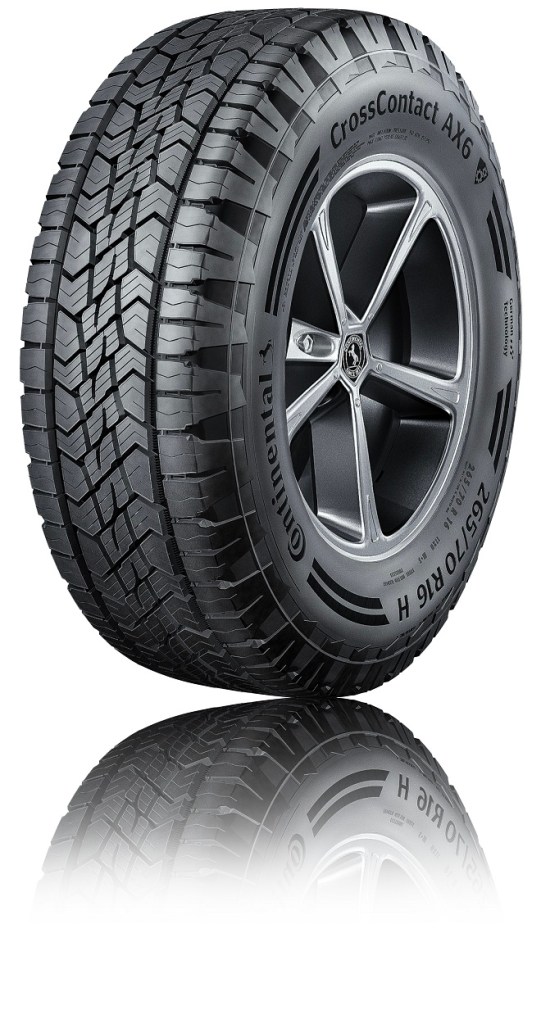
Continental Tires has introduced its new range of CrossContact AX6 SUV tyres in India. The new all-terrain Generation 6 CrossContact AX6 tyres provide excellent durability, low noise, and tread design engineered for a blend of control and performance on all terrain and wet road conditions.
The SUV sales in the country have been significantly growing in the past few years. As per reports, the share of SUV and crossover sales in total passenger vehicle sales across India was approximately 38 percent in 2021 compared to a mere eight percent in 2001. The shift in consumer preferences has created a demand for high-performance tyres for SUVs in India.
The CrossContact AX6 tyres are designed for performance and are perfect for ever-changing road conditions across the country and enable a smooth, quiet and comfortable ride. The tyres ensure grip on loose surfaces like gravel and provide additional traction on off-road surfaces. Further, they offer short braking distances in wet road conditions.
According to Samir Gupta, MD Continental India, “The CrossContact AX6 tyres are designed specifically keeping in mind the various conditions found both on-road and off-road. The tyres are highly suitable for markets like India, which feature various geographies, road conditions, and growing SUV demand. They are a perfect fit for any driver who spends most of their time on the road but requires more traction when heading off the beaten track.”
He further added, “Markets across the globe have widely appreciated the CrossContact AX6 tyres, and we hope to see similar results in India.”
One of the essential factors while off-roading is the traction and grip provided by the tyres. The open tread pattern of the CrossContact AX6 tyres provides maximized edges and contact area, helping in additional off-road traction. The tyres also include traction grooves with gripping teeth that prevent the loose surface sliding through the tread grooves. In addition, thanks to the Silica Tread Compound, the polymer structure that grips on the road give excellent traction and braking on wet and slippery roads. The sipped pattern on the tyres further aid the grip of the tyres.
On the other hand, the large tread blocks, and tough tread compound, aid in minimizing the stone retention and resisting cutting and chipping of tyres, which leads to excellent durability and robustness. The innovative design features the noise blockers in the shoulder of the tyre to block sound waves and unnecessary noise generated by the tyres and provide a smooth and quieter ride.
The CrossContact AX6 tyres are available for the latest range of SUVs in India.
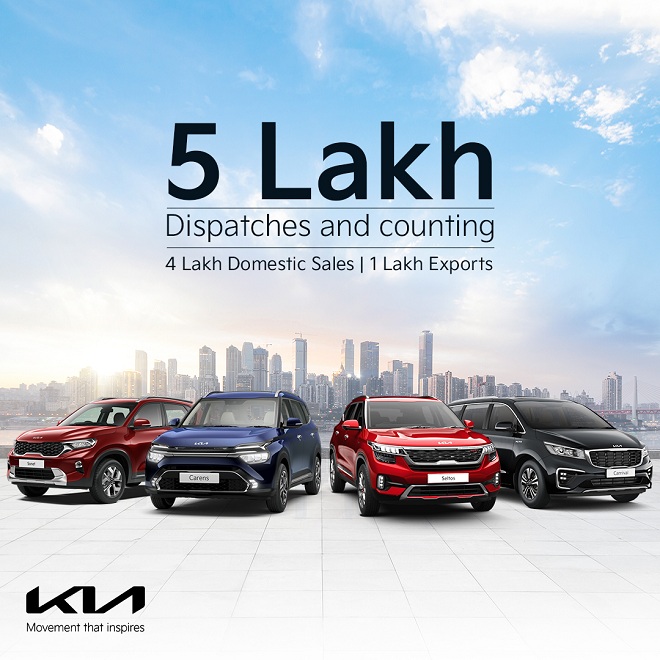
Kia India today announced completion of 5 lakh dispatches from its Anantapur plant, including both domestic and export market. With this, the company has also surpassed the 4 lakh sales milestone in the country and has already exported over 1 lakh cars to more than 91 countries, since it started shipping Seltos in September 2019. Kia India also became the number one utility vehicle exporter in the country, with a market share of over 25 percent in 2021.
Tae-Jin Park, Managing Director and CEO, Kia India, said, ”Half-a-million is a big number and we are proud to have attained this milestone in less than 2.5 years. Ever since our inception in India, we have focused on providing great value to our customers through our ground-breaking products and services. Today, Kia is a part of 4 lakh Indian families and we are extremely grateful for the affection bestowed upon us by our esteemed customers. Now, with the Carens already launched, we are confident of achieving our next milestones at a much faster pace, creating new benchmarks that will chart the course of our growth journey in the country.”
The London Concours, presented by Montres Breguet, has revealed that its 2022 edition will celebrate arguably one of the greatest marque of all time: Mercedes-Benz. Running from the 28th to 30th of June at the Honourable Artillery Company in the heart of the City of London, the show will feature iconic examples from the company that invented the motorcar; a consistent flagbearer for innovation, luxury and engineering excellence from its inception to the present day.
The London Concours will assemble exquisite models from this hallowed manufacturer, whose history can be traced back to the first internal combustion car, on the HAC’s immaculately manicured lawns. The line-up will span the decades, assembling the brand’s landmark cars, all high points for both luxury and performance.
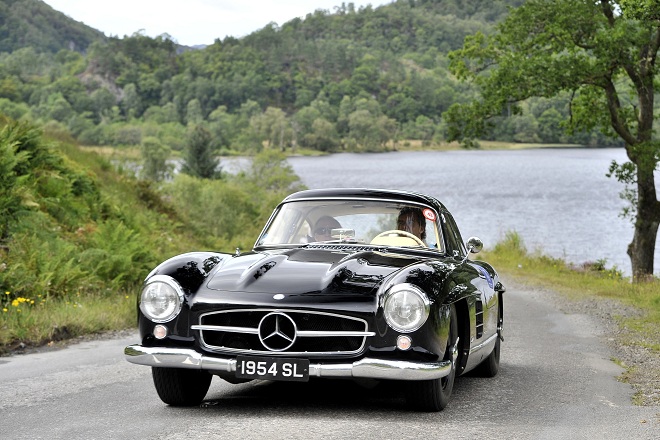
The array of stunning motorcars will include genuine automotive icons such as the 300 SL ‘Gullwing’, to many the most beautiful car ever produced. The 300 SL, codenamed ‘W 198’, made its debut in February 1954 at the International Motor Sports Show in New York; the crowds had never seen a road car like it. With a streamlined body, cloaking an innovative lightweight spaceframe, and 215 bhp straight-six engine – the first to feature direct fuel injection – the Gullwing was capable of 155mph, remarkable in the mid-1950s. A similarly stunning roadster version followed in 1957 and in all 3,258 cars were built by the time production ceased.
The Honourable Artillery Company will also welcome the roadster tasked with succeeding the 300SL: the SL ‘Pagoda’. Launched in 1963, Mercedes-Benz’s drop top of the 60s and early 70s has also gone down in history as one of the most revered automotive shapes of all; simple, elegant and of the highest quality. The SL was offered with a series of inline-six-cylinder engines, ranging in size from 2.3 to 2.8-litres, giving sprightly performance. Often specified with both a soft top and removeable hard-top, the ‘W113’ was a favourite of the great and good; owners in period included Juan Manuel Fangio, John Lennon and Sophia Loren.
June’s event will also play host to a modern Mercedes-Benz created in the 300SL’s image: the SLS Coupe – a modern interpretation of the ‘Gullwing’. Launched to the world in 2009, the high-performance SLS echoed its antecedent’s design, a strict two-seater with a long bonnet and of course, those dramatic doors. The SLS also acted as a direct successor to the SLR McLaren, and featured a snarling, naturally aspirated, 563 bhp 6.2-litre V8 which propelled it to a top speed of 196 mph. The SLS evolved over its production run, culminating in the savage, bewinged ‘Black Series’ cars. All variants of this stunning GT car are now sought-after modern classics.
Guests will also be able to revel in the details of one of the rarest modern Mercedes-Benz: the CLK DTM Coupe. Launched in 2004 to celebrate the marque’s victory in the 2003 German Touring Car championship with Bernd Schneider at the wheel, the DTM looked outlandish, with its vented body work and dramatically flared arches. Performance lived up to the wild looks, with a 582 bhp 5.4-litre supercharged V8, propelling it from 0-60 mph in 3.9 seconds and on to a (limited) top speed of 199 mph. With only 100 examples produced, the CLK DTM remains one of Mercedes-Benz’s rarest and most sought-after performance models.
This June there will also be a chance to savour one of the most luxurious limousines ever created: the stately Mercedes-Benz 600 LWB ‘Pullman’. A technological tour de force, this limo set new standards for both performance and opulence when it was launched to the world in 1963. The ‘Grosser’ featured a silken 6.3-litre V8, affording it suitably imperious performance. The 600 LWB was a favourite of heads of state and celebrities alike, with a diverse list of owners ranging from Saddam Hussein to David Bowie. With only 428 LWB examples built, this summer’s event will present a rare opportunity to pore over the details of this titanic automotive icon.
These sensational Mercedes-Benz, and many more, will be exhibited at the event in June, the ultimate automotive extravaganza, in the heart of the City of London. Further announcements will be made about the exiting further classes in the coming weeks and months, as we build up to the 6th edition of the show, set to be another occasion of complete automotive indulgence.
Andrew Evans, London Concours Director, said: “We are extremely excited to reveal that this summer’s ever popular ‘Great Marques’ class will celebrate the seminal automotive brand – Mercedes-Benz. Long associated with style and luxury, qualities central to our event, we will assemble the rarest and most alluring examples from this wonderful, storied manufacturer – all in an immaculate setting in the heart of the City of London. Guests to the Honourable Artillery Company will be treated to an astonishing array of cars, as well as delectable food and drink options, and a carefully curated line-up of designer brands and boutiques, at the summer’s ultimate automotive garden party.”
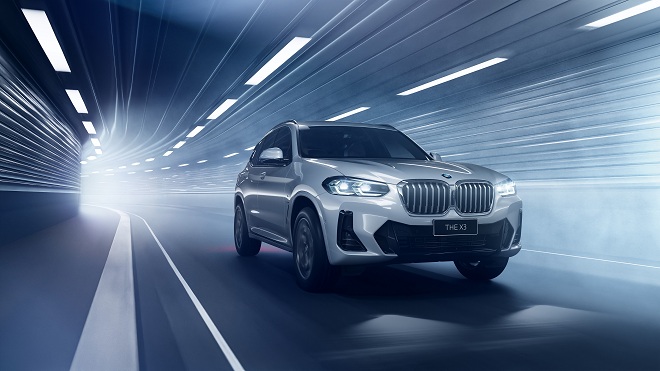
The new BMW X3 has been launched in a diesel variant in India today. Introduced as Luxury Edition, the new BMW X3 xDrive20d is locally produced at BMW Group Plant Chennai. It is available at dealership from today onwards in addition to the two existing petrol variants.
Refreshed design and driving performance make BMW X3 a luxurious and practical car that is agile on and off-road. Thanks to the BMW TwinPower Turbo technology, the diesel engines meld power with efficiency and offer spontaneous responsiveness even at low engine speeds. The two-litre four-cylinder diesel engine of the BMW X3 xDrive20d produces an output of 140 kw/ 190 hp and maximum torque of 400 Nm at 1,750 – 2,500 rpm. The car accelerates from 0 -100 kmph in just 7.9 seconds with top speed of 213 kmph.
The car is available at an attractive introductory price (ex-showroom) as follows –
BMW X3 xDrive20d Luxury Edition : INR 65,50,000
The new BMW X3 is available in the following metallic paintworks: Mineral White, Phytonic Blue, Brooklyn Grey, Sophisto Grey, Black Sapphire and Carbon Black. The new BMW X3 features Sensatec Perforated Upholstery as standard with the following combinations – Canberra Beige and Cognac.
Jeep India has announced the name of their most anticipated offering for the Indian market, a 7-seater SUV – the Jeep Meridian. The name has been carefully chosen for the customer’s sensibilities, keeping in mind the relevance and importance of this model for the Indian market. The Jeep Meridian encapsulates the core DNA of the Jeep brand, an innate need to travel and make new adventures possible.
For Jeep, the name of the vehicle was the first step. A list of 70 different names were studied including a few global Jeep names. However, for an SUV that is completely ‘Made in India’ – a name with strong relevance and resonance to the market was required. The name is inspired by the line which passes through the length of India connecting some of the most beautiful states and cultures.
The ‘Made in India’ Jeep Meridian will be the first 7-seater SUV for Indian customers and fulfils an important commitment to the Indian market. The Jeep Meridian will be a combination of refinement, sophistication, class-leading performance, and unmatched capability.
Roland Bouchara, CEO & Managing Director, Stellantis India, said on the occasion, “Jeep is an iconic brand, globally recognized for its capable SUVs. The Jeep brand’s journey in India has been legendary and we hope to build on this, with another equally legendary SUV – the Jeep Meridian. Developed specifically for the Indian customer, we have delivered a sophisticated and capable SUV ready to harness a unique segment opportunity.
Our product offensive for 2022 and beyond will continue to illustrate our commitment to India as we work towards strengthening our market presence. The Jeep Meridian will further push the brand’s attractiveness and transform the product portfolio for the Indian market.”
Sharing his excitement on the announcement, Mr. Nipun J Mahajan, Head of Jeep India said, “The Jeep Meridian is our latest offering for the Indian market as part of our 2022 product strategy. We wanted to announce the name with an innovative activation and the K2K drive through the length of India is in line with the name of our new model. We tested the SUV on every kind of terrain India has to offer – by taking it on a challenging journey from Kashmir to Kanyakumari.”
“We are proud to say, the Jeep Meridian performed flawlessly. We are delighted to deliver today, a car that is both Made-in-India and Made-for-India for our customers anticipating the Meridian. From performance to looks and comfort to off-roading prowess, the Jeep Meridian is truly unmatched in its category” he added.
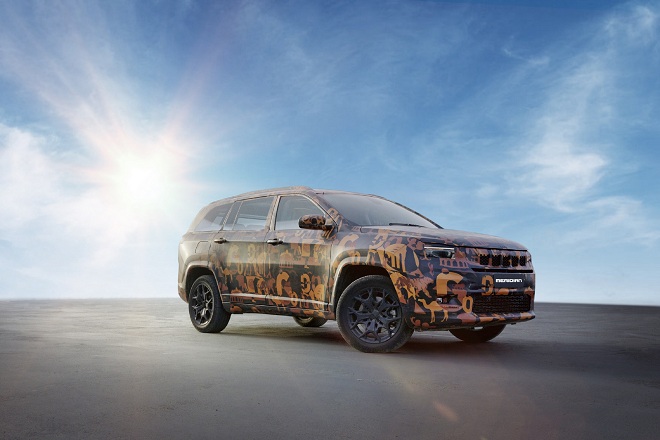
Staying true to its name, the Jeep Meridian was camouflaged in a unique and innovative design, capturing some of the most recognizable icons and cultures of the states which lie on the Meridian-77 passing through the length of India. These include the famous India Gate from Delhi, the camel of Rajasthan, the tiger of Madhya Pradesh, the flag of Maharashtra, the elephant of Karnataka, the coconut tree of Kerala, among others.
The camouflaged Jeep Meridian traversed across Ladakh, Kashmir, Himachal Pradesh, Rajasthan, New Delhi, Haryana, Madhya Pradesh, Maharashtra, Kerala, and Tamil Nadu, elegantly navigating the most arduous topographical challenges. The Jeep Meridian covered a distance of more than 5,000 kms through India testing its performance on various parameters of build quality, engineering, and capability.
The Jeep Meridian will deliver on everything that is truly Jeep, emblematic of its DNA and a product delivering sophistication with the heart of an adventure-seeking persona. Jeep Meridian launches in India mid-2022, with local specifications and pricing being announced closer to launch.
Kia India has announced the launch of its fourth and latest ‘Made-for-India’ offering, the three-row recreational vehicle, Carens. The Kia Carens is aggressively priced with the Premium Smartstream 1.5 Petrol 6MT variant bearing a price tag of INR 8.99 Lakhs (ex-showroom, pan-India). The Carens is offered in 19 variants with prices ranging from INR 8.99 to 16.99 lakhs. This highly anticipated model is available in five trims, three engine and three transmission options.
With a comprehensive list of features and a strong emphasis on safety, the Kia Carens is designed to be one of the safest cars in the country and the most compelling value proposition for modern Indian families, packing the sophistication of a family mover and the sportiness of an SUV in one. So far, the company has received 19,089 bookings for the car in just over one month since the bookings opened on January 14.
The Kia Carens is available in five trim levels: Premium, Prestige, Prestige Plus, Luxury, and Luxury Plus. The vehicle comes in seven-seater configurations from Premium to Luxury trims, with the Luxury Plus trim offering both 6- and 7-seater configurations. The Robust 10 Hi-safety package, which includes 6 airbags, DBC, VSM, HAC, ESC and All-Wheel Disc Brakes, to name a few, comes standard on all five trim levels, making the Kia Carensone of the safestfamily movers. The Kia Carens is offered with three engine options: Smartstream 1.5 Petrol, Smartstream 1.4 T-GDi Petrol, and 1.5 CRDi VGT Diesel, mated with three transmissions – 6MT, 7DCT, or 6AT.
In addition to the exciting pricing, the Carens also offers maintenance cost as low as 37 paisa per kilometre. The company continues to personalise the vehicle servicing process for its customers and offer a competitive maintenance cost for all its models in the country.
Commenting on the occasion, Tae-Jin Park, Managing Director and CEO, Kia India, said, “Since inception, we have remained focused on adding value to Indian customers’ driving experiences through our ground-breaking vehicles and services. The Carens is a true Kia, offering Best in Class features, immaculate design and practicality, a wide range of variant choices at a compelling price point. The pricing offers us an opportunity to cater to an even more diverse set of our customer. We will enhance our production to meet this increased demand.”
He further added: “We are confident also that our customers will have a wonderful ownership experience of the Carens, which incursmaintenance cost starting from as low as 37 paisa per kilometre. The value proposition offered would make this a vehicle of choice for modern Indian families.”
Exterior
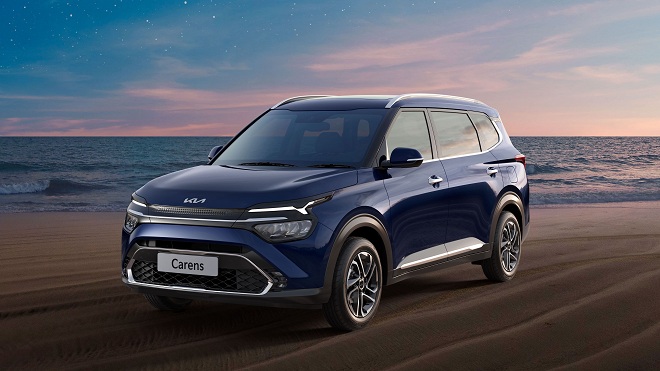
For the first time, the Carens’ styling introduces the “Opposites United” design language to India. The two main pillars on which Carens’ exterior development was based were futuristic and bold design. It is the result of a collaboration between the Kia Design Centre in Namyang, South Korea, and the Indian design team.
Key highlights of the exterior features Kia signature tiger face with digital front grille, star map LED DRLSs with crown jewel LED headlamps, star map LED tail lamps, sky light sunroof, R16 – 40.62 cm (16-inch) dual tone crystal cut alloy wheels and chrome rear bumper garnish with diamond knurling pattern.
Kia Carens is available in eight colour options with three all-new colours – Imperial Blue (New Colour), Moss Brown (New Colour), Sparkling Silver (New Colour), Intense Red, Aurora Black Pearl, Gravity Grey, Glacier White Pearl and Clear White.
Interior and Comfort
The Carens interior is sophisticated and plush, wrapped around a high-tech dashboard to appeal to the always-connected consumer. The car’s interior has many storage spaces throughout the cabin, and the first-row seats are ventilated, adding to the car’s convenience factor. The Carens packaging is one of the most important factors to consider and offers plenty of room for adults in the third row, thanks to the longest wheelbase in its class.
Key highlights of interior are 2nd row one-touch easy electric tumble seat, Bose premium sound system with eight speakers, smart pure air purifier with virus and bacteria protection, Kia Connect next gen connected car technology, ventilated front seats, 31.7 cm (12.5-inch) full segment LCD cluster with advanced 10.6 cm (4.2-inch) colour TFT multi-information display, cabin surround 64 colour ambient mood lighting and smartphone wireless charger with cooling function.
Powertrain and Transmission
Carens offers a surprisingly wide range of powertrain choices in its class with three engine options – Smartstream 1.5 Petrol, Smartstream 1.4 T-GDi Petrol and 1.5 CRDi VGT Diesel. These are mated to three transmission options – 6-speed manual, an intuitive 7-speed DCT and 6-speed automatic. Additionally, automatic variants of the Carens offer multi-drive modes for added convenience and driver-confidence.
Ride and Handling
The Carens is supported at the front by McPherson struts and the rear by a coupled torsion beam axle setup. With disc brakes all around and across the board, the ride quality has been tuned to absorb everything in its path, providing a comfortable driving experience for all. Carens prototypes have been driven and tested for over 1,00,000 kilometres on Indian roads, and across a variety of conditions, resulting in a driving character that offers a compliant ride quality and high comfort.
Safety
The Kia Carens is a true family car, offering several active safety features. The model comes with Robust 10 Hi-Secure Safety Standard Package, a first in India. Included as standard across all trims of the Carens are 6 airbags, Electronic Stability Control (ESC), Vehicle Stability Management (VSM), Hill-Assist Control (HAC), Downhill Brake Control (DBC), Brake Assist System (BAS), Anti-Lock Braking System (ABS), Rear Parking Sensors, Highline TPMS and All-Wheel Disc Brakes. While the ESC protects the car from the loss of traction, HAC and DBC let drivers confidently drive on uphill and downhill roads. Additionally, the VSM ensures occupant safety by offering stability to the car when the driver must perform sudden braking and turns. Continuing this focus on safety, the company has also offered Front-Parking Sensors, Highline TPMS, and Rain-Sensing Wipers with the car, giving utmost confidence to the driver at all times and allowing them to fully focus on road conditions ahead.
Kia Connect
With Carens, the connected car platform gets a complete revamp with the next-generation Kia Connect app, which replaces the previous UVO system. Kia Connect now hosts updated and exciting features with added safety and convenience. One of the major updates with Kia Connect is the enhancement of OTA (Over the Air) Map and System Updates, which is now capable of updating software without visiting the Kia workshop. The Carens will come equipped with 66 connected car features and what is more exciting is that the AVNT of the vehicle now supports ten native languages.
My Convenience Plus
Along with the launch of the Carens, Kia India also announced the launch of the Carens ownership differentiator: ‘My Convenience Plus’. The initiative offers comprehensive coverage for new Carens buyers that provide them complete peace of mind.
‘My Convenience Plus’ is a Carens-exclusive aftersales initiative that can be purchased alongside the vehicle and includes PPM (Pre-Paid Maintenance), EW (Extended Warranty), and optional RSA (Road Side Assistance). It is available with pan India coverage and uniform pricing across the country. The customers can choose from Premium and Luxury package, which covers the car for 4 and 5 years respectively. The initiative also offers an attractive package on car care services, if availed during the program tenure, and protects the customers from inflation in service cost.
My Kia
With the vision to offer convenience to its customers, the company also launched the ‘My Kia’ mobile app – a one-stop solution for existing and prospective customers for all their needs related to Kia. ‘My Kia’ app is available on iOS and Android platforms wherein prospective customers can request test-drive, video consultation and can even book their preferred Kia car. The existing customers of Kia can use this app for service appointment and reminder, request pick and drop and track service progress, etc. Customer can also get real-time notifications, tips and FAQs for direct assistance from Kia through a unique customer dashboard. The app also offers a unique and exclusive reward program for existing customers, offering exclusive discounts on various consumer brands across different categories like Fashion, Travel, F&B, Electronics, and Lifestyle etc.
Kia Carens Pan India Ex-Showroom Prices in INR:
Trim
Engine
Transmission
Pan India (Ex-Showroom Prices in Lakhs)
Premium
Smartstream1.5 Petrol
6 MT
8.99
Smartstream1.4 T-GDi Petrol
6 MT
10.99
1.5L CRDi VGT Diesel
6 MT
10.99
Prestige
Smartstream1.5 Petrol
6 MT
9.99
Smartstream1.4 T-GDi Petrol
6 MT
11.99
1.5L CRDi VGT Diesel
6 MT
11.99
Prestige Plus
Smartstream1.4 T-GDi Petrol
6 MT
13.49
7 DCT
14.59
1.5L CRDi VGT Diesel
6 MT
13.49
Luxury
Smartstream1.4 T-GDi Petrol
6 MT
14.99
1.5L CRDi VGT Diesel
6 MT
14.99
Luxury Plus (6 Seater)
Smartstream1.4 T-GDi Petrol
6 MT
16.19
7 DCT
16.99
1.5L CRDi VGT Diesel
6 MT
16.19
6 AT
16.99
Luxury Plus (7 Seater)
Smartstream1.4 T-GDi Petrol
6 MT
16.19
7 DCT
16.99
1.5L CRDi VGT Diesel
6 MT
16.19
6 AT
16.99
Fuel Efficiency:
G1.5 with 6MT: 15.7 kmpl
G1.4T with 6MT: 16.2 kmpl
G1.4T with 7DCT: 16.5 kmpl
D1.5 with 6MT: 21.3 kmpl
D1.5 with 6AT: 18.4 kmpl
*The above are ARAI-ratified figures. Real world figures are expected to be lower.
BMW Group India has launched the new BMW M4 Competition Coupé at an ex-showroom price of INR 1,43,90,000. The pace-setting high-performance sports car is available from today onwards as a completely built-up unit (CBU).
Mr. Vikram Pawah, President, BMW Group India said, “For the last 50 years, BMW M has stood for those who enjoy high performance and supremacy of excellence. The all-new BMW M4 Competition Coupe delivers an uncompromised track and street experience at a whole new level with distinctive combinations. Superior engineering promises unparalleled driving dynamics, adrenaline-fueled body styling, head-turning road presence, while still holding the famous legacy of its motorsport lineage.”
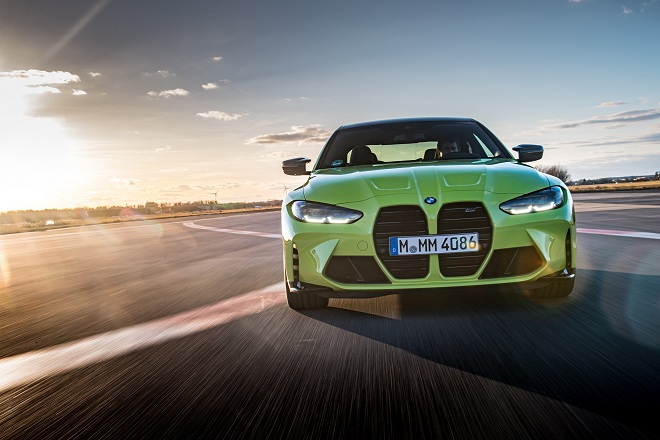
The distinctive body design of the all-new BMW M4 Competition Coupé sends out a bolder statement than ever of its performance supremacy and emotionally engaging driving experience at hand. Visually striking exterior includes the M-specific version of the large, vertical BMW kidney grille with hallmark double bars in a horizontal design, the powerfully sculpted wheel arches with eye-catching M gills, and the prominently extended side sills with attachment parts for the front and rear aprons. Adaptive LED Headlights with BMW Laserlight are specified as standard. The M-specific exterior mirrors have aerodynamically optimized contouring and are painted in High-gloss Black as standard. The car also sports aerodynamically optimized fins, a rear spoiler and two pairs of exhaust tailpipes finished in Black Chrome.
The interior has clearly structured surfaces and an ergonomically impeccable cockpit design that ensures the driver’s focus remains one hundred per cent on the intense driving experience. The electrically adjustable M sport seats and M Leather ‘Merino’ with extended contents upholstery with Carbon fiber trim come as standard. Exclusive functions such as M Seat belts, , Multifunction for steering wheel, seat heating with lumbar support (driver and front passenger), electrical seat adjustment with memory function, and automatic anti-dazzle function in all mirrors add a further sporty touch to the interior. Extremely lightweight high-tech Carbon Fibre Reinforced Polymer (CFRP) sunroof lowers the centre of gravity and enhances its agility. Ambient Lighting creates an atmosphere for every mood while Automatic 3 zone A/C further enhances the in-cabin experience. The car is equipped with Adaptive M-Specific Suspension, M Sport Differential, M high performance compound brakes and 19″/20″ M forged wheels Double-spoke style 826 M Bicolour Black in the standard profile. Customers can add more equipment to enhance the overall experience through optional offerings such as Active seat ventilation, M Racetrack package, M Carbon Exterior package, M Drive professional, M Compound Break red high gloss and 19”/20” 825 M double-spoke wheels in polished Orbit Grey and Bicolor black.
The new 3.0-litre straight-six unit combines the hallmark high-revving character of BMW M GmbH engines with the latest version of M TwinPower Turbo technology. The petrol engine of the BMW M4 produces an output of 510 hp and a maximum torque of 650 Nm at 2,750-5,500 rpm. The car accelerates from 0 -100 kmph in just 3.5 seconds.
The eight speed M Steptronic transmission enables extraordinary short shift times and fast, precise responses to every nudge of the accelerator. The driver can access three clearly distinct setups in both automatic and manual mode – comfort oriented, sports focused, or track optimized. The Setup button on the centre console provides direct access to the settings options for the engine, chassis, steering and braking system, plus traction control. EFFICIENT, SPORT and SPORT PLUS settings can be engaged to modify the engine’s characteristics, while selecting the COMFORT, SPORT or SPORT PLUS chassis mode provides access to the three settings for the electronically controlled dampers.
A host of BMW ConnectedDrive technologies continue to break the innovation barrier in automotive industry – Telephony with wireless charging, Head Up Display, Smartphone Integration, Active Protection including attentiveness assistant with Park Distance Control with sensors at the front and rear and Parking Assistant. Options include the Driving Assistant, Parking Assistant Plus, Comfort Access System, Gesture control, Steering and Lane Control Assistant, as well as the BMW Drive Recorder. The modern cockpit concept BMW Live Cockpit Professional running on latest BMW Operating System 7.0 includes 3D Navigation, a 12.3-inch digital instrument display behind the steering wheel and a 10.25-inch Control Display. Harman Kardon surround sound system with 16 speakers provides an intense musical feast for the ears.
For utmost safety, the all-new BMW M4 Competition comes with head and side airbags for driver and front passenger as well as head airbags for rear seats as standard. Additional standard equipment includes Dynamic Stability Control (DSC) including Anti-lock Braking System (ABS), Automatic Stability Control (ASC), M Dynamic Mode (MDM), Cornering Brake Control (CBC), Dynamic Brake Control (DBC), Dry Braking function and Active M Differential. DSC with M xDrive further enhances the safety aspect.
The all-new BMW M4 Competition delivers maximum driving pleasure coupled with an outstanding performance and fuel consumption ratio thanks to BMW EfficientDynamics measures such as intelligent lightweight design, Brake Energy Regeneration, Auto Start-Stop function, electric power steering, differential and transfer case with optimised warm-up behaviour and aerodynamics.
The all-new BMW M4 Competition is available in metallic paintworks – Skyscraper grey, Portimao Blue, Black Sapphire, Sao Paulo Yellow, Toronto Red and Alpine White in non-metallic. Optional BMW Individual metallic paint finishes available are – Tanzanite Blue, Dravitgrey, Aventurine Red, Frozen Brilliant White, Frozen Portimao Blue. Other optional BMW Individual Special Paintworks available are Frozen Orange, Frozen Black, Frozen Deep Grey. The new M4 is available in a range of fine upholstery combinations – M Leather ‘Merino’ with extended contents in the following combination – Yas Marina Blue, Kyatami Orange, Silverstone | Black, Black | Black.
The Concours of Elegance – famed for gathering together the rarest cars ever created – will showcase seven of the world’s finest Packard Twelves at Hampton Court Palace this year. Taking place from 2-4 September, the event is renowned as one of the top three concours d’elegance events in the world for the quality of cars it attracts; nowhere else in the UK can the public see such a high standard of rare historic vehicles.
Packard was an American luxury automobile maker famed for its opulence, mechanical quality, refinement and reliability. The company was active from the production of the first Packard automobiles in 1899, to the last Detroit-built Packard model in 1956. It was one of the finest luxury car makers before World War II, and was a firm favourite among European Royalty, celebrities and Corporate America.
Belonging to a prominent American collection, The JBS Collection, the selection of Packards – the ‘Magnificent Seven’ – have been subject to an exacting 100-point concours restoration by American specialists LaVine Restorations, and have never been displayed outside the US before. The Concours of Elegance will offer a once in a lifetime opportunity to pore over these spectacular motor cars on UK soil.
The first model on display is a Gun Metal Gray 1933 Packard Twelve Coupe Roadster – of which only five were ever manufactured – and just two remain. This model and year was the first run of the Packard Twelve, which succeeded the earlier Packard Twin Six. The car features a 7.3-litre 160bhp V12 engine and was the only year which featured a unique foldout window design. This particular Packard commands a sizeable trophy cabinet, having won three recent awards, at Pebble Beach Concours d’Elegance, Amelia Island Concours d’Elegance and Concours d’Elegance of America at St. John’s.
Alongside it is a stunning Packard Blue 1934 Packard Twelve Coupe Roadster. As a 12-cylinder Eleventh Series, this is one of the most sought-after of all the Packard Coupe Roadsters. 1934 was the first year of the Eleventh Series cars, and is widely considered to be the most prestigious year for the Packards’ iconic design. This car features a 160bhp, 7.3-litre V12 Engine with a Three-Speed Selective Synchromesh Manual Transmission.
The third Packard Twelve on display is a 1934 Packard Twelve Formal Sedan. This particular example is also an Eleventh Series car, in brown. The Sedan features beautifully elegant ‘suicide’ doors, and the same smooth V12 engine, and running gear as the Coupe cars, but with seating for more passengers.
The 1934 Packard Twelve Victoria is the next Packard on display. This car features a LeBaron body and is the only car ever known which features a Dietrich custom interior in a Victoria. It was also the first Packard model that offered a radio option, which this Victoria has installed. This model was only offered for three years of production, and the 1934 model was the most sought after. There are now fewer than ten Packard 1107 Convertible Victorias still in existence.
Visitors to Hampton Court Palace will also have the chance to pore over a particularly special 1934 Packard Twelve Convertible Sedan, originally commissioned by an adventuring American heiress, Louise Arner Boyd. The Dietrich individual custom car subsequently accompanied Ms Boyd around the world, including on a famous – naturally chauffeur driven – exploratory tour around rural Poland in the mid-1930s. More recently, this well-known example has won awards at The Pebble Beach Concours d’Elegance and Concours d’Elegance of America at St. John’s.
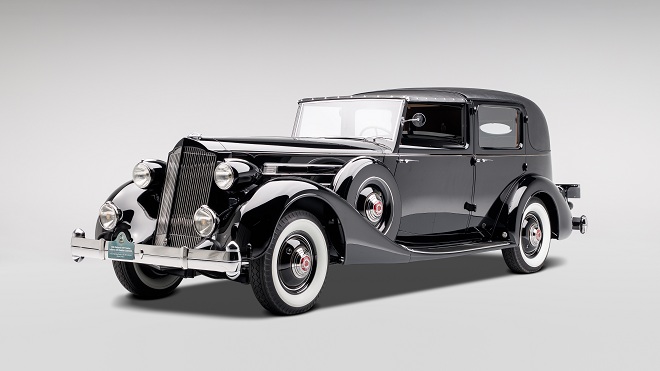
The next Twelve is something quite special, a black 1936 Packard Twelve All Weather Cabriolet, which spent time as a Hollywood car. The car was once owned by Charlie Chaplin via Charlie Chaplin Studios. Not only that, the car also featured in ‘The Godfather’, and ‘The Betsy’, as well as appearing in ‘Remington Steele’ with Pierce Brosnan. There are only two of this particular version known in the world. This particular All Weather Cabriolet is also a LeBaron car. It was a 1407, which was also a limited, special-order model. The 1407 featured an upgraded 7.8-litre 175hp engine.
The final variant on display is one of the last Twelves ever made, a Convertible Coupe model. In 1938 Packard started an overall new design featuring a more upright radiator, higher front fenders that wrapped around the side-mounted spare wheels, and a Dietrich inspired V-shaped windshield. This is the 24th of 32 1607 Twelve Convertible Coupes that Packard made in 1938, and is believed to be one of only eight of this make and model still in existence. This particular car is a finished in a subtle Columbian Beige.
Outside of the main display of vehicles, the Concours of Elegance will gather a total of around 1,000 cars in a number of special features and displays, including a collection of Ferrari Formula 1 cars to mark the 70th anniversary of the iconic marque’s first World Championship win, a display of unique or bespoke modern rarities in the Future Classics class, and a triumphant return of star cars from in the inaugural 2012 Concours of Elegance. 2022’s event will also feature a stunning array of royal cars from around the world that have passed into private ownership, and the 30UNDER30 Concours returns after it’s highly successful debut last year, once again aiming to inspire the next-generation of classic car enthusiasts.
Away from the automotive displays, Concours of Elegance remains an occasion of pure luxury, with champagne provided by Charles Heidsieck, picnics by Fortnum & Mason, live stage interviews with Chubb Insurance, and a collection of art, jewellery, and fashion displays. Presenting Partner A. Lange & Söhne will once again showcase some of its most intricate timepieces.
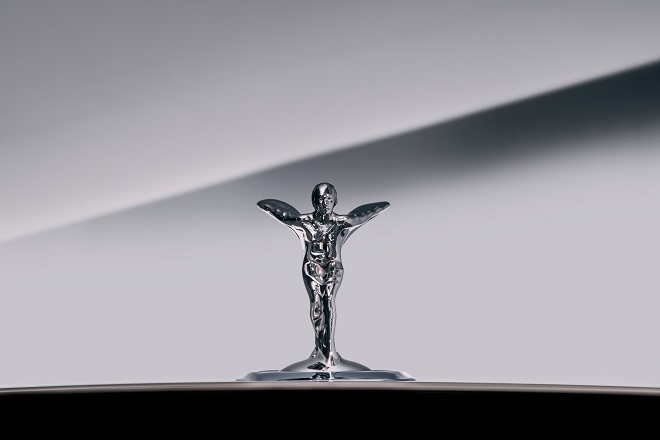
For more than a century, Rolls-Royce motor cars have been graced by the Spirit of Ecstasy mascot, one of the most recognisable emblems ever created. Yet, remarkably, given her immense fame and global reach, aspects of her story remain open to speculation, confusion and no little controversy.
As the marque embarks on a new era of electrification, we revisit the legend to separate established fact and documentary evidence from speculation and hearsay. It is a tale of four people from different backgrounds, whose individual personalities and intertwined, sometimes complex relationships were the genesis for the world’s most famous and desirable icon.
Torsten Müller-Ötvös, Chief Executive Officer, Rolls-Royce Motor Cars said, “Our Spirit of Ecstasy mascot is the most recognisable automotive emblem in the world. Like our company and our motor cars, she has changed constantly over time, yet remains true to her origins and inspiration. As we enter a new era with Spectre, we have taken the opportunity to revisit our treasured icon and her story, which remains endlessly fascinating, eye-opening and intriguing after more than 100 years. It is both a significant chapter in the brand’s memory, and a rich human drama that, though the product of a bygone age, still resonates with us and our clients today.”
The Spirit of Ecstasy story is a very human drama, in which fact and fiction often become blurred. What is undoubtedly true is that in 1902, freelance journalist and motoring enthusiast John Montagu – richly titled but perennially short of cash – set up Britain’s first motoring magazine, The Car Illustrated, and hired Charles Sykes as his chief illustrator. It is also certain that around the same time, Montagu’s friend, Claude Johnson, employed a young woman named Eleanor Thornton as his assistant at The Automobile Club, where he was General Secretary.
When Montagu met Eleanor, who was both highly intelligent and famed for her beauty, he was instantly smitten and offered her the job of Office Manager at his magazine. She accepted, and the aristocratic publisher and his new colleague – 14 years his junior and from humble origins in south London – soon embarked on a 13-year affair that was as passionate and sincere as it was inevitable and clandestine.
During 1903, Eleanor became pregnant. She and Montagu decided it would be best for the baby to be adopted at birth. For a few seconds, Eleanor held the infant Joan before handing her to Montagu, instructing him “never again to mention the name of the baby”. Eleanor never saw her again; but her father did. He arranged (and paid) for Joan to be initially brought up by an ex‑sergeant from his regiment and his wife, and latterly a doctor and his wife. Over the years that followed he visited his daughter, who knew him only as Uncle John, and did what he could to support her, within the bounds of propriety and secrecy.
It is here that the various strands of the story start to draw together. Sykes and Eleanor would, of course, have met through their work at The Car Illustrated; but intriguingly, they knew one another already. A few years earlier, Eleanor had taken rooms at The Pheasantry, an artists’ colony in the Kings Road, Chelsea. Here, she lived a secret double life: demure, respectable, professional assistant to Johnson at The Automobile Club by day; sensuous exotic dancer and life-model by night. One of the artists for whom she regularly posed was Charles Sykes.
Although Sykes was employed by Montagu as an illustrator, he was also a talented sculptor, having studied under the eminent Professor Edouard Lanteri at the Royal College of Art. In 1903, he sculpted a trophy, modelled on Eleanor, for Montagu to present at the Gordon Bennett race. Another of Sykes’ works, entitled Bacchante, was shown at the Royal Academy and the Paris Salon. Her face and figure are also strikingly similar to those of his long-time muse.
During this period (the precise date is unknown) Sykes produced a mascot for Montagu’s Rolls‑Royce Silver Ghost. Called ‘The Whisper’, it was a small aluminium statuette of a young woman in fluttering robes with a forefinger to her lips. It has been confirmed that Eleanor was the model: whether the mascot was a token of appreciation from Sykes to his friend and employer, or made at Eleanor’s instigation as a gift for her lover, remains a mystery. Whatever the truth, Montagu displayed it on every Rolls-Royce car he owned until his death in 1929; perhaps as a discreet acknowledgment of his love for Eleanor, which he kept secret for so long.
The conventional wisdom is that ‘The Whisper’ was the inspiration for the Spirit of Ecstasy; and that the mascot, therefore, is modelled on Eleanor Thornton. It is an appealing and logical notion, and there are enough similarities to support it. But once again, the story is not as clear-cut as it first appears.
In 1910, Eleanor’s erstwhile employer, Claude Johnson, re-enters the narrative. No longer at The Automobile Club, he was now Managing Director of Rolls-Royce, the company co-founded by his former business partner, The Hon Charles Stewart Rolls, and the brilliant engineer Henry Royce.
Royce was already becoming irritated by what he felt were tasteless mascots adorning radiator caps atop Rolls-Royce motor cars, including black cats, devils and a jovial policeman. Claude Johnson, however, spotted an opening, and argued that they should produce their own mascot that would enhance a Rolls-Royce rather than demean it. Eventually, Royce grudgingly agreed; and through his friend Montagu, Johnson commissioned Charles Sykes to create it.
Johnson already had a mental picture of the kind of adornment he wanted. On a trip to Paris, he had been impressed by the artistry of the Grecian marble statue of ‘Nike of Samothrace’, Goddess of Victory, sculpted in 190 BC and exhibited in the Palais du Louvre since 1883. Standing nine feet (2.75 m) tall, she is depicted as a winged deity descending from the heavens, draped in a flowing tunic and mantle. Sadly, the vicissitudes of time and fortune have deprived her of both arms and her head.
“I want something beautiful, like Nike,” Johnson said to Sykes. “Go and have a look at it.” Sykes did so, but quickly decided Nike was too martial and domineering to be a suitable Rolls-Royce mascot. Having often travelled in Montagu’s Silver Ghosts, he believed a more delicate, ethereal figure would better express the marque’s grace, silence and subtle power. Once again, his muse was almost certainly Eleanor Thornton.
But even here, doubt remains. While it seems highly probable that Eleanor was the model for the Spirit of Ecstasy’s overall form, the face could be that of another as it is an excellent likeness of a woman with whom Sykes had a close and adoring relationship – his mother, Hannah Robinson Sykes. Some have speculated that Sykes used his imagination to create a female physique that satisfied his artistic eye and vision of the ideal of womanhood.
Sykes’ new mascot was initially called ‘The Spirit of Speed’. The title that would make her immortal appears in a letter from Rolls-Royce to John Montagu. In it, the Company describes its search for a mascot that would convey “the spirit of the Rolls-Royce – namely, speed with silence, absence of vibration, the mysterious harnessing of great energy, a beautiful living organism of superb grace like a sailing yacht”.
The letter adds that when Sykes designed his “graceful little goddess”, he had in mind “the Spirit of Ecstasy, who has selected road travel as her supreme delight and alighted on the prow of a Rolls-Royce car to revel in the freshness of the air, and the musical sound of her fluttering draperies”.
Rolls-Royce registered the Spirit of Ecstasy as its intellectual property in 1911. However, it is noteworthy that she did not receive the unreserved blessing of either of its founders. Sir Henry Royce disliked mascots of any kind; and The Hon Charles Stewart Rolls never set eyes on her, since she was created after his death in a flying accident in June 1910. It is due almost entirely to the vision, acumen and sheer force of character of Claude Johnson that she exists.
His instincts were proved correct when, in 1920, Rolls-Royce entered the Spirit of Ecstasy in a competition in Paris to find the world’s best motor car mascot. She won, of course, and Sykes received a gold medal.
It is also not often appreciated that the Spirit of Ecstasy was an ‘Optional Extra’ right up until 1939. Perhaps reflecting Sir Henry’s undimmed antipathy, mascots graced only about 40% of the 20,000 or so cars delivered during this period, though many were later retrofitted.
The Spirit of Ecstasy has been a defining feature of the Rolls-Royce brand since 1911. But just as the marque and its motor cars have constantly evolved and changed with the times, so she herself has undergone her own periodic transformations.
In her original 1911 form, she was a statuesque 6 7/8 inches (~18cm) in her bare feet; by the 1960s, she had passed through eight iterations and stood a more petite 4 5/16 inches tall (~11cm). The distance from her nose to the tip of her outstretched robes had also shrunk proportionally, from five inches to three. There have also been subtle variations in her base shape, stance and precise inclination of her ‘wings’ over the decades.
More radically, clients buying models from 1934 until 1959 had the option of a kneeling figure, which some considered better suited to the coachwork designs of the period.
In the 1970s, some countries tried to ban the mascot on safety grounds. In Switzerland, for example, clients weren’t allowed to display her at all, and on receiving their cars found her languishing in the glove compartment. Rolls-Royce’s typically elegant and ingenious solution was to mount the mascot on a spring-loaded base, allowing her to sink into the radiator out of harm’s way at the merest touch. This retraction mechanism has evolved into a smooth, graceful movement known as ‘the rise’ and is a standard feature on every Rolls-Royce motor car hand-built at Goodwood.
One of the many remarkable aspects of the Spirit of Ecstasy’s story is that from 1911, every figurine was personally cast, inscribed and hand-finished by Charles Sykes himself. His daughter, Josephine, took over in 1928 and continued until manufacture was interrupted by the outbreak of war in 1939. Each Spirit of Ecstasy from this period is therefore minutely different from every other.
Today, they are made by specialists in Southampton, England, using a wax casting process combining methods and materials dating back over 5,000 years with 21st Century technology.
Each figurine is based on a three-dimensional computer-generated image, digitally mapped from the original Spirit of Ecstasy. Using this image, skilled craftspeople created a solid cast tool, made by hand using cutters measuring just 0.2mm in size to ensure even the finest details were precisely replicated. From this cast tool, they produced a highly accurate wax model of the figurine, which was then coated in ceramic. After this coating had dried, the wax was melted away, leaving a perfect mould from which the new cast would be taken.
Each figurine is made by filling the mould with molten stainless steel, at a temperature of 1600°C. Once the steel has cooled, the mould is opened to reveal the Spirit of Ecstasy in all her glory. The final transformation takes place in the Finishing Department, using a process called peening. The casting is blasted by millions of stainless-steel balls, just 17 thousandths of an inch (0.04mm) in diameter, which help to polish the surface without being abrasive. After machining, a final mirror polish and stringent quality assurance checks, the completed figurine takes her rightful place above the iconic Rolls-Royce grille.
In 2020, Rolls-Royce unveiled The Spirit of Ecstasy Expression. For this wholly new visual treatment, designers redrew her in a simplified, modern form to be used as a graphic symbol as part of the marque’s updated corporate identity. The computer-generated, online-friendly illustration translates the figurine’s curves into a ribbon of parallel lines that undulates and changes according to its setting. It is designed to evoke movement; a silky, fluid form that appears to drape and flow over physical and digital surfaces.
Today, Rolls-Royce Motor Cars announced that the Spirit of Ecstasy would take a new form for her adornment on Spectre, the marque’s first electric motor car. She is more streamlined and graceful than ever before – the perfect emblem for the most aerodynamic Rolls-Royce ever created, and for gracing the prow of our bold electric future.
The earliest Spectre prototypes have a drag coefficient (cd) of just 0.26, making it the most aerodynamic Rolls-Royce ever created. The figure is expected to improve during the product’s exhaustive testing protocols undertaken in 2022.
On 30 December 1915, Montagu and Eleanor Thornton were enjoying lunch in the first-class saloon of the P&O passenger ship SS Persia. They were sailing through the Mediterranean en route to India, where Montagu had been made Chief of Mechanical Transport for the British army. Eleanor was to disembark at Port Said and return to England for the duration.
The ship was struck by a torpedo and sank in less than five minutes. Eleanor Thornton, together with hundreds of other passengers, was never seen again.
Montagu, however, was lucky. After 38 hours adrift in a lifeboat, suffering with a broken shoulder and a damaged lung, he and a handful of other survivors were picked up by a passing liner. While recovering in Malta as a guest of the Governor, he enjoyed the bittersweet pleasure of reading his own obituaries in the London newspapers.
Montagu never got over the loss of Eleanor, which of course he could never mention publicly. But for the rest of his life, she was with him in spirit wherever he travelled in his Rolls-Royce motor car.
Bosch has always focused on technologies for a mobility experience that is economical and sustainable, safe and secure, convenient and exciting in the future. This will be accomplished via new platforms to meet changing requirements of legislations and user experience. Bosch is taking further strategic steps towards a leading position in the software-dominated future of mobility by combining its‘ automotive know-how, wide-ranging electronics and software expertise. In mobility hardware and software development, BGSW is the largest R&D centre outside Germany with 20,000+ engineers.
Bosch is the market leader in the powertrain business. They have a technology neutral approach with regards to powertrain, be it gasoline, diesel or electrification. Considering the ever-changing needs of mobility Bosch provides more than one powertrain technology to make mobility more sustainable.
Bosch is the global leader in electric powertrain solutions. The company estimates that by 2030, every third new vehicle in India will be an EV. At the same time, dependent on use case / customer strategy, the Internal Combustion Engine (ICE) could also be electrified with mild and strong hybrids. The ICE remains an important part of the powertrain mix especially in commercial vehicles and off highway segments.
Bosch supports govt. vision to reduce road accidents by over 50 percent by 2025. Bosch’s expertise in assisted and automated mobility ranges across passenger and commercial vehicle driver assistance with India-specific object identification technology, motorcycle safety and rider assistance, and braking and occupant safety (4W and 2W). Bosch India has invested INR 380 crores over the last 10 years and an additional INR 238 crores is planned over the next 5 years in safety domain.
As an AIoT company, Bosch India is leveraging AI, IoT, automation, and digitalization to develop smart, secure, efficient, and sustainable smart products of the future. Sales of connected power tools, household appliances, and heating systems alone have grown by 50 percent within one year – from four million units in 2020 to more than six million in 2021 globally. With the Bosch Center for Artificial Intelligence (BCAI), the company has established a strong unit in the field of AI that has already contributed some 300 million euros to result.
Bosch will continue to invest heavily in India to expand its portfolio close to 7 percent of total net sales. Backed by the biggest R&D team outside Germany – Bosch’s Beyond Mobility business works to the highest international standards of manufacturing, product, and service quality to formulate indigenous, affordable, and India-specific innovations.
Bosch remains committed to improving quality of life through advanced technology. Having aided the construction of “modern India” over the past 26 years, Bosch Power Tools aims to increase its localisation share by more than 10 percent by 2025. And BSH Home Appliances recently expanded its production capacity at its Chennai factory for manufacturing refrigerators towards an ambition to achieve up to 75 percent of localisation by 2025.

 Power Drive