Volvo Cars To Supply Autonomous Drive-Compatible Cars To Uber

Volvo Cars and Uber join forces to develop autonomous driving cars

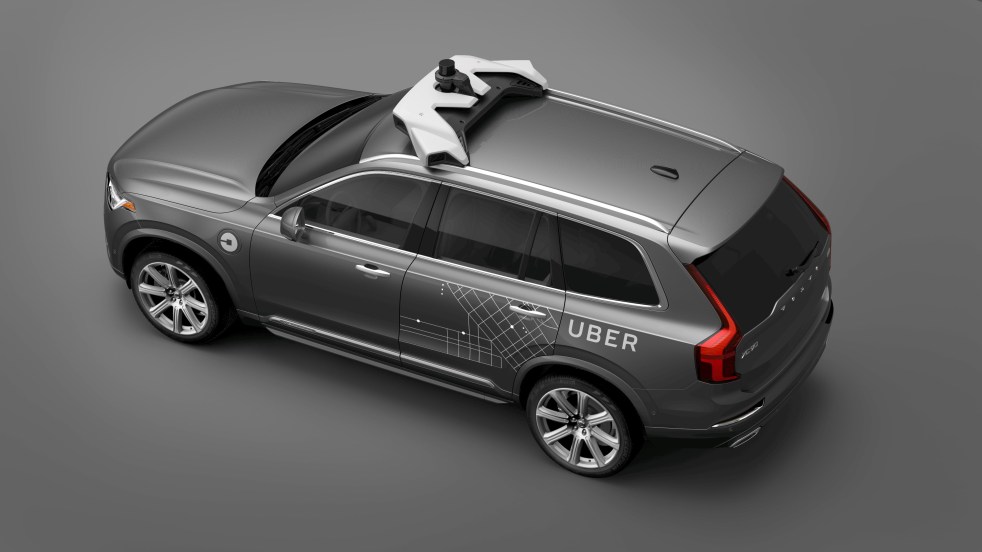
Swedish car maker Volvo Cars has signed a framework agreement with Uber, the ride-sharing company, to sell tens of thousands of autonomous driving-compatible base vehicles between 2019 and 2021.

The base vehicles are developed on Volvo Cars’ fully modular, in-house-developed Scalable Product Architecture (SPA). The SPA is one of the most advanced car architectures in the world and is currently used on Volvo Cars’ top-of-the-line 90 series cars as well as on the new XC60 mid-size SUV.

Volvo Cars and Uber join forces to develop autonomous driving cars

The non-exclusive agreement enhances the strategic partnership between Volvo Cars and Uber announced in August 2016, and also marks a new chapter in the convergence of car makers and Silicon Valley-based technology companies.

“The automotive industry is being disrupted by technology, and Volvo Cars chooses to be an active part of that disruption,” said Hakan Samuelsson, President and Chief Executive of Volvo Cars. “Our aim is to be the supplier of choice for AD ride-sharing service providers globally. Today’s agreement with Uber is a primary example of that strategic direction.”

Volvo Cars and Uber join forces to develop autonomous driving cars

Volvo Cars’ engineers have worked closely together with engineers from Uber to develop the XC90 premium SUVs that are to be supplied to Uber. The base vehicles incorporate all the necessary safety, redundancy and core autonomous-driving technologies that are required for Uber to add its own self-driving technology.

“We’re thrilled to expand our partnership with Volvo,” said Jeff Miller, Head of Auto Alliances, Uber. “This new agreement puts us on a path towards mass-produced self-driving vehicles at scale.”

At the same time as providing Uber with AD-compatible cars, Volvo will use the same base vehicle in the development of its own independent autonomous-car strategy, which is planned to culminate in the release of its first fully autonomous car in 2021.

Jose Mourinho Makes Surprise Visit To Jaguar Production Line

01_Jaguar F-PACE José Mourinho Surprise Visit

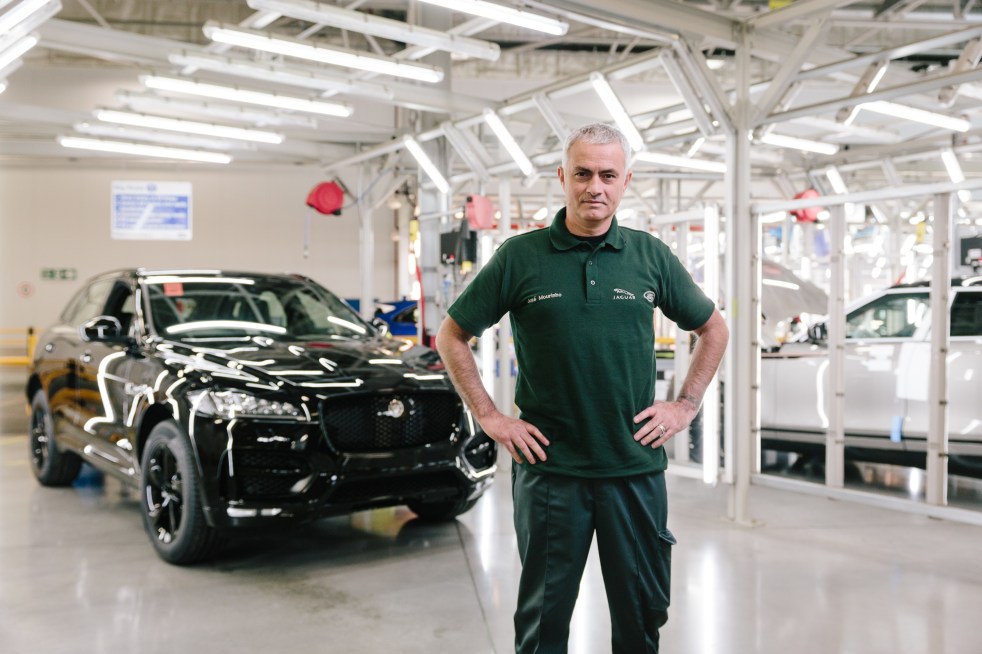
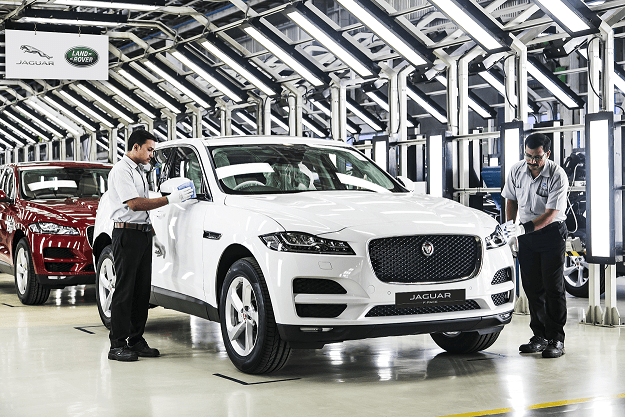
Jose Mourinho made a surprise visit to Jaguar Land Rover’s factory in Solihull, to watch employees build his new car, the 100,000th F-Pace.

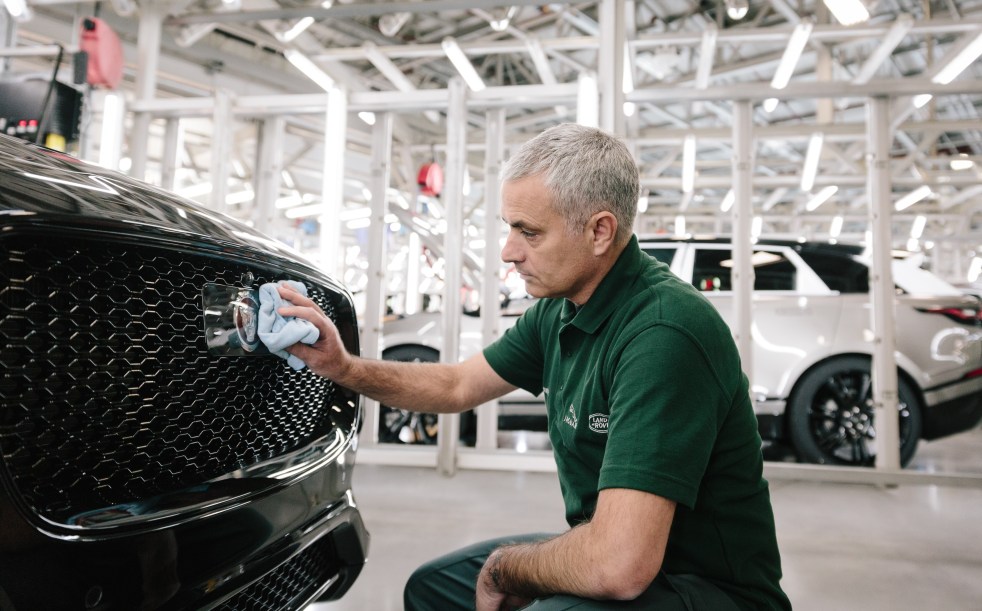
Mourinho wore bespoke Jaguar overalls and made his way directly to the factory floor to oversee the production of his car and helped the team as it moved along the production line.

Mourinho said: “It was an amazing experience to visit Jaguar’s factory and see all the cars, technology and hard work that goes into developing such a beautiful car. Jaguar is a brand that I have been involved with for many years. Back in 2014, I was the first UK customer to receive the F-TYPE Coupe and now to become the 100,000th Jaguar F-PACE customer is something that is very special.”

Upon arrival at the factory, Jose gave a team talk to the employees, motivating them and talking about having pride and passion in your work, and the products they deliver.

02_Jaguar F-PACE José Mourinho Surprise Visit

Ian Callum, Director of Design, Jaguar said: “It’s great to have one of the most successful football managers drive the F-PACE, our SUV that has been voted as the best and most beautiful car in the world by the 2017 World Car of the Year jury. Just like José Mourinho, the F-PACE is all about individual style and top performance.”

The F-Pace is the fastest selling Jaguar vehicle ever and is currently the fastest Jaguar vehicle to reach the 100K sales mark.

In 2016, Mourinho test drove the Jaguar F-Pace as part of a high-performance driver training experience in the Arctic Circle. Jose Mourinho mastered the art of high speed drifting and full throttle ice driving on a 60km frozen lake at Jaguar’s extreme testing facility in Arjeplog, Sweden.


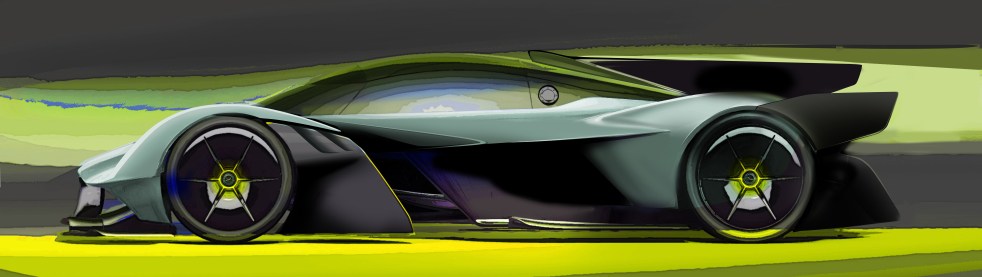
Aston Martin Valkyrie AMR Pro Revealed

Valkyrie AMR Pro_01

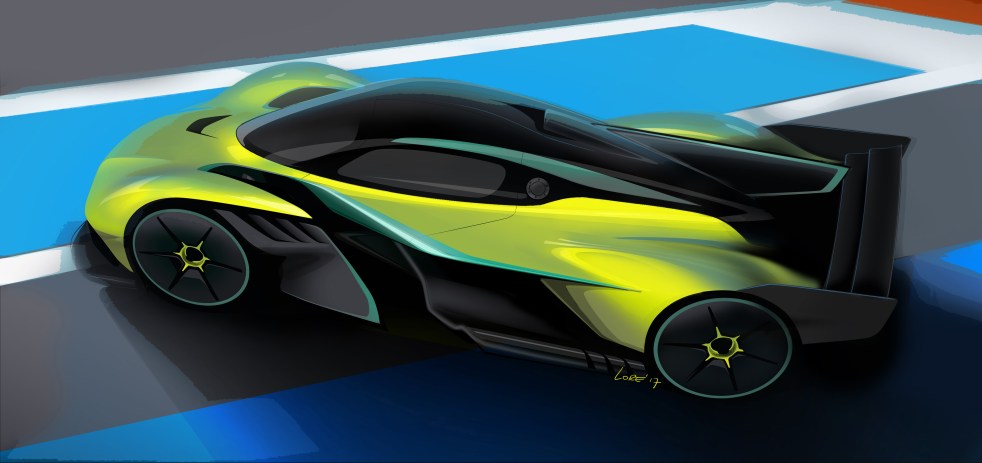
Aston Martin Valkyrie AMR Pro is an extraordinary track-only evolution of the most extreme Aston Martin in history. Developed in parallel with the road car, but freed from the constraints and considerations of road use, the Aston Martin Valkyrie AMR Pro is the ultimate expression of performance.

The brainchild of Adrian Newey – the most successful Formula One designer of all-time – and the product of the unique collaboration between Aston Martin, Red Bull Advanced Technologies and project partner AF Racing, just 25 Aston Martin Valkyrie AMR Pros will be built. Deliveries are expected in 2020. All cars are sold.

The most obvious changes have been made to the Aston Martin Valkyrie AMR Pro’s exterior. All the aerodynamic surfaces have been revised in the pursuit of significantly increased downforce, including the addition of much larger front and rear wing elements, together with revised active aerodynamic control strategies tailored for the demands of track driving.

The hypercar’s naturally-aspirated 6.5-litre Cosworth-built V12 engine develops more power and torque – exact figures will be released in due course – thanks to a significant engine recalibration and the modification of the road car’s emission control systems. The output of the Rimac Energy Recovery System remains unchanged, but its control systems will be re-programmed.

The AMR Pro runs on wheels of a smaller diameter than the road car (18in front and rear) in order to facilitate the fitment of Michelin racing tyres, which are made to the same specification as those used by LMP1 cars in the World Endurance Championship. The AMR Pro also features F1TM inspired race-spec carbon-carbon brakes as their performance characteristics are perfectly suited to the extremes of track use.

Valkyrie AMR Pro_02

The opportunity has also been taken to make further weight savings, both through the removal of extraneous items such as the heater/de-mister blower and infotainment screens fitted to the road car, and through the fitment of new ultra-lightweight track-specific components. These include polycarbonate windscreen (with heater elements) and side windows, a lighter construction of carbon fibre bodywork, new suspension uprights and carbon fibre wishbones, plus moulded race seats in place of the adjustable road car items. The AMR Pro’s exhaust system will also be lighter than that fitted to the road car due to the minimal silencing requirements.

The result of this unprecedented pursuit of performance is a genuinely mind-blowing car. One with a higher top speed (predicted to be close to 250mph), coupled to the ability to sustain cornering forces in excess of 3.3g and braking deceleration of more than 3.5g. According to Red Bull Technology’s extensive simulation work the Aston Martin Valkyrie AMR Pro will be capable of achieving lap times to rival those of a contemporary F1 or LMP1 car – pace previously unthinkable in a car derived from a fully homologated road car.

Given the car’s extraordinary capabilities Valkyrie AMR Pro customers will be taken through an intensive and comprehensive driver development programme. Tailored to their individual experience and skill levels, owners will have access to the same facilities as Aston Martin Red Bull Racing’s F1TM drivers. This includes time in the simulator and professional on-track tuition, plus programmes to improve their physical fitness. They will then be ready to enjoy their cars to the full with a series of dedicated track events held at some of the world’s most prestigious race tracks.

Red Bull Technology’s Chief Technical Officer, Adrian Newey, said: “While it is endowed with extraordinary performance, it has always been vitally important to me that the Valkyrie functions well as a true road car, and that naturally comes with some constraints. However, with the track-only Valkyrie AMR Pro we have the freedom to create an extreme evolution that makes no such concessions. While the core elements of the road and track versions are shared, every aspect of the AMR Pro – aerodynamics, chassis, powertrain and weight – has been optimised to significantly extend the performance envelope. It offers a level of track performance significantly beyond any previous two seat closed roof car.”

Dr Andy Palmer, Aston Martin President and Chief Executive Officer, adds: “Valkyrie has always been about pushing the limits and redefining the possible. The road car will set new benchmarks for performance, engineering and technology – a hypercar in the truest sense – and with the track-only Valkyrie AMR Pro those limits will be pushed further still. It’s a remarkable project. One that’s propelling Aston Martin and 25 of our most passionate customers into a new and extraordinary realm”.

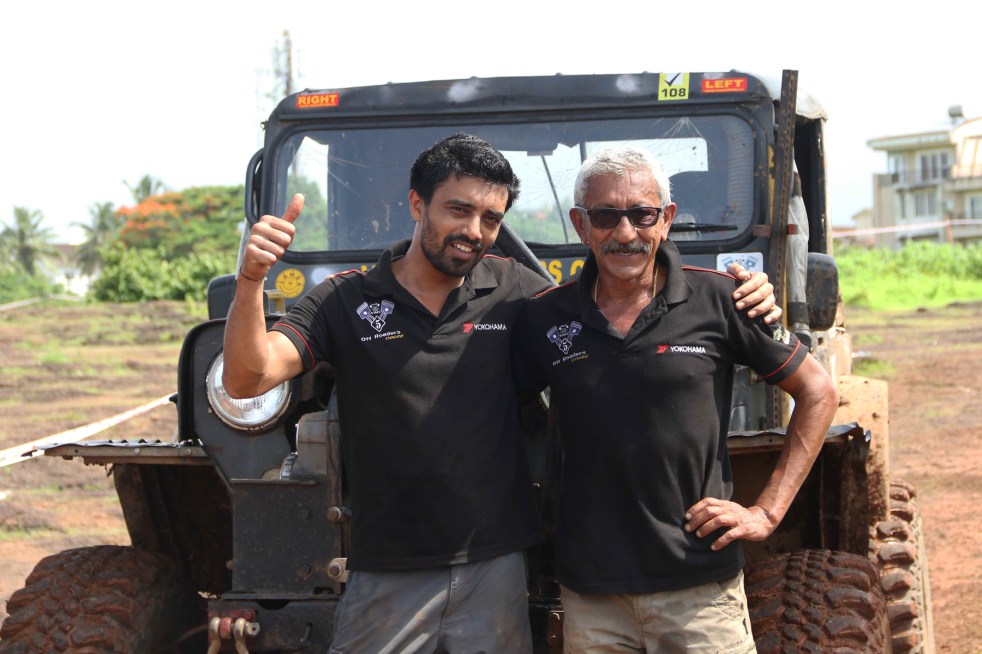
Veteran Rallyist Jagat Nanjappa And Co-Driver Chetan Changappa To Represent India At RFC 2017 Global Series Finale In Malaysia  

Jagat Nanjappa (right) with co-driver Chetan Changappa

After impressing everyone with their incredible performance at the Force Gurkha RFC India 2017, veteran rallyist Jagat Nanjappa and co-driver Chetan Changappa are all set to hoist the tricolor on the Malaysian soil at the 21st edition of the Rainforest Challenge Global Series Finale. To be held from 24th November to 5th December, RFC 2017 Global Series Finale is going to be a grand clash of the best offroaders from across the globe, as they compete for the winner’s trophy at one of the top 10 toughest motor races in the world.

RFC 2017 Grand Final is the culmination of the Global RFC Series, which has 25 editions worldwide in countries like India, Australia, Russia, China, Vietnam, Thailand, Sri Lanka, Korea, Myanmar, Ukraine, Balkans, South Europe and North Europe among others. In India, the event was launched in 2014 by Delhi-based Cougar Motorsport Pvt. Ltd. and despite being only four editions old, has gained enormous acclaim across the international offroading fraternity.

Jagat Nanjappa and Chetan Changappa sealed their entry into the RFC Global Series Finale this year due to an exceptional performance at Force Gurkha RFC India 2017, wherein they claimed the overall second position. When asked about his plans for the forthcoming event, Jagat shares, “I went to watch the RFC Malaysia event in 2011 and was amazed by the level of vehicular modifications and equipment at play. After 37 years of racing in India, this is my maiden opportunity to go abroad and compete. I want to put every bit of effort in it and win it for my country. To prepare for the challenges ahead, Chetan and I have adopted a tougher fitness regime, as the competition is going to last for 10 days which is a bit longer than its Indian version. We plan to land there and acclimatize ourselves with climate and the vehicle a few days prior to the flag-off. We want to stay cool, carefully walk our path and try to clinch a podium finish. Rest, we have our fingers crossed, let’s see how it fares out.”

Speaking of his vehicle, Nanjappa explained, “I’ll be driving a rented modified Jeep, turbo charged with a 2L Petrol engine. We are using a mechanical winch, which happens to be faster than the electrical ones. I’m satisfied with the vehicle and I’m hopeful that it’ll perform well.” At the age of 59, Nanjappa carries with him a vast experience in offroad motorsports and has been a celebrated motorcyclist and rallyist, having won the prestigious National Rally Championship nine times in his illustrious career, before entering into offroading.

Cougar Motorsport’s Director, Ashish Gupta said, “Ever since we brought RFC to India, I have dreamt of seeing an Indian team emerge as an overall champion at the Global Series Finale. We tasted a milestone victory last year at the RFC Global Series Final with Team India winning their category for the first time ever. That victory said a lot about the massive progress that has been made by Indian offroaders in such a short span since the launch of RFC India. My belief that Indian offroaders are very much capable of giving a tough fight to the international offroaders was strengthened by the incredible performances we witnessed this year at RFC India. I am confident that Jagat Sir and Chetan would deliver an outstanding performance and make India proud at the international offroading stage.”

This year’s edition of RFC Global Series Finale will start in Kuala Lumpur and subsequently travel to Pahang, the biggest state in Malaysian peninsula and a tropical paradise for sports and adventure based tourism. The event will have twenty four Special Stages (SS) that will be divided into four progressively difficult competitive legs – the Prologue, the Predator, the Terminator and the Twilight Zone. The competition will test the competitors’ strength, endurance, driving and vehicle recovery skills under extreme off-road conditions and the team with the maximum points at the end of all the SS will be announced as the winner.

This is the third attempt by an Indian team at RFC Global Series Finale. Chandigarh’s Gurmeet Virdi and co-driver Kirpal Singh Tung successfully won their category in the previous edition of the competition. Though the top 4 teams from Force Gurkha RFC India 2017, including Champions Gurmeet Virdi and Kirpal Singh Tung, qualified for the mother event in Malaysia, the other three teams are unable to participate due to personal commitments. Therefore, Jagat Nanjappa and Chetan Changappa would be the sole team among the RFC India 2017 Top Four that would represent India at the mega event this year.

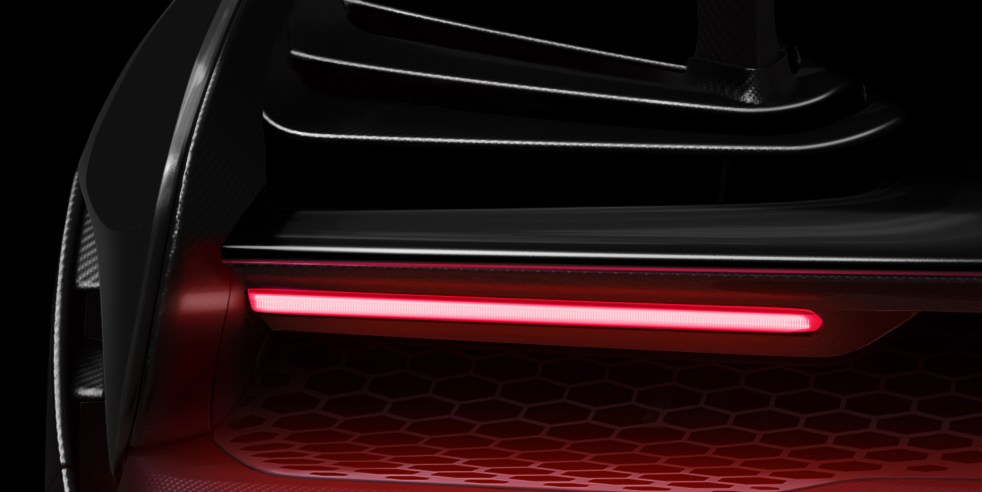
Date Confirmed For Online Reveal Of Ultimate Track-Concentrated McLaren Road Car

Next McLaren Ultimate Series_2

McLaren Automotive has confirmed at the Dubai International Motor Show that its next Ultimate Series model will be revealed online on December 10, 2017, at 00:01 GMT.

With daily usability sacrificed to give the most intensive driver experience around a circuit, the new Ultimate Series car will be the ultimate track-concentrated McLaren. Designed as the most extreme road-legal McLaren ever, it is the third of 15 new models or derivatives due by the end of 2022 under the McLaren Track22 business plan. It will be delivered ahead of a second future Ultimate Series model codenamed BP23, which aims to be the world’s first Hyper-GT.

Positioned above McLaren’s core Super Series, the Ultimate Series has previously comprised the McLaren P1 and McLaren P1 GTR. Like these two cars, the new generation of McLaren Ultimate Series models will be available in strictly limited numbers.

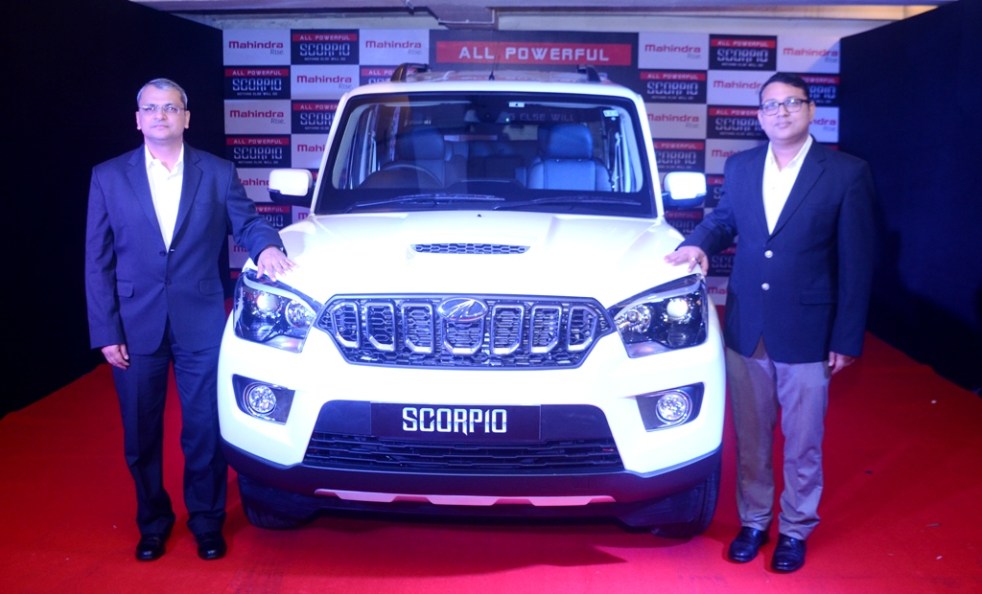
Mahindra Scorpio Facelift Launched At Rs 9.98 Lakh

Scorpio_Kolkata(L-R) – Amit Sagar, Vice President, Sales, Automotive Division, M&M Ltd and Manoj Gupta, General Manager, Sales, Automotive Division, M&M Ltd at the launch of the new all powerful Scorpio in Kolkata

Mahindra & Mahindra Ltd. (M&M Ltd.), today launched the Scorpio facelift in Kolkata with prices starting from Rs 9.98 lakh (ex-showroom Kolkata) for the base S3 variant.

Speaking on the launch, Rajan Wadhera, President – Automotive Sector, Mahindra & Mahindra Ltd. said, “The Scorpio has pushed the boundaries for Mahindra and created new benchmarks for others ever since its launch in 2002. To see the Scorpio become the pride of over 6 lakh customers is a matter of pride. Today as we launch the New All Powerful Scorpio, we have further enhanced its on road presence while retaining its core DNA of power, thrill and adventure. I firmly believe that the consumers will find the New All Powerful Scorpio a perfect companion for their thrilling and adventurous journeys.”

Under the hood, the new Scorpio is powered by the mHawk engine which has been tuned to deliver higher power of 140 bhp and more torque of 320 Nm. Its low-end torque ensures a pleasurable city drive and abundant mid-range torque delivers a pleasurable highway drive.

Its new 6th generation Borg Warner Turbo Charger makes the drive peppy and responsive all through. The all-new easy shift 6-Speed manual transmission optimises performance, allows cruising on highways and saves fuel.

Its refinement in NVH ensures a quieter cabin. Its new latest generation braking system with 9.1 Bosch ABS system offers enhanced high-speed braking and improved brake feel.
Other features include new reverse parking camera with dynamic assist, new 1-touch lane change indicator and new auto window roll-up.

It will be available in multiple seating configurations allowing owners to choose from 7, 8 and 9 seater options to match their needs. It will be available at Mahindra dealerships starting November 14, 2017 in 5 attractive colour options, namely, new Pearl White (Only in S11), Diamond White (Except S11), Napoli Black, D Sat Silver, Molten Red and 6 variants – S3, S5, S7 (120 bhp), S7 (140 bhp), S11 (140 bhp) and S11 (140 bhp with 4WD).

Jaguar Launches Locally Manufactured F-Pace In India At Rs 60.02 Lakh

02_Locally Manufactured F-PACE at Pune Plant

Jaguar Land Rover India today announced the start of local manufacturing of Jaguar’s first performance SUV, the F-Pace. Available in the Prestige derivative and powered by a 2.0-litre 4-cylinder, 132 kW (180 PS) Turbocharged Ingenium Diesel engine, the locally manufactured 2018 Model Year F-Pace is priced at Rs 60.02 Lakh (ex-showroom price in India).

Rohit Suri, Managing Director & President, Jaguar Land Rover India Ltd (JLRIL), said: “Since its launch in October last year, Jaguar F-PACE has captured hearts and minds of Jaguar fans as well as its distinguished & discerning customers spread across India. The launch of the locally manufactured F-PACE signifies another milestone in our continued commitment and efforts towards ‘Make in India’ policy of the Government of India.”

The Jaguar F-Pace is a performance SUV that has the DNA of a sports car. Its powerful and agile look makes it very distinctive and gives it a head-turning road presence. It also comes with a range of exciting features including adaptive LED headlights, activity key, Wi-Fi hotspot and pro services and 25.91 cm (10.2 inch) touch screen. With premium features such as rear recline seats, four-zone climate control, 380 W Meridian sound system and configurable interior mood lighting (with 10 colours), one can enjoy the thrilling performance of the F-Pace in supreme comfort and leisure.

Dani Pedrosa Scores Great Win In Valencia, Marc Marquez 2017 World Champion

Dani Pedrosa scores great win in Valencia, Marc Marquez 2017 WORLD CHAMPION

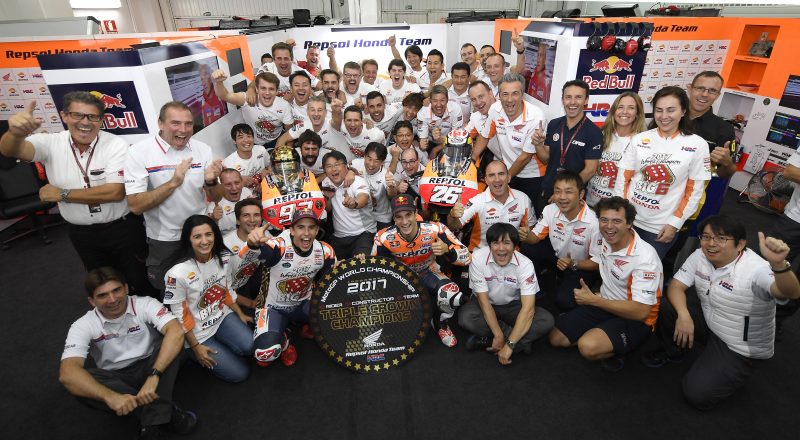
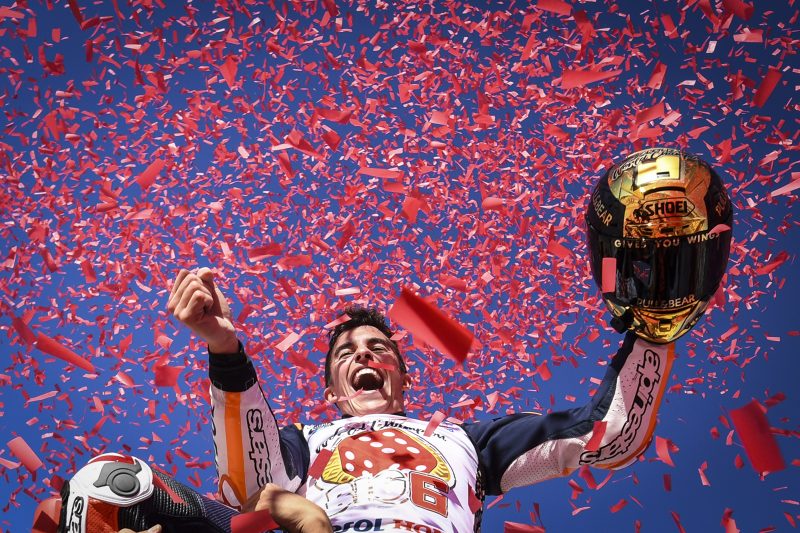
The Repsol Honda Team enjoyed a dream day in Valencia on Sunday, with Dani Pedrosa winning the Grand Prix (his seventh at Valencia across all classes, his 54th in career, and his 31st in the MotoGP class); Marc Marquez taking the third step of the podium to earn the 2017 World Championship Title (his sixth in career, and his fourth in the MotoGP class in five years); and Honda securing the “Triple Crown,” comprising the Constructor, Rider, and Team Championships.

Marc and Dani were also the two riders to score the most podium finishes this year, twelve and nine respectively, making the Repsol Honda Team the most successful team of 2017, with eight double-podium finishes.

Marc and Dani got away brilliantly at the start, entering the first corner in first and second positions, but Johann Zarco assumed the lead on lap four. Marc stuck to him for 20 laps and then made the pass, but he immediately ran wide in turn 1 and almost crashed. He made one of is signature incredible saves but dropped to fifth behind Zarco, Dani, Jorge Lorenzo and title contender Andrea Dovizioso.

Dani, who had been closely chasing them, engaged the Frenchman in a battle for the win and finally passed him on the last lap. In the meanwhile, crashes by both Ducati riders allowed Marc to celebrate his incredible sixth Title, from the third step of the podium.

Marc Marquez 2017 WORLD CHAMPION

Marc Marquez, 2017 World Champion said, “I’m living a dream. ‘Six Titles’ are big words. The truth is that I’m incredibly happy because we worked so much this year, and today the race was incredibly tense and exciting—a bit ‘Marquez Style.’ I made a mistake, but I also made my best save of the year. From that moment on, I just tried to finish the race in a good position. I’m sorry that Andrea didn’t finish the race, as he deserved to do so. He had an incredible season and I would have liked to have him on the podium with me today. The key to the year has been our mentality. In our world it’s very important to remain positive and motivated during the difficult moments. Some things happened to us at the beginning of the season but when we found the way to sort things out, everything went better. Congratulations to Honda and the entire team for the Triple Crown. It’s an amazing achievement. Winning the Title at the last race of the season in front of our fans is one of the best things possible, really special. Now I want to enjoy this with my entire team and my family, and after that we’ll start to work for next year.”

Dani Pedrosa, Race winner said, “Obviously I’m very very happy because a win is a win, and this was a very tough and hard-fought one. Today we had a chance because we got a good start and the setup was working well, so we took it. The track wasn’t easy as front grip wasn’t perfect, and in fact we saw a lot of crashes in the race. I was just behind Marc when he made that save and it was incredible. The smoke, the noise, the speed—wow, impressive! I realized that the track had a limit, maybe because the rear had more grip, which pushed the front. Anyway, I tried to manage the front grip, but then in the last three laps I gave it everything to pass Johann. He was so good into the corners but finally I passed him on the last lap. I’m so happy to have won in front of my crowd, and I would like to dedicate this victory to my family, friends, fans, and the team. This was a fantastic day for all of us, as Marc clinched the Rider Title and we secured the Constructor and Team Titles. I also move up one place in the Championship, and that’s great as well.”

Tetsuhiro Kuwata, HRC Director General Manager Race Operations Management Division said, “Today our riders and team did a perfect job. The race was very tense for everybody, but the final result was amazing! Marc was brave and pushed hard as always, managing to get on the podium despite a big scare! Dani finished the Championship with a victory, so I don’t think we could have asked for more today. I would like to thank the riders, everyone in the Repsol Honda Team, and HRC at home. We’ll keep giving our 100% to continue in this way.”

Yoshishige Nomura, HRC President said, “Today was the ‘perfect storm’ for HRC and Honda, as we won the Rider Title, Constructor Title, and Team Title, earning the Triple Crown. Of course I am extremely happy with this fantastic result, and I would like to congratulate Marc and Dani for their hard work and commitment, as well as all the HRC Engineers and our Sponsors, who together have contributed to this incredible result. I am very proud of all them.”

Stunning KIA Stinger Gran Turismo Unveiled

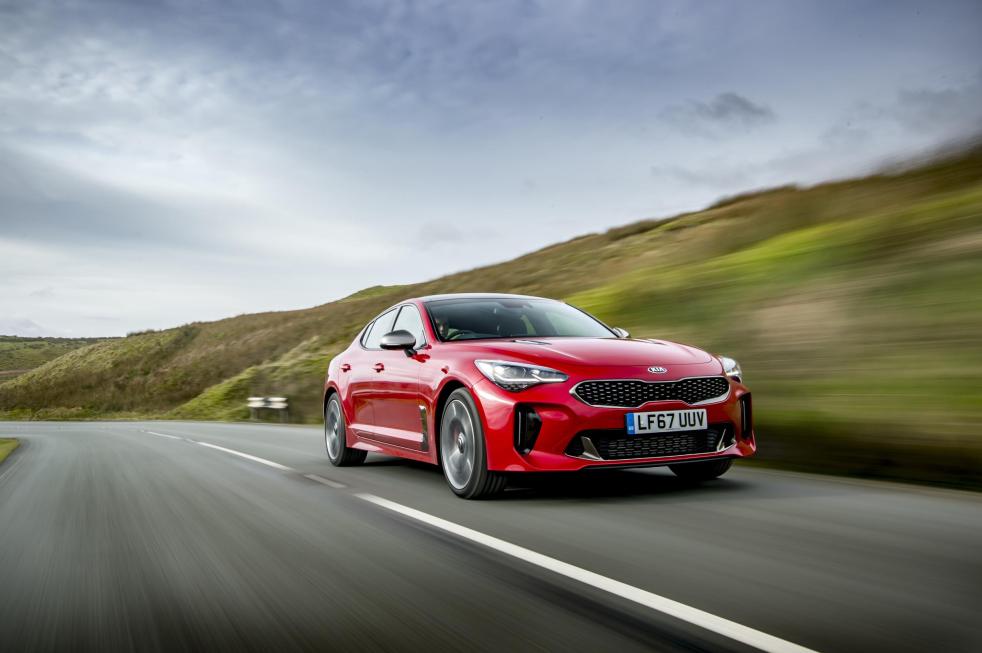
1477074_Kia Stinger GTS red_019

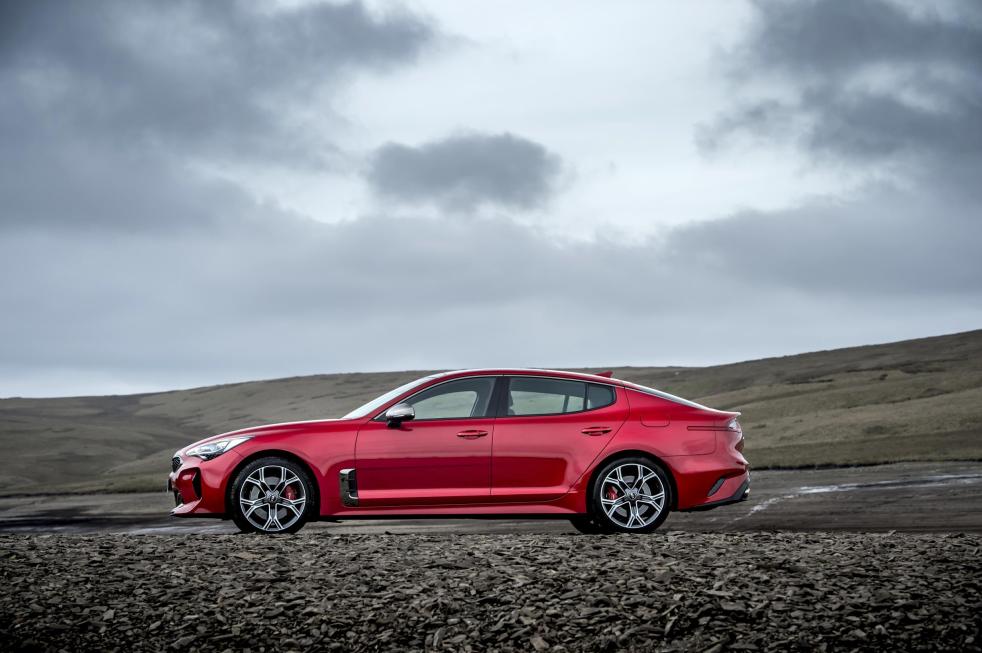
It’s here at last! The stunning Kia Stinger, an elegant gran turismo based on the 2011 Kia GT Concept from the Frankfurt Motor Show, is now in full production and today goes on sale in the UK.

Stinger is the most adventurous model in Kia’s history, the company’s first classic grand tourer and the first rear-wheel-drive model it has introduced to Europe. In range-topping twin-turbo V6 guise, it is also the fastest-accelerating Kia ever, with a 0-60mph time of 4.7 seconds.

Six years in the making, it was designed in Europe at the Frankfurt studios under the watch of President of Design and Chief Design Officer Peter Schreyer and European Head of Design Gregory Guillaume. Prototypes have covered the equivalent of 27 trips around the Equator, taking in extreme climate testing in Europe, Asia, the Middle East and North and South America, to perfect the car, and every development model has done at least 480 laps (10,000 kilometres) of the tortuous Nurburgring Nordschleife. The testing regime was headed by Kia’s Head of Vehicle Test and High Performance Development, Albert Biermann.

Five versions are available in the UK, all with turbocharged direct-injection engines mated to an eight-speed automatic gearbox and featuring state-of-the-art electronic driver aids and connectivity systems. The GT-Line and GT-Line S offer the choice of a 2.0-litre 244bhp T-GDi petrol engine or a 2.2-litre 197bhp CRDi turbodiesel, while the range-topping GT S has exclusive use of a 3.3-litre 365bhp twin-turbo V6. The GT S, as the fastest and most powerful model in the range, also has adjustable electronic suspension damping and Brembo brakes.
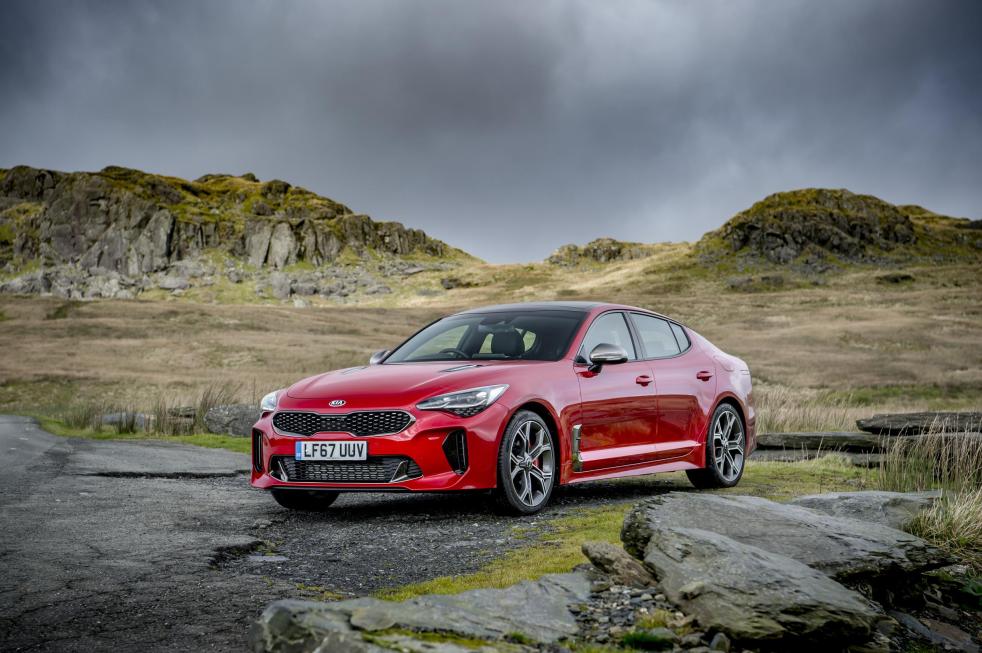
1477005_Kia Stinger GTS red_004

A gran turismo, not a sports car

Stinger is a classic grand tourer, not a hard-edged sports car. It harks back to an era when travelling was all about the joy of the journey and getting to the final destination could be an anti-climax.

“The Stinger has nothing to do with being the first to arrive,” says Gregory Guillaume. “This car is all about the journey. It’s about passion.”

It was inspired by the elegant grand tourers Guillaume saw as a child growing up in 1970s France, wafting their occupants effortlessly from Paris to St Tropez and other glamour spots on the Riviera. Even as a young boy Guillaume was drawing his own ideas for elegant grand tourers, hoping that one day they might become reality. They were his inspiration for the 2011 GT Concept and, subsequently, Stinger.

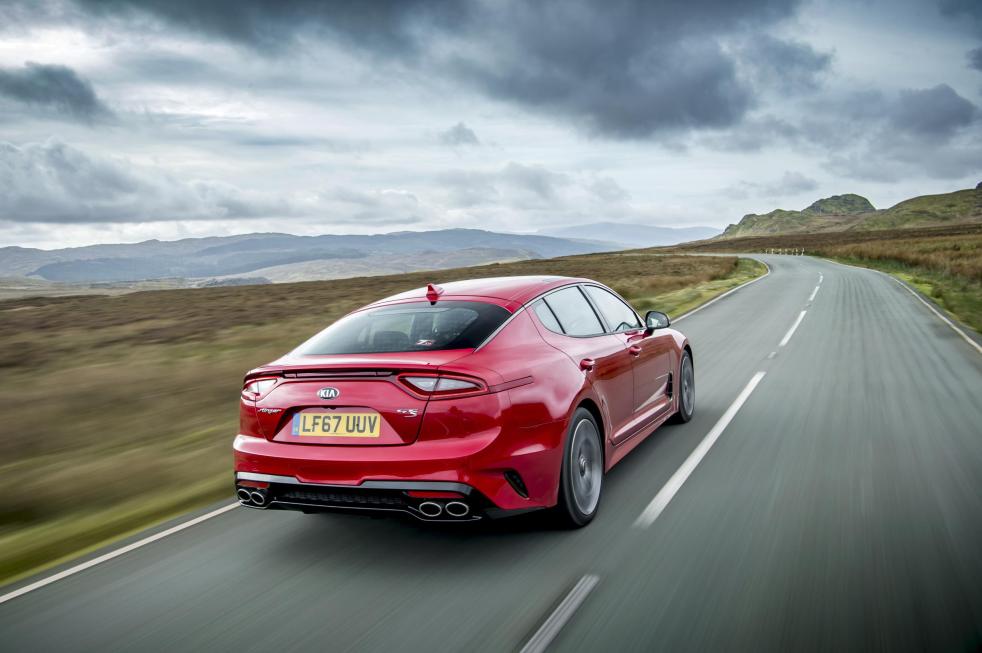
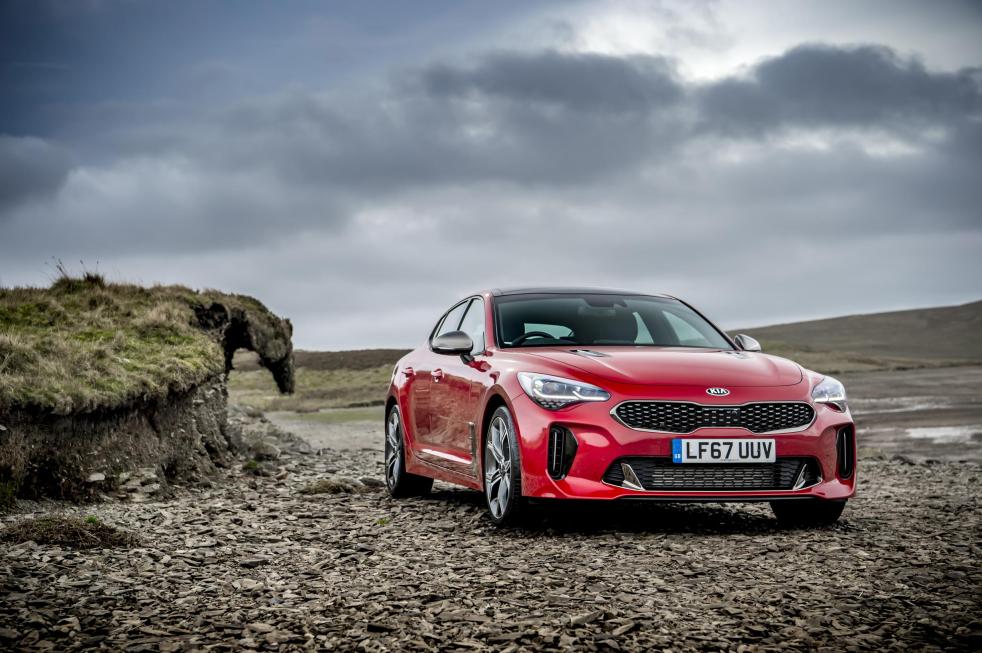
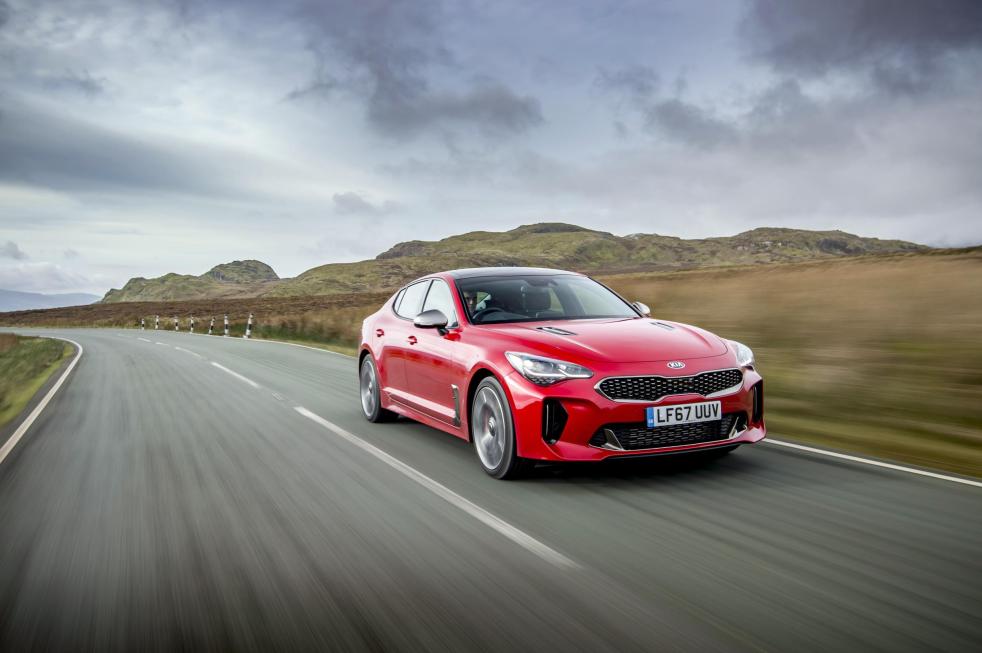
Stinger exhibits classic gran turismo proportions – long bonnet, short front overhang, long wheelbase, cabin positioned towards the rear of the car, lengthy rear overhang beneath broad shoulders and a ‘Coke-bottle’ nip in the waist. It sets a template for Kia’s bold and exciting future and is the final step in the company’s transition from a manufacturer of purely rational, durable, value-centric cars to one able to compete with the world’s best for desirability, design and technology.
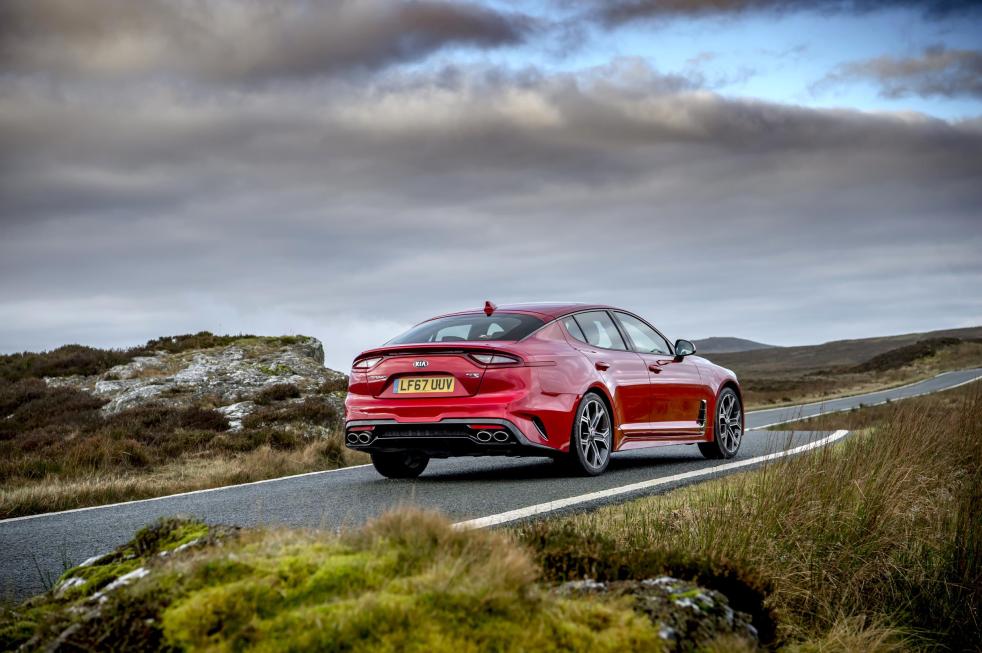
1477027_Kia Stinger GTS red_009

This may be a new kind of Kia, but the design cues which have stood the company in good stead since Schreyer joined in 2006 are all in evidence. What Guillaume calls the “sleek and sharky” front end has a new interpretation of Kia’s ‘tiger-nose’ grille mounted between complex headlamp units. There is a castellated upper edge to the windscreen. And the flanks are simple and unadorned. Visual engagement also comes from the large lower grille and air intake, dark chrome highlights and bold rear diffuser with quad tailpipes on petrol models and twin tailpipes on diesels. There are 18-inch alloy wheels on GT-Line and GT-Line S versions and 19-inch wheels on GT S.

What exterior decoration does appear is there to aid aerodynamics and ensure the car remains stable at the high speeds it is capable of. There are air curtains at the front and finned gills behind the rear wheel arches to reduce wake as turbulent air passes around the large wheels and tyres. The final shape of Stinger called for intense collaboration between designers and aerodynamicists to make airflow around the car as clean as possible without diluting its stunning styling.
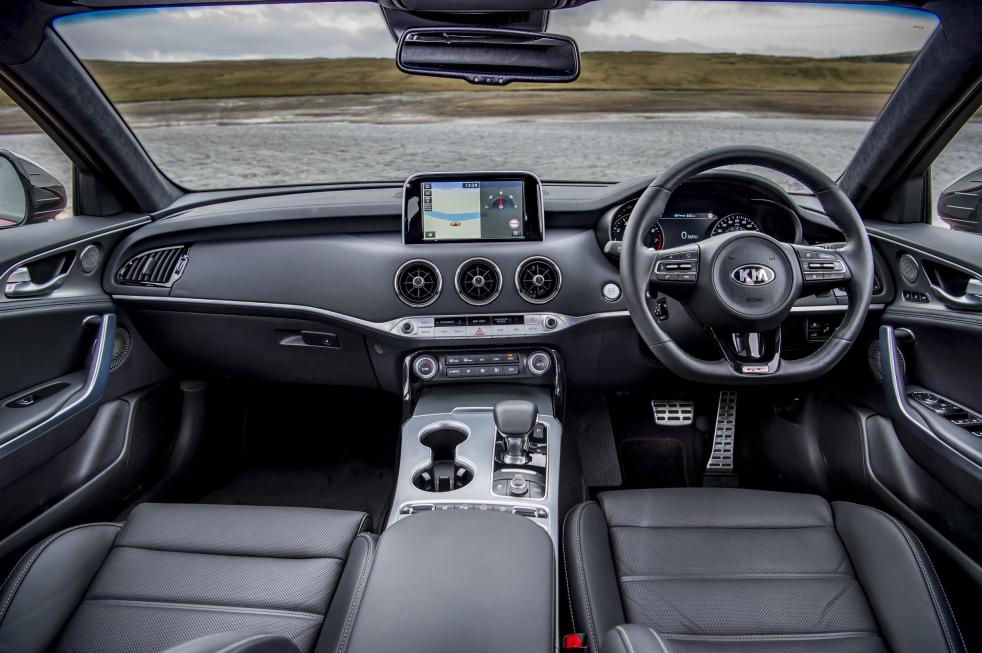
1477284_Kia Stinger GTS red_073

An interior fit for cross-continent travel

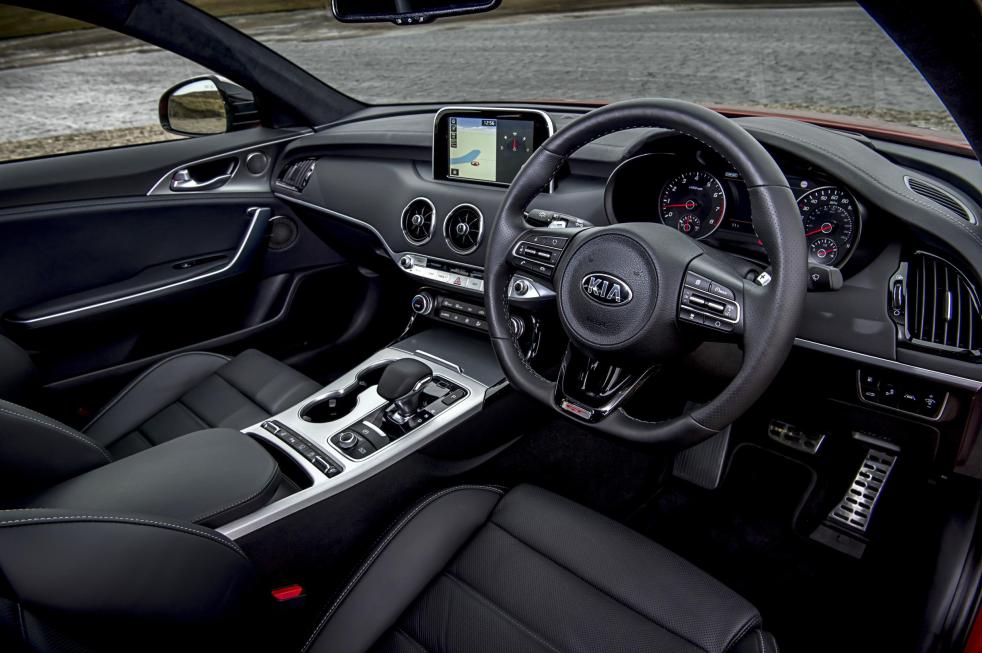
Stinger’s luxurious interior is a blend of cocooning intimacy and space for five people and their luggage. Occupants slip down into their low-slung seats – leather in GT-Line and GT-Line S versions, and Nappa leather in GT S.

There is a horizontal sweep to the high-mounted, wing-shaped dashboard – also covered in leather – which is broken only by the 8.0-inch touchscreen for the navigation and infotainment system. Leather also adorns the door armrests, the D-shaped steering wheel and the gearshifter, which also has chrome sections.

The seats are snug and enveloping, and the two in front have eight-way power adjustment – with a memory function on the driver’s side – and a two-way power cushion extender plus four-way power lumbar adjustment. The front seats and steering wheel are heated, and in GT-Line S and GT S they are also ventilated, while the outer rear seats are also heated.
1477276_Kia Stinger GTS red_072

The luxurious ambience is enhanced by an aluminium-finish centre console, a chrome strip running all the way around the cabin, suede-like headlining, satin chrome interior door handles, alloy pedals, stainless steel door scuff plates and five aeronautically inspired spoked circular air vents.

To enhance comfort, dual automatic air conditioning is fitted to every model, while to aid the driver there is a 7.0-inch LCD Thin Film Transistor (TFT) supervision cluster and a customisable head-up display which allows key information – speed, navigation instructions and audio, cruise control and blind spot detection information – to be projected onto the windscreen. GT-Line S and GT S also have a 360-degree around-view monitor.

Every model has a DAB radio with MP3 compatibility and Bluetooth with voice recognition and music streaming. In GT-Line there is a nine-speaker sound system with front under-seat subwoofer, while GT-Line S and GT S have a concert hall quality 15-speaker harman kardon premium system with subwoofer, external amp and front centre speaker. It features Clari-Fi, which restores the sound often lost when digital music files are heavily compressed, and QuantumLogic Surround Sound, which redistributes signals from the original recording to deliver multi-dimensional playback.
1477091_Kia Stinger GTS red_024

Powertrains perfectly tuned for long-distance touring

Grand tourers should not only be beautiful, comfortable and luxurious – they must also be fast. The three turbocharged engines chosen for Stinger are ideally suited to its role as a long-distance gran turismo.

On the one hand the 3.3-litre twin-turbo V6 T-GDi is the fastest-accelerating Kia ever, with a 0-60mph time of 4.7 seconds and a top speed of 168mph, while on the other the 2.2-litre CRDi’s combined fuel consumption of 50.4mpg gives it a touring range of comfortably more than 600 miles. In between there is the 2.0-litre T-GDi offering much of the best of both: acceleration from 0-60mph in 5.8 seconds with combined fuel economy of 35.8mpg, allowing it to cover more than 450 miles before the driver will need to stop for fuel.

The 2.0-litre T-GDI (Turbocharged Gasoline Direct injection) engine develops 244bhp at 6,200rpm and 353Nm of torque all the way from 1,400 to 3,500rpm, ensuring outstanding driveability. The 3.3-litre T-GDi V6 can deliver 365bhp at 6,000rpm and a huge 510Nm of torque which is even more widespread – starting at 1,300rpm and continuing uninterrupted until 4,500rpm. The 2.2-litre CRDi delivers 197bhp at 3,800rpm and 440Nm of torque, also across a wide range – 1,750 to 2,750rpm.

All versions drive the rear wheels through an electronic eight-speed automatic gearbox. It was designed in-house and rewards drivers with immediate shifts and optimum fuel efficiency. Stinger’s transmission marks Kia’s first use of a Centrifugal Pendulum Absorber (CPA) torque converter more typically found in aviation and racing applications. CPA reduces torsional vibrations through the drivetrain.

The transmission offers up to five different shift and throttle programmes, accessed through the car’s electronic Drive Mode Selector. Drivers can leave the car to shift for itself, or change gears with steering wheel-mounted paddles. A limited slip differential is fitted to all models so that torque is transferred to the rear wheel with most grip.

ISG, Kia’s engine stop/start system to ensure no fuel is wasted and no emissions are released into the air when the car is stationary, is standard. The engine cuts out as soon as the driver brakes to a standstill and restarts when the brake pedal is released.

To ensure occupants can enjoy the refined sporting tones of the Stinger’s turbocharged engines, the car is the first Kia to be fitted with an Active Sound System. This relays the engine note to the cabin through the car’s audio system rather than the more conventional actuator. It was engineered in Europe and can be customised through the Drive Mode Selector according to which of the five programmable settings the driver has chosen.
1477024_Kia Stinger GTS red_007

Sportiness with comfort: the ideal gran turismo combination

A gran turismo must provide exceptional comfort for occupants on the long distances it is designed to cover, but it must also reward enthusiastic drivers. Stinger meets those demands. Right-hand-drive cars have undergone additional testing in the UK to meet the unique challenges of the country’s roads.

All versions have fully independent suspension through MacPherson struts at the front and a five-link set-up featuring double wishbones at the rear, but there are two different systems. GT-Line and GT-Line S have a passive set-up, while GT S introduces adaptive Dynamic Stability Damping Control (DSDC), which can be changed through the Drive Mode Selector. DSDC allows the driver to choose a more comfort-oriented Normal setting or a Sport setting which introduces more powerful damping force.

A variable-ratio version of Kia’s rack-mounted Motor Driven Power Steering (R-MDPS) is fitted to the GT S grade, and this can also be adjusted via the Drive Mode Selector. The Normal setting requires less turning effort from on-centre, becoming progressively firmer as more lock is added. Sport requires more initial effort, while shorter gearing ensures more immediate response by reducing the need for larger steering inputs.

Stinger’s brakes have had more development work than those on any previous Kia to ensure they are up to the performance of the engines. There are ventilated discs at all four corners for the 2.0-litre T-GDi and 3.3-litre T-GDi V6 models, with ventilated front discs and solid rear discs for the 2.2-litre CRDi models.

The disk brakes for the 3.3-litre GT S were co-developed with Brembo and are 350mm on the front and 340mm on the rear and are holed and grooved, to provide high heat capacity with low fade, even in repeated heavy use. They were developed on some of the highest mountain passes in Austria, Germany and Spain as well as around the Nurburgring. There are quad-piston front calipers and dual-piston rear calipers.

There are 18-inch alloy wheels with 225/45 R18 tyres for GT-Line and GT-Line S, while the GT S has 19-inch alloys with 225/40 R19 tyres at the front and even wider 255/35 R19 tyres at the rear.
1477088_Kia Stinger GTS red_021

Fully equipped for the life of a modern gran turismo

Stinger may evoke memories of the golden age of gran turismos, but it is not a retro car. Its advanced driver aids take into account that roads are busier and there are more distractions than yesteryear, while its 8.0-inch touchscreen infotainment system acknowledges that drivers no longer use maps to find their way around but expect the car to guide them to their destination, and that they expect to remain fully connected throughout the journey.

All versions have Autonomous Emergency Braking, which automatically intervenes to stop the car if the driver fails to respond to a potential accident, and there is Lane Keep Assist to prevent a driver straying into an adjoining lane accidentally, and High Beam Assist to adjust the headlights according to other traffic and local lighting. Driver Attention Warning alerts a tired driver that it is time to take a break, and there is a Speed Limit Information system.

GT-Line S and GT S supplement this with Blind Spot Detection with Rear Cross Traffic Alert: together, these act as an extra pair of eyes for the driver, warning of vehicles approaching out of his or her eye-line when changing lanes or exiting parallel parking spaces. An Active Bonnet is standard with all three trim grades to provide additional protection for pedestrians’ heads in a collision.
1477061_Kia Stinger GTS red_013

Stinger has Electronic Stability Control linked to Vehicle Stability Management (VSM) to correct potential skids without any intervention from the driver. VSM incorporates a new dynamic torque vectoring system which monitors driver inputs and road conditions and automatically applies power and braking force to the inner rear wheel to minimise understeer and enhance tractability and steering feel.

The standard touchscreen navigation has full European mapping and a Traffic Messaging Channel. Stinger also has Kia Connected Services with TomTom, giving access to traffic, speed camera and weather information plus local search details in a number of categories. This is supplemented by Android Auto and Apple CarPlay connectivity which, via pre-downloaded apps on a suitable smartphone, links the car to maps, music, podcasts and texts through voice commands.

There are front and rear USB ports, while GT-Line S and GT S have a wireless phone charger.

Infiniti Unveils New QX80 At Dubai International Motor Show

QX80 Hero 2k

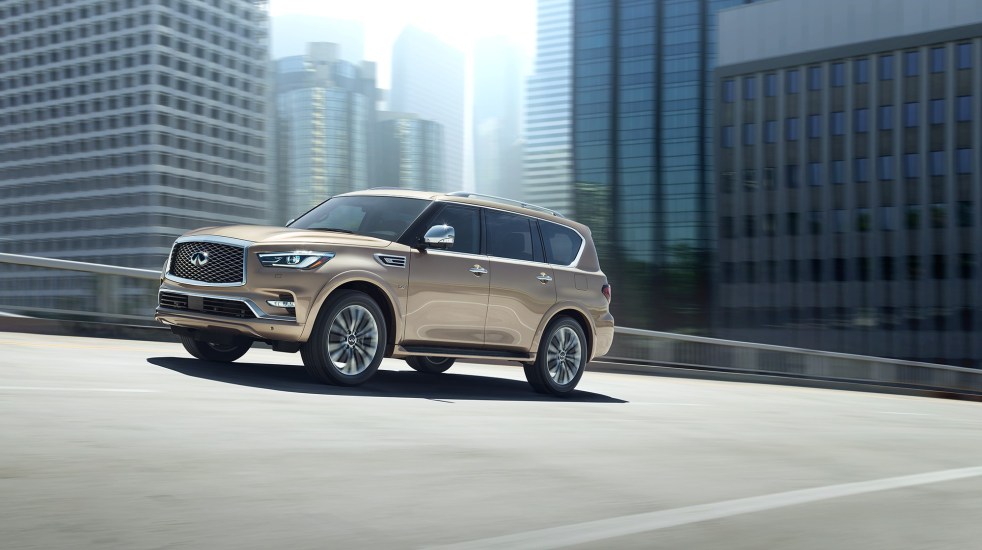
Infiniti unveiled its all-new QX80 full-size luxury SUV today at the 2017 Dubai International Motor Show. Although the top-of-the-line SUV is not sold in Western European countries, it fascinates enthusiasts across the continent and is an iconic car for the brand globally.

The QX80 takes Infiniti’s ‘Powerful Elegance’ design language in a bold new direction, creating a vigorous, contemporary and commanding aesthetic. The new model reveals a modern exterior design combined with a high-tech cabin engineered for relaxation. The new Infiniti QX80 has been designed and engineered to allow customers to travel everywhere in style and luxury and it strengthens the brand’s position in the full-size SUV segment.

The QX80 has a refined and spacious cabin that features high-quality materials, a hand-crafted finish and advanced drive-assist technologies. With a taut yet comfort-oriented suspension, and ample performance from its 5.6-litre V8 engine, the new QX80 gives drivers an assured feeling of control and confidence at the wheel.