
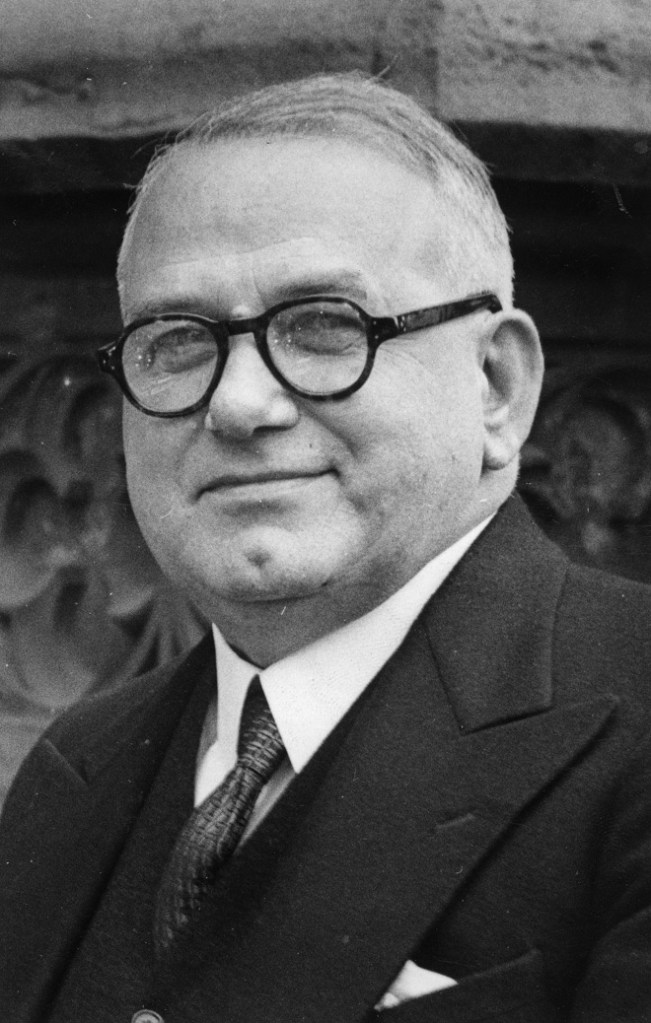
Rolls-Royce ‘Makers of the Marque’: Ernest Hives

Photo by ANL/Shutterstock (1475290a)
Lord Hives Managing Director Of Rolls Royce Ltd.

Ernest Walter Hives was born on 21 April 1886 in Reading, Berkshire. In 1898, aged just 12, he began a three-year apprenticeship with a local engineering company that had a sideline dealing in motor cars.

From the outset, the young Hives was captivated by these fascinating new machines. He saw his future in them and, like Henry Royce a generation earlier, he did not allow his humble background and limited formal education to impede his ambitions. He shared Royce’s unending capacity for hard work, putting in long hours and applying what was evidently a similarly lively and enquiring mind. In particular, he would watch and listen to those on the night shift, steadily building his knowledge of the motor cars’ inner workings and operation.

But his was not merely a theoretical interest, and he soon taught himself to drive by moving cars around the garage. We can assume this was with his employers’ blessing since, though still only 14, he quickly graduated to the road, where he taught clients to drive. His combination of technical understanding, an intuitive ‘feel’ for the motor car and outstanding practical skills would shape his career in the years that followed.

That nascent career took a defining turn sometime around 1903 (the precise date is not known) when Hives rendered assistance to a motorist who was having trouble with one of his motor cars (likewise, history does not record whether this was at the Reading garage or out on the open road). What is certain is the motorist’s identity: The Hon. Charles Stewart Rolls.

Whenever and wherever this encounter occurred, Rolls was so impressed that he promptly took Hives on as his personal chauffeur. The young man’s star continued to rise with a swift promotion to the position of mechanic at C S Rolls & Co, the prestigious London motor car dealership established by his new employer at the start of 1903.

But driving remained Hives’ true calling. He left C S Rolls & Co to work first at Owens and then Napier, for whom he drove in the gruelling Scottish Reliability Trials of 1907 and 1908, and also at the 1908 Brooklands meeting, where he sported jockey’s racing colours of yellow and white (which he described as looking like ‘a poached egg’).

In 1908, he made what would be the most pivotal move of his career; taking a job at Rolls-Royce, by now in its fourth year, as an experimental tester. His own account suggests he was less than overjoyed at the prospect, at least initially. “When I got to Derby in 1908 and walked out of the station it was raining hard,” he wrote later. “Looking up Midland Road, it was so drab that I spun a coin to decide whether to go on to Rolls-Royce or catch the next train home.” By such small chances, momentary decisions and tiny margins for error are careers, lives and history itself so often determined.

Rolls-Royce had created the new role of experimental tester following its showing at the 1907 Scottish Reliability Trial. Not that the event had gone badly for the fledgling marque, on the contrary: the 40/50 H.P. – better known as the Silver Ghost – had comprehensively beaten the opposition, including the Napier driven by Hives; even more impressively, the punishing 15,000-mile test had been the motor car’s first competitive endurance run. Never one to rest on his laurels, however, Henry Royce saw this overwhelming success as conclusive proof of the need for continued testing to, in his own words, ‘take the best that exists and make it better’.

Hives joined the company’s newly formed experimental department, and immediately proved a natural at this highly structured, technically exacting work. His insights into the subtleties of a motor car’s performance and responses – that it developed a resonance noise at a certain speed, that the chassis felt either too stiff or not stiff enough under cornering, or that the engine seemed to have a ‘flat spot’ at a particular rpm (revolutions per minute) – would have been invaluable to Royce and his design team. Indeed, such were his gifts that when the Royal Automobile Club (RAC) announced its headline 1911 endurance trial from London to Edinburgh and back, Hives was automatically chosen to drive Rolls-Royce’s entry: Silver Ghost 1701.

Designed as an ‘Experimental Speed Car’, 1701 easily won the event, in which entrants completed the entire 794-mile trip between the two capitals locked in top gear. Under Hives’ expert handling, the vehicle averaged almost 20mph and returned a then unheard‑of fuel efficiency of over 24mpg – genuinely astonishing figures given the parlous state of Edwardian Britain’s roads, and a testament to Hives’ skills, courage and powers of concentration behind the wheel, as well as Royce’s engineering.

Rolls-Royce followed up this performance by contesting the even more daunting Alpine Trials, held over eight days and 2,600km on some of the highest roads in Europe. After an embarrassing underperformance by a ‘privateer’ car in 1912, Managing Director Claude Johnson was eager to set the record straight and approached the 1913 event in typically energetic and uncompromising fashion. He assembled an official ‘works’ team of three specially prepared Silver Ghosts, each with a hand-picked driver and mechanic, plus a fourth car built to the same specification driven by private owner James Radley. Hives was one of the company’s top drivers – as proven by his being the first to exceed 100mph in a Silver Ghost – and therefore an obvious selection for Johnson’s new crack team. Piloting the Number Two car, accompanied by mechanic George Hancock, he completed a near-faultless run (he was docked a single point for stalling on leaving the parking area in Salzburg) that earned him one of the team’s three silver medals, in an overall performance that saw the Silver Ghosts generally accepted as ‘the fastest, quietest and strongest cars in the event’.

Alongside his racing exploits, Hives continued to make a vital contribution to Rolls-Royce’s research and development efforts as an experimental tester, introducing the first ‘chassis bump rig’, that could test chassis’ components to destruction. He also undertook the still potentially hazardous work of testing Royce’s latest designs on the open road. Having settled on France as the ideal place to carry out high-speed road testing, he made regular sorties along a route he devised between Paris and Royce’s winter home at Le Canadel, near Nice. For someone who had adored motor cars since childhood, this must have been as close to the perfect job as it is possible to get.

The natural-born talent and sheer love of driving that Hives first demonstrated as a teenager never left him. Many who knew him spoke of a ‘sixth sense’ he had when driving, seeming to know instinctively if the road ahead was clear and when he could take the fastest line through a corner or needed to ease off.

As his career progressed, Hives became increasingly involved with developing Rolls-Royce’s aero engines as well as its automotive products. In 1937, he became a Board Director and General Works Manager; his most significant act was to split the company’s motor car (chassis) and aero engine operations into two independent entities, which remains the case to this day.

In 1946, he became Managing Director, and in 1950, Chairman of the Board: that same year, he received a peerage and, as 1st Baron Hives, completed an extraordinary journey from working as Charles Rolls’s chauffeur to leading the great company his late employer had co-founded almost 50 years earlier. Yet the man who had doggedly worked his way up from a Reading garage to the House of Lords always remained modest, describing himself with an understatement worthy of Royce’s equally understated self-characterisation as ‘just a mechanic’. Respectfully, Rolls-Royce Motor Cars begs to differ.

Andrew Ball, Head of Corporate Relations and Heritage, Rolls-Royce Motor Cars, said: “Even for so gifted an engineer as Henry Royce, there’s a limit to how far theory can take you: there comes a point where someone has to determine whether your design actually works in practice. In the early days of Rolls-Royce, that was Ernest Hives. From humble origins, Hives turned his fascination for motor cars and outstanding self-taught driving skills into a glittering career with Rolls-Royce, first as an experimental test driver, then as one of the ‘works’ team contesting the great motor trials of the day. His observations and hands-on experiences from the road would have been crucial to Royce’s continuous improvement process, making him a key figure in the technical development of the ‘best car in the world’.
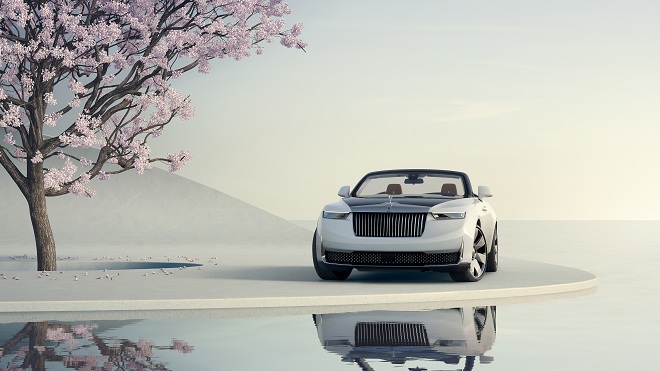
Rolls-Royce Unveils Arcadia Droptail

Rolls-Royce Motor Cars is delighted to present Rolls-Royce Arcadia Droptail, an exquisite coachbuilt expression of tranquillity. Arcadia Droptail is the epitome of quiet irreverence, celebrating purity of form and natural materials while serving as a bold statement of the client’s personal taste. Commissioned by an individual who possesses a distinct affinity for architecture and design, Arcadia Droptail is a testimony to the patron’s sensibilities and personal codes of luxury, defined by purity and subtle restraint, reflecting their firm belief in distilling complexity to reveal the inherent, fundamental essence.

This coachbuilt commission takes its name from the mythical realm of Arcadia, a place depicted in Ancient Greek mythology as ‘Heaven on Earth’ – a land renowned for its extraordinary natural beauty and perfect harmony. Like the haven that inspires its name, Arcadia Droptail was envisioned by the client as a serene space characterised by reduction, material depth and tactility that would serve as a refuge from the complexities of their business life.

In capturing the theme of tranquillity, Coachbuild designers embarked on an exploration of design, sculpture and architecture from the client’s favourite regions around the world. This included the precision and richness of modernist tropical sky gardens seen in Singapore, Indonesia and Vietnam as well as British ‘Biomimetic’ architecture, where organic forms and material honesty are celebrated.

In addition to these references, the client was also inspired by the motor car itself and the purity of the Droptail design concept. The commissioning client insisted that their Coachbuild motor car should be absolutely faithful to the earliest hand-drawn sketch they were first presented with in 2019.

It was the profile of this highly contemporary projection of the roadster body type that resonated so strongly with the commissioning client. They were particularly compelled by the motor car’s bold, low stance, ensconcing cabin design and dramatic body lines. They also immediately recognised the nautical inspiration behind Droptail’s ‘sail cowls’: named after their resemblance to a yacht’s jib, these sharp, angular forms rise behind the doors and curve gently inwards, subtly directing the eye to the motor car’s occupants.

EXTERIOR: A TRIBUTE TO DROPTAIL
In order to fulfil the client’s ambition to honour Droptail’s form, Rolls-Royce Coachbuild designers developed a calm, natural duotone colourway for the motor car’s coachwork. The client’s aspiration was to define a timeless white, appearing as a solid colour at first glance, but creating a level of intrigue upon further study under natural light. To achieve this, the main body colour is a solid white infused with aluminium and glass particles. This not only creates an effervescent shimmer when the light strikes the coachwork but, upon close inspection, creates the illusion of unending depth in the paint. Rolls-Royce specialists developed a more faceted, striking metallic using larger sizing of aluminium particles. The client was very particular and involved in their request for the Bespoke silver to contrast against the white, not only in colour, but also in terms of intensity.

In a key departure from the other three coachbuilt Droptails in this series, the carbon fibre used to construct the lower sections of Droptail is painted in the solid Bespoke silver colour rather than left fully or partially exposed, visually ‘lifting’ the motor car in profile to intensify its lithe, dynamic intent.

In tribute to the brilliant mirror finish of brightwork on historical Rolls-Royces, which particularly fascinate the client, the exterior grille surround, ‘kinked’ vane pieces and 22-inch alloy wheels have been fully mirror-polished.

While Arcadia Droptail’s exterior palette is rich in subtle detail, its primary intention is to celebrate the form and proportions of the coachwork. The client was particularly compelled by Droptail’s clean, monolithic surfacing and bold use of negative sculpture – features that are amplified by the motor car’s muted paint colours, which reflect sunlight and cast dramatic shadows, highlighting Droptail’s many subtle design gestures.

INTERIOR: THE CENTRALITY OF WOOD
As the exterior of Rolls-Royce Arcadia Droptail celebrates the motor car’s form, the interior is a deeply personal reflection of the client’s individual aesthetic, reflective of the style they have curated in their residences and business spaces around the world. Arcadia Droptail’s colour palette and material treatment was envisioned to be a truly personal statement and instantly recognisable as a personal signature of the commissioning client.

Wood development was central to Arcadia Droptail’s interior and the client’s focus, whose very specific expectations concentrated on the texture, grain, colour and richness of the material itself. The client shared many examples of preferences and inspiration from architecture, residences and classic cars, to guide Rolls-Royce Coachbuild designers and material specialists.

Santos Straight Grain was eventually selected as the most modern statement, based upon its rich texture and visual intrigue, which is derived from its unique, interlocking grain pattern.

Using this high-density hardwood on Droptail’s interior posed a significant challenge for the marque’s craftspeople. Santos Straight Grain has one of the finest grain types of all the wood species used within a Rolls-Royce – if not handled with the greatest care, it easily tears when machined and ‘checks’ (a crack that appears parallel to the grain) during the drying process. Despite the challenges of working with this delicate material, Santos Straight Grain is used throughout Droptail, including the aerodynamically functional rear deck section, where the grain of the open pore veneer is laid at a perfect 55° angle. To achieve a perfect composition over complex geometry, Rolls-Royce artisans used a total of 233 wood pieces throughout Arcadia Droptail, with 76 pieces applied to the rear deck alone.

Given that Arcadia Droptail will be used internationally, including some tropical climates, specific attention was paid to developing a protection system and testing process for the exterior wood surfaces. Coatings used on superyachts were initially considered but rejected given that they require regular servicing and re-application. Instead, a Bespoke lacquer was developed that requires just one application for the lifetime of the motor car.

To validate this coating, Rolls-Royce specialists conceived a unique testing protocol wherein veneer pieces were subject to a punishing cycle inside a specialist machine simulating global weather extremes. This involved spraying sample wood pieces with water intermittently, between periods of leaving them to dry in darkness and exposing them to heat and bright light.

This was repeated for 1,000 hours on 18 different samples before the marque’s specialists were satisfied with the endurance of the pieces. In total, the wood pieces and protective coating required more than 8,000 hours of development.

INTERIOR: A STUDY IN WHITE
The leather interior is finished in two entirely Bespoke hues, named after the client and reserved exclusively for their use. The main leather colour is a Bespoke White hue, continuing the exterior paint theme, while the contrast leather is a Bespoke tan colour, developed to perfectly complement the selected wood.

The interior also includes the exquisite shawl panel that unites all four Droptail motor cars and is the largest continuous wood section ever seen on a Rolls-Royce motor car. In Arcadia Droptail, it is made in the same Santos Straight Grain open pore veneer as the rear deck, book-matched at the same 55° angle, with individually shaped leave stripes running seamlessly into the door linings. CAD tools were used to map the placement of each wood piece, and although it appears to be constructed from just two mirrored sections of veneer, this panel alone is made up of 40 sections, each digitally mapped before being fixed to the motor car.

Applying wood to the complex curvatures of Droptail’s interior required Rolls-Royce engineers to develop an entirely new substructure for several components. The dramatic geometry of the dashboard, door linings and central cantilevered ‘plinth’ armrest had to be incredibly rigid to ensure the stability of the wood pieces once they were laid in place. Engineers called on carbon fibre layering techniques used in Formula 1 motor racing to develop an incredibly stiff base onto which the wood could be applied, ensuring that it remained secure regardless of the dynamic extremes the motor car experienced.

BESPOKE TIMEPIECE: A PRECISION INSTRUMENT
The Santos Straight Grain veneer fascia incorporates a clock conceived and developed by Rolls-Royce Coachbuild designers and craftspeople. This expression of haute horlogerie is the most complex Rolls-Royce clock face ever created: the assembly alone was a five-month process, which was preceded by more than two years of development.

The clock incorporates an exquisite geometric guilloché pattern in raw metal with 119 facets. This is a symbolic nod to the marque’s heritage; as the client first saw a preview of the motor car in late 2023 – the year when Rolls-Royce celebrated its 119-year anniversary. The specially designed clock face also includes partly polished, partly brushed hands and 12 ‘chaplets’ – or hour markers – each just 0.1mm thick. To ensure the readability of the timepiece, specialists gave each chaplet an infill bridge and painted them by hand using a camera capable of magnifying an image by up to 100x.

While many haute horlogerie methods were used to develop the timepiece, the testing and validation standards at Rolls-Royce are higher than those of the watch world. This required the marque’s specialists to draw on an expansive palette of materials. For example, instead of anodizing the timepiece’s minute marker, which is common practice in watch manufacturing, it is finished in a ceramic coating chosen because of its stability over time as well as its aesthetic merits. Small areas of the coating were laser-etched away to reveal the mirror finish of the aluminium material beneath it. Like every piece within the timepiece, including the Bespoke ‘double R’ monogram, they were individually machined from solid stainless-steel billet and polished by hand prior to assembly.

Themes from the clock are paired with the instrument dials, sharing materials, techniques and execution. They feature the same repeated guilloché pattern, as well as brushed and polished brightwork and frosted white inserts, recalling the colourway of the motor car.

STATEMENT OF A COSMOPOLITAN LIFESTYLE
Reflecting the patron’s international lifestyle, the motor car is specified with left-hand drive to facilitate its use around the world. This international dimension was so important to the commissioning client that the Coachbuild Collective wanted them to experience the motor car in multiple locations around the world before it was built. Coachbuild designers used the marque’s ‘holodeck’ to facilitate this – a unique virtual 3D environment in which the client uses an advanced virtual reality (VR) headset to view the motor car as it would appear in specific locations around the world.

ARCADIA DROPTAIL: AN ELEGANT SPACE IN THE DROPTAIL CANON
While every Rolls-Royce client is different, they each share a powerful strength of conviction, and this individual’s requirements were clearly stated from the outset. However, translating these complex, highly personal sensibilities into a coherent, workable design was the product of a significant body of work. It was here that the Coachbuild process, with its unprecedented investment of time – over four years in total – and uniquely close relationship between the client and the marque, paid incalculable dividends.

Coachbuild designers invested many months examining and interrogating the client’s tastes in everything from clothes and furnishings to food and travel destinations. From this, they defined and codified an aesthetic rooted in the client’s truth and experience; an objective portrait of their internal world and external surroundings, backed by the certainty and authority of the design team’s own discernment, understanding and professional judgment. Other family members, notably the client’s daughter, also become engaged with the process. When the final design was ready, the client’s wider family were invited to review it: all agreed that it perfectly captured the client’s aesthetic and character.

The client derived enormous pleasure from having their tastes and identity so clearly rationalised and projected back to them. Indeed, the process revealed the client had a far more modern outlook than they realised, defined by lightness, the use of natural materials and a clear passion for precision. Arcadia Droptail has since become a reference point for the client’s commissions from other luxury houses and architects.

This unique expression of Rolls-Royce Droptail reflects this remarkable client’s confidence, clarity of vision and long-term relationship with Rolls-Royce Motor Cars. Its significance lies both in its exquisitely minimal execution and the unique skill of Rolls-Royce Coachbuild designers in capturing the sensibilities and soul of an individual.