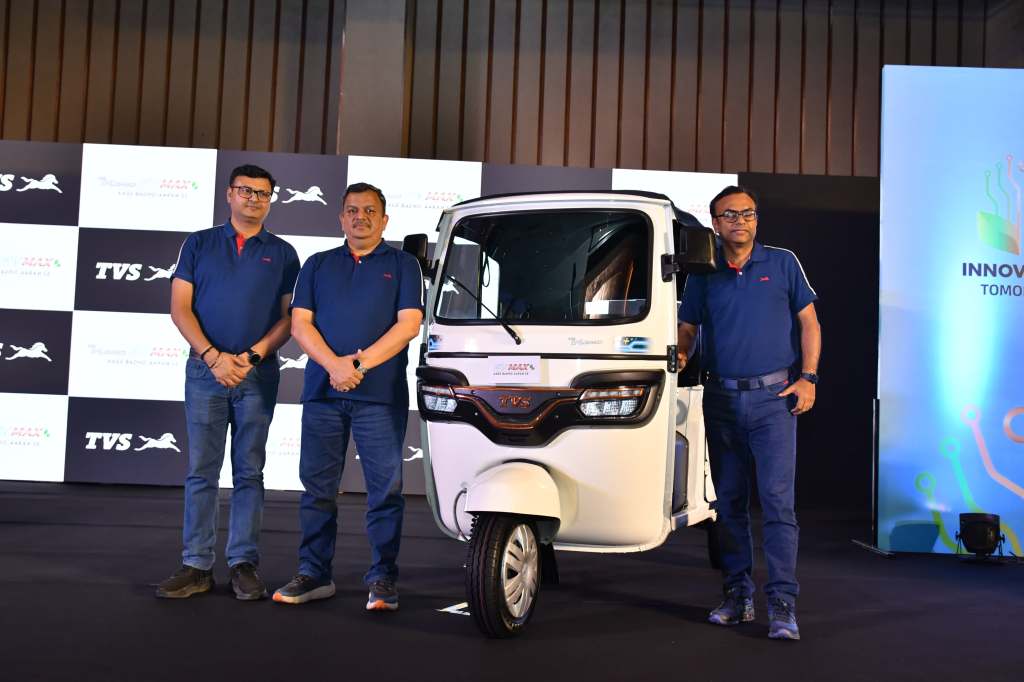
TVS Motor Company has announced the launch of its connected passenger electric three-wheeler, TVS King EV MAX. The vehicle has best-in-class features including bluetooth connectivity through TVS SmartXonnect. The TVS King EV MAX combines innovative technology with eco-friendly solutions, catering to the growing demand for sustainable urban mobility.
Speaking at the launch, Mr. Rajat Gupta, Business Head, Commercial Mobility, TVS Motor Company, said, “The launch of TVS King EV MAX is a significant step forward in our commitment to providing sustainable solutions for last-mile connectivity. As urban areas continue to grow, the demand for clean mobility options has never been more critical. The TVS King EV MAX combines advanced electric propulsion with superior comfort and connectivity. The distinctive blend of long-range, impressive acceleration and quick charging time guarantees high uptime, enabling more trips and increased earning potential for customers, including fleet operators. The vehicle is being launched in UP, Bihar, J&K, Delhi and West Bengal, right away. It will be available across the country in the coming months.”
With a range of 179 kilometres on a single charge, quick charging in just two hours and 15 minutes for 0 – 80% charge and 3.5 hours for 100% charge; smart features like TVS SmartXonnect, the King EV MAX offers users real-time navigation, alerts and vehicle diagnostics through their smartphones. It combines excellent performance, comfort and connectivity, making it a standout choice for modern urban mobility.
The TVS King EV MAX is powered by a high-performance 51.2V lithium-ion LFP battery enabling making it perfect for urban commuting. With a top speed of 60 kmph (ECO Mode: 40 kmph; City: 50 kmph; Power: 60 kmph), the vehicle ensures efficient travel while maximising passenger comfort through its spacious cabin and ergonomic seating design.
The TVS King EV MAX is now available across select dealerships in UP, Bihar, J&K, Delhi and West Bengal, at a price of INR 2,95,000 (ex-showroom). It also comes with a warranty of 6-years / 150,000 kilometres (whichever is earlier), along with 24/7 road-side-assistance for the first three years.
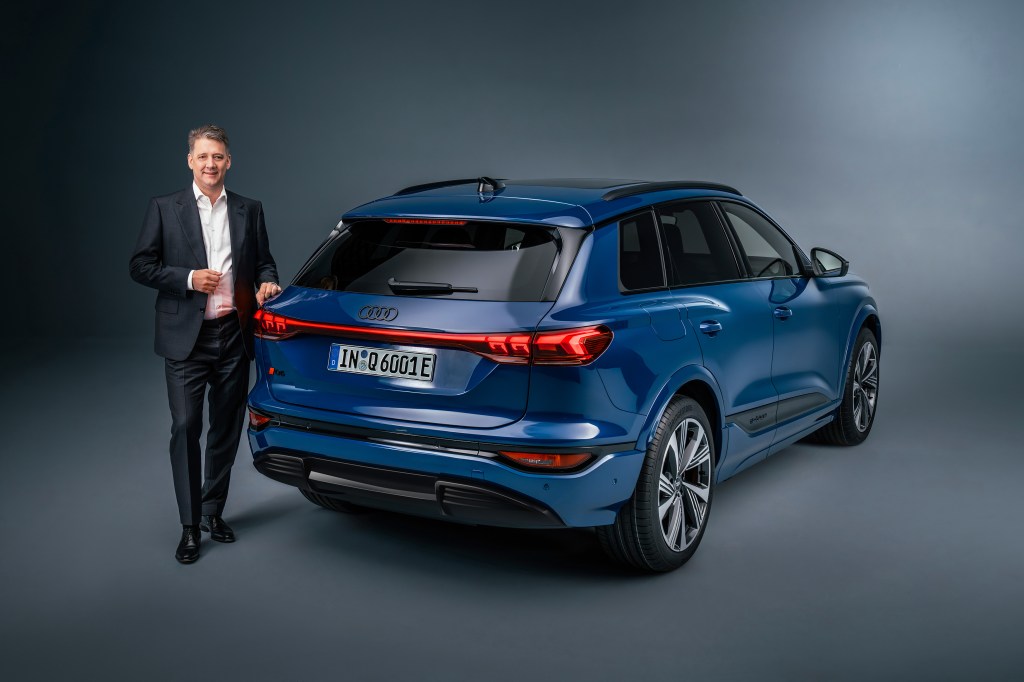
Audi CEO Gernot Döllner, the Premium Platform Electric and with it the Audi Q6 e-tron model series are the next technological leap towards electric premium quality.
Audi delivered around 1.7 million vehicles worldwide in 2024. More than 164,000 of those were fully electric models. Reasons for this overall decline of almost 12 percent (8 percent for fully electric models) compared to the previous year included the challenging economic conditions, an intensely competitive market, and limited availability of parts. In addition, the new product portfolio is only gradually having an impact on global sales volumes.
“We have a clear vision of how we are redefining Vorsprung durch Technik. Our ongoing model initiative shows the direction Audi is taking. The year 2024 was part of a transitional phase as we move towards our new product portfolio,” says Audi CEO Gernot Döllner. “Global economic uncertainties and intensified competition also shaped the past year. Despite these challenges, we are convinced that we will achieve our long-term goals. With a clear product and technology road map, Audi is systematically rejuvenating its product portfolio with over 20 new models in 2024 and 2025.” Last year, Audi already presented more than half of these, including the new battery-electric vehicles Audi Q6 e-tron and Audi A6 e-tron, plus combustion-engine vehicles such as the Audi A5 and Audi Q5. “In 2025, we will continue our model initiative and renew key model families such as the Audi A7 and the Audi Q3. Customers can look forward to numerous new plug-in hybrids as well.”
After a record year in 2023, geopolitical and industrial conditions impacted delivery figures in 2024. A general economic environment characterized by stagnation and structural problems as well as a tense political situation posed major challenges for the entire automotive industry and influenced consumer behaviour on an international scale.
“From the beginning, 2024 was considered a transitional year. We have strong models entering the markets, but they will only gradually become significant in terms of sales volume. At the same time, some models have been phased out. Challenging economic conditions and the intransparency in terms of government incentive structures are currently causing a certain reluctance to buy affecting the entire industry, especially when it comes to fully electric vehicles,” says Marco Schubert, Board Member for Sales and Marketing.
“With our three-pronged approach of electric cars, plug-in hybrids, and combustion-engine vehicles, we are positioned flexibly and robustly for the coming years and offer our customers a diverse range of premium vehicles. With our clear strategy and the strong commitment of our retail partners and international teams, we are setting ourselves up for the future.”
Sales performance in Europe, North America, and China Audi delivered more than 164,000 fully electric models to customers worldwide (–8 percent) in 2024. Demand was notably strong for the Audi Q4 e-tron, with almost 108,000 units delivered globally. Since its market launch in the third quarter, the new Audi Q6 e-tron recorded almost 15,000 deliveries.
In addition to the all-electric models, the Audi Q5 (298,000 units), the Audi A6 (244,000 units), and the Audi Q3 (215,000 units) sold particularly well.
Audi Sport delivered more than 41,000 high-performance vehicles worldwide, a decrease of roughly 14 percent. In the USA, Audi Sport models recorded over 9,000 deliveries – their best result ever (+4 percent).
With around 466,000 vehicles, the number of deliveries in Europe (excluding Germany) was almost 6 percent below the previous year. The number of electric vehicles was just below 81,000 units (+6 percent). The most popular models in Europe were the Audi A3 (84,000 units), Audi Q3 (79,000 units), and Audi Q4 e-tron (57,000 units).
In Germany, Audi delivered over 198,000 cars (–21 percent). This figure includes roughly 22,000 fully electric vehicles (–33 percent).
In the UK, the number of deliveries was around 123,000 units (–11 percent), in France around 48,000 units (–3 percent). For electrically powered models, Audi recorded an increase of 24 percent in France compared to 2023. Audi also showed a solid result in Italy, delivering more than 67,000 units (+1 percent), including roughly 3,000 electric vehicles (+7 percent). In Spain (incl. Canary Islands), Audi delivered over 39,000 units (–4 percent) to customers.
In North America, Audi sold just below 241,000 vehicles (–13 percent) in 2024 – almost 29,000 of those were fully electric (–6 percent).
In the intensely competitive market of China, Audi delivered a total of more than 649,000 cars to customers. This represents a decline of around 11 percent compared to the previous year.
In the overseas and emerging markets, Audi delivered over 116,000 vehicles (–18 percent) in 2024.
Kia India has achieved a historic milestone by delivering 255,038 vehicles in 2024. This marks a 6% increase over the 240,919 units delivered in 2023, making it the highest-ever delivery performance in the company’s history.
Throughout the year, Kia India focused on strengthening its presence across Tier-I and Tier- II cities, reflecting its commitment to reaching new customers in every corner of the country. In 2024, the company opened 126 new dealerships and 36 Certified Pre-Owned (CPO) outlets, expanding its network to 700 touchpoints across 301 cities nationwide.
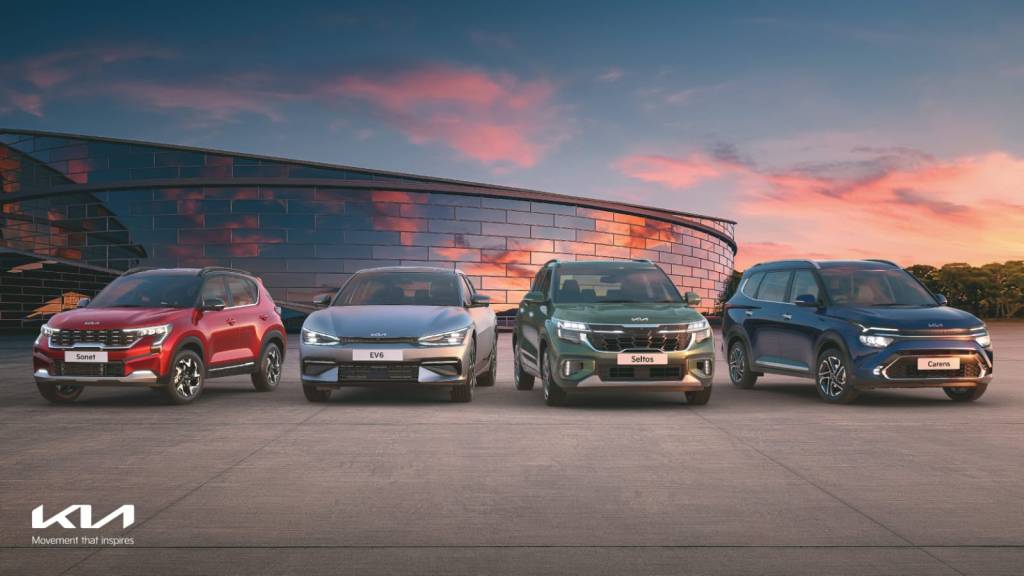
The Kia Sonet was a key driver of this success, with the delivery of 102,337 units, solidifying its leadership in the highly competitive sub-compact SUV segment. The Sonet’s continued popularity was complemented by strong performances from the Seltos and Carens, further bolstering Kia India’s position in the market. Additionally, the brand set a new benchmark by delivering over 563 units of the luxurious Carnival Limousine within just two months of its launch.
Kia India’s international reach also grew, with exports totaling 25,404 units in 2024, underscoring the increasing global appeal of its vehicles.
Commenting on this landmark achievement, Mr. Hardeep Singh Brar, Senior Vice President and Head of Sales and Marketing at Kia India, said, “2024 has been a defining one for Kia India. Our focus on ensuring the timely delivery of our vehicles has not only allowed customers to enjoy their favorite Kia models but also strengthened our foundation for future growth. Expanding our touchpoints across the country is not just a strategy for immediate gains—it’s a long-term investment in building customer trust and expanding our reach. As we move into 2025, we are excited about the upcoming launch of the Syros, which promises to redefine the Indian automotive landscape. With this, we will set new industry benchmarks and reinforce our leadership position in the market.”
Volvo Cars set a new global sales record as the company reports full-year sales of 763,389 cars during 2024, an increase of 8 per cent compared with the full year of 2023. For the month of December, Volvo Cars sold 73,804 cars globally, a decrease of 3 per cent compared to December 2023.
Volvo Cars also saw a significant increase in sales of its electrified cars. For the full year 2024, Volvo Cars sold 175,194 fully electric cars, an increase of 54 per cent compared with 2023, and 177,593 plug-in hybrid cars, a 16 per cent increase compared with 2023. Sales of electrified models accounted for 46 per cent of all Volvo cars sold globally during 2024. Sales of fully electric cars accounted for 23 per cent of all Volvo cars sold globally during 2024, compared with 16 per cent in 2023.
European sales reached 369,685 cars during 2024, an increase of 25 per cent compared with 2023. Volvo Cars’ line-up of electrified models – fully electric and plug-in hybrid cars – accounted for 65 per cent of all the cars sold in the region last year.
Volvo Cars’ US sales for 2024 amounted to 125,243 cars, down 3 per cent compared to the full year of 2023. The number of electrified models sold increased by 20 per cent and accounted for 34 per cent of all cars sold in the US during the year.
Sales in China decreased 8 per cent compared to 2023, resulting in 156,370 sold cars during 2024. Overall, sales of electrified models grew 3 per cent during the January-to-December period.
For 2024, the Volvo XC60 was the top-selling model with sales of 230,853 cars (2023: 228,646), followed by the XC40/EX40 with total sales of 173,890 cars (2023: 200,670) and the XC90 at 108,621 cars (2023: 107,549).
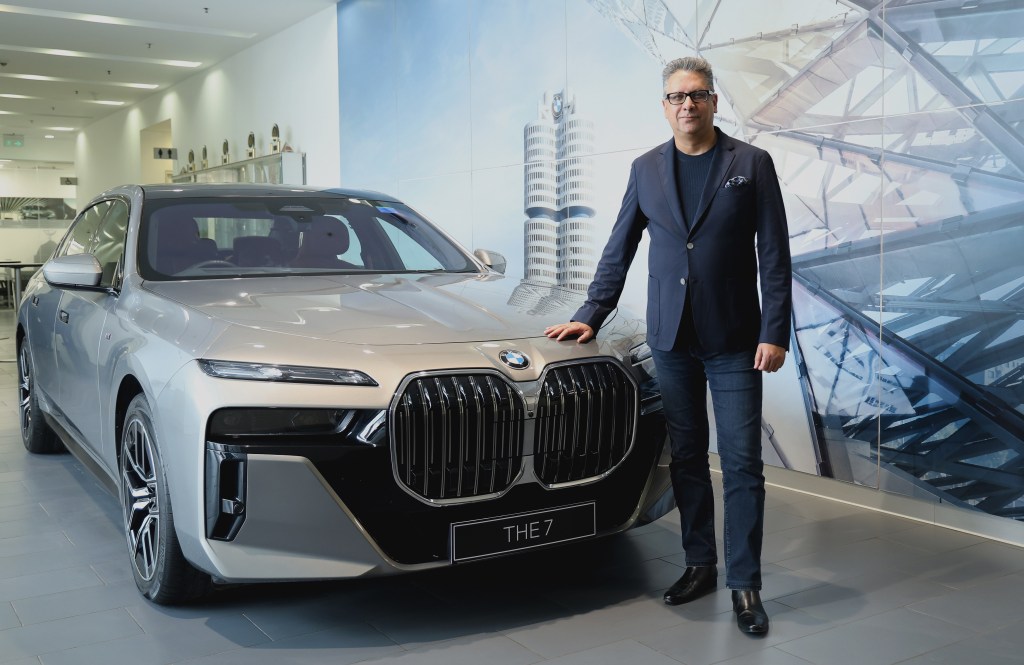
Writing a new chapter of success, BMW Group India has achieved its best-ever annual car deliveries with 11% growth. The company delivered 15,721 cars (BMW and MINI) and 8,301 motorcycles (BMW Motorrad) between January – December 2024. BMW sold 15,012 units and MINI 709 units.
BMW sales clocked the highest Q4 (4,958 units | +15%) and highest December sales as well (2,244 units | +17%).
Mr. Vikram Pawah, President and CEO, BMW Group India said, “Posting the highest-ever car sales in India, BMW Group India has also crossed a milestone of 15,000 cars. We had the strongest product offensive in the luxury car segment, paired with the introduction of new initiatives like Retail.NEXT and expansion of bespoke experiences and services for our customers. BMW is leading significantly across segments in the Indian luxury car market including sustainable electric mobility, Luxury Class and aspirational premium compact segment. This tremendous success is driven by our resolute focus on creating customer delight. Together with our dedicated team of dealer partners, we are committed to achieving new benchmarks in luxury mobility.”
BMW Luxury Class (BMW 7 Series, BMW i7, BMW X7 and BMW XM)
2024 recorded the highest ever sales of BMW Luxury Class in India (2,507 units | +8%). BMW Luxury Class is the flagship range and the ultimate mark of exclusivity for Indian customers. Nearly every fifth car that BMW sold in India in 2024 was a top-of-the-range model. In 2024, BMW X7 was one again the highest-selling Luxury Class model (1,570 units | +4%). Since its launch, more than 5,000 units of the BMW X7 have been delivered in India. The BMW 7 Series leads the epitome of luxury in its segment (865 units | +15%).
BMW Group Electric Vehicles (EV)
BMW Group India upheld its top position in the electric mobility space for the third consecutive year. Thanks to the widest and most attractive range of electric vehicles in luxury segment, complimented by a strong charging network and host of new services, BMW Group India remains the most desirable choice for luxury EVs. In 2024, 1,249 units of fully electric BMW and MINI cars were delivered. i7 was the largest selling EV in its class with 384 units.
BMW Group India also crossed 3,000 EV deliveries till date, becoming the first luxury car manufacturer in the country to reach this milestone. BMW iX is the most popular luxury EV in India with over 1,100 units sold till date. BMW Group India offers six electric cars and two electric scooters in India – BMW i7, BMW iX, BMW i5, BMW i4, BMW iX1, MINI Countryman Electric, BMW CE 04 and BMW CE 02.
BMW Sports Activity Vehicles
BMW Sports Activity Vehicles (SAV) contributed 56% to sales with 8,351 units. Deliveries of SAVs rose by +16%, as they offer unparalleled dynamism, space and comfort for an active lifestyle and the ability to dominate any kind of road. BMW X5 posted its highest annual sales till date (2,056 units | +89%). BMW X1 was the most popular SAV with over 20% share in sales and also the highest selling car in Indian premium compact SAV segment.
BMW Long Wheelbase Range
The highly successful long wheelbase range of BMW India was in tremendous demand in 2024. BMW offers the largest portfolio of long wheelbase models in the luxury segment including the BMW 7 Series, BMW 5 Series and BMW 3 Series. These models are a prime choice as they bring the highest degree of luxury, space, comfort and performance and are perfectly suited for different requirements. The BMW 3 Series was the highest selling sedan with 20% share in sales and also a class-leader in its segment. The all-new BMW 5 Series Long Wheelbase, the most aspirational business sedan in India, garnered over 1,000 deliveries in less than six months of launch.
BMW M
2024 was a big year for BMW M in India with eight new launches including seven M cars and one M motorcycle. M cars deliveries increased to 875 units. BMW M340i was the highest selling M model. Since its introduction, more than 1,000 BMW M340i have been sold in India. The engineering brilliance of BMW M represents precision, agility, and the exhilarating thrill of high-performance driving.
MINI
MINI delivered 709 units in 2024. The MINI 3-Door Cooper S posted its highest-ever sales at 250 units with +77% growth.
BMW Motorrad
BMW Motorrad delivered 8,301 motorcycles in 2024. BMW Motorrad registered the highest-ever half-yearly sales (July – December) (4687 units | +14%). At 1,041 units, the brand also achieved best-ever annual sales of its completely built-up bike portfolio.
BMW and MINI 360°
Customers enjoy great value proposition and complete peace of mind with the 360⁰ finance plan from BMW India Financial Services which offers attractive low monthly instalments, assured buy-back, flexible end of term options and an opportunity to upgrade to a new car amongst other benefits. 1 out of 4 cars financed by BMW India Financial Services is through BMW and MINI 360⁰.
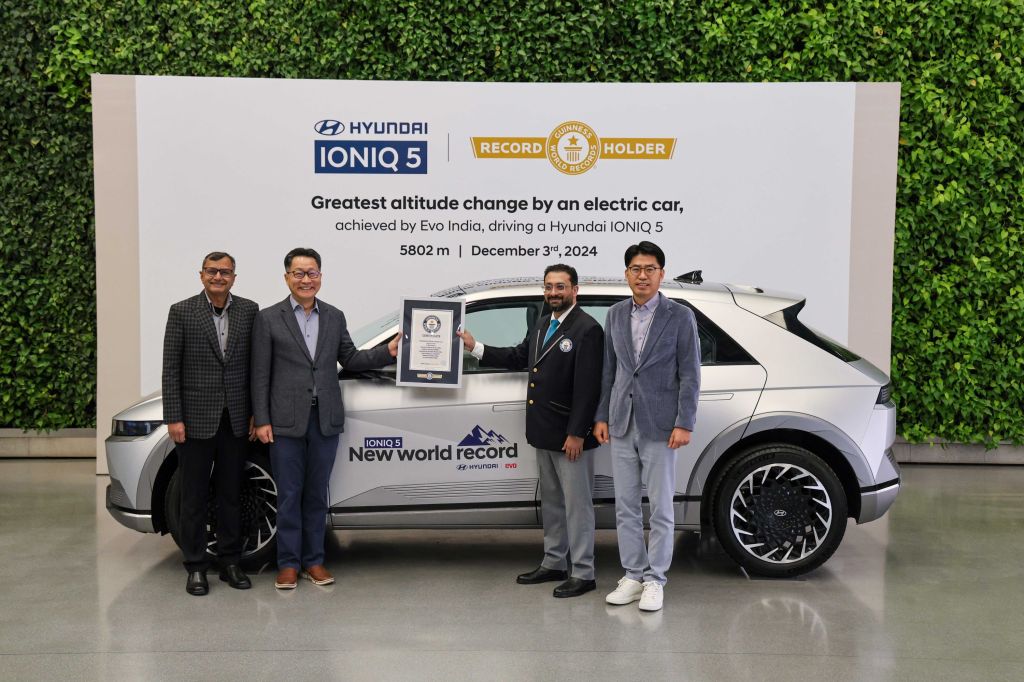
Hyundai Motor India Limited (HMIL), is proud to announce that its flagship electric SUV, the Hyundai IONIQ 5, took part in a prestigious Guinness World Records title attempt for the Greatest altitude change by an electric car. Driven by the professional team from Evo India, the Hyundai IONIQ 5 set a remarkable record by registering an altitude change of 5802 metres—from India’s highest drivable point, Umling La in Leh Ladakh, located 5799m (19,024 feet) above sea level, to Kuttanad in Kerala, situated 3 metres below sea level.
The extraordinary feat was accomplished in just 14 days, covering an extensive distance of over 4900 kilometres across challenging terrains and extreme climatic conditions, truly demonstrating the Hyundai IONIQ 5’s resilience, advanced technology, and superior performance. Throughout the journey, the Hyundai IONIQ 5 reaffirmed its position as a benchmark in electric mobility, seamlessly navigating harsh environments, from freezing temperatures and steep mountain passes in the Himalayas to humid coastal regions in Kerala.
Speaking on the achievement, Mr. Unsoo Kim, Managing Director, Hyundai Motor India Limitedsaid, “We are incredibly proud to see the Hyundai IONIQ 5 create history by achieving the Guinness World Record for the highest altitude change by an electric car. This achievement is a testament to Hyundai’s unwavering commitment to innovation, technological excellence, and sustainability. The IONIQ 5’s performance in such extreme conditions reflects its engineering prowess and durability. At Hyundai, we are dedicated to pushing boundaries and setting new benchmarks in e-mobility, and this record further reinforces our vision of ‘Progress for Humanity.”
The Hyundai IONIQ 5, developed on the state-of-the-art Electric-Global Modular Platform (E-GMP), has been designed to redefine smart mobility experiences. It features a futuristic and progressive design inspired by Hyundai’s iconic PONY, a revolutionary step towards a new era of electric mobility. Equipped with a high-capacity 72.6 kWh battery, the Hyundai IONIQ 5 delivers exceptional driving range, advanced safety, and cutting-edge smart technologies, offering customers an exhilarating and versatile e-mobility experience.
The Hyundai IONIQ 5 has once again proven its capabilities, setting a new standard in the electric vehicle segment while offering an unmatched combination of performance, safety, technology, and design. Hyundai Motor India remains committed to delivering advanced mobility solutions and shaping a sustainable future for all.
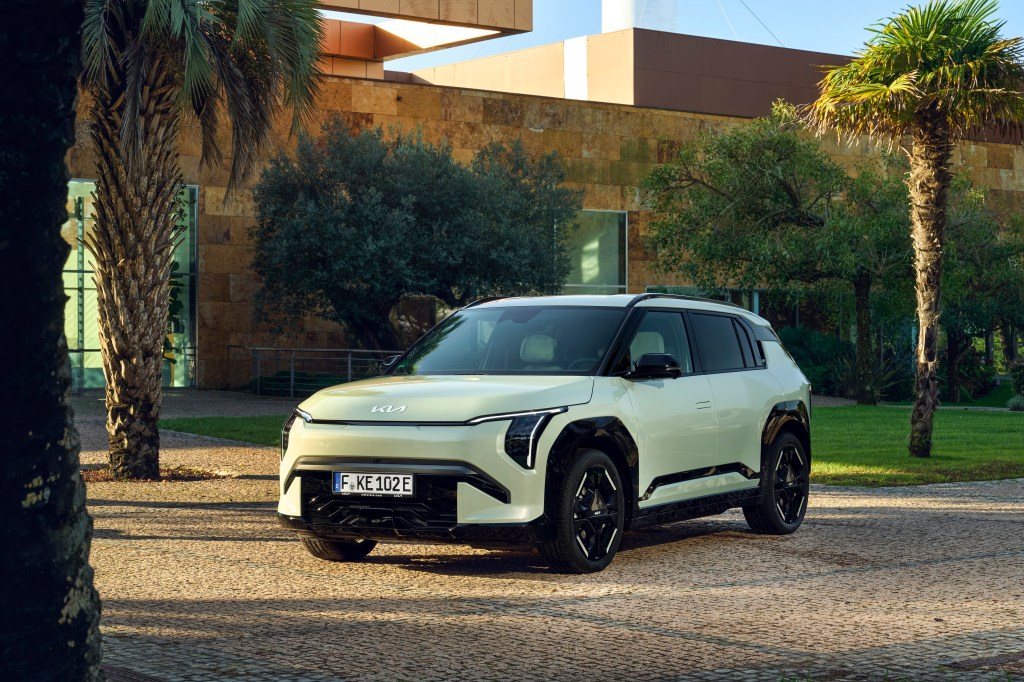
The Kia EV3 has arrived to redefine the compact electric SUV market, with a segment-leading range of up to 375 miles on a single charge and an innovative interior design that optimises space, comfort and accessibility. Kia’s first dedicated electric compact SUV is ready for all European journeys and lifestyles, and sets a new benchmark for design, efficiency and performance in a high-demand market segment.
The Kia EV3 leverages the premium-level technologies of the EV6 and EV9, both multi-award-winning vehicles, in a compact, efficient, spacious, and comfortable car. The EV3 can adapt to every lifestyle and has the flexibility and affordability to be the main car of the household. Following extensive testing in Europe in all driving conditions, the model is proven to perform equally well on highways, city streets, winding roads, and long journeys. This testing also included validation of range and charging, with the EV3 confirmed as one of the most efficient EVs on the market.
“The Kia EV3 is an amazingly versatile vehicle, built and designed to accommodate the diverse needs and distinctive lifestyles of customers across Europe,” said Marc Hedrich, President & CEO of Kia Europe. “It also shows how a high-volume EV can be part of a broad ecosystem that includes in-car payments, over-the-air updates, bi-directional charging, digital upgrades and much more, to make driving more convenient than ever before.”
Built on Kia’s dedicated EV architecture, the Electric-Global Modular Platform (E-GMP), the EV3 is designed to prioritise the driving and ownership experience while making EVs available to a wider range of customers. It is part of Kia’s strategy to have 11 electric vehicles on the market by 2026, expanding to 15 models by 2027, with a fully electric product line-up in Europe by 2035.
The 375-mile range of the EV3 goes up to 479 miles when the vehicle is used purely in city driving situations. This is supported by i-Pedal technology and a Regenerative Braking System that offers the driver more flexibility and control by separating the level of regenerative braking from the full stopping control function. Full one-pedal driving can be used in all regenerative braking modes, as well as in reverse. The system also remembers the previously selected level when the vehicle is turned off, and automatically applies it when the vehicle is turned on again.
The efficiency and performance of the EV3 is aided by active air flap technology and a boat-tail shape, to improve aerodynamics. The drag coefficient of just 0.263 helps to reduce power consumption and increase the range. Extensive wind tunnel testing enabled Kia engineers to hone the EV3’s aerodynamic performance, including optimising the wheel shapes and enhancing the rear combination lamps. There are also new side sill undercovers, along with eight parts covering the underbody, for cleaner underfloor airflow and reduced drag.
Also helping drivers extend the range is the Driving Range Guide. Located in the instrument cluster, it displays the maximum and minimum driving ranges achievable depending on driving style, and an estimated range based on past driving efficiency.
400V fast charging technology enables the EV3 to go from 10-to-80% in 29 minutes for the 58.3 kWh battery version, and 31 minutes for the 81.4 kWh version. Up to 125 miles of range can be added in just 15 minutes. A stable charging power profile, combined with excellent efficiency, makes the EV3 one of the leading EVs for mile-per-minute charging in its segment. Fully compatible with European charging infrastructure, the EV3 is supported by Kia Charge, the brand’s network that offers access to more than 800,000 charging points in 28 European countries.
Kia is one of the leading manufacturers to bring Vehicle-to-Load (V2L) charging to the compact EV SUV segment. This feature enables the car to power external devices and allows customers to maximise the EV3’s accessibility. Every EV3 is also capable of bi-directional charging, including Vehicle-to-Grid, Vehicle-to-Home, and Vehicle-to-Building, which will gradually be introduced across European markets.
The EV3 features the world’s first highly efficient and super-compact thin HVAC (heating, ventilation, and air-conditioning) system that delivers consistent cabin comfort in all weather conditions, maximising comfort, and minimising power usage, without compromising range. The cleverly packaged system gives front-seat passengers an extra six centimetres of room in the footwell when compared with a conventional HVAC system. The highly efficient thermal management system, now in its fourth generation, improves heat pump performance, simultaneously absorbing outside air heat and driving heat (from powertrain components, for instance).
The EV3’s driving dynamics have been developed and tuned to meet the high expectations of European customers in terms of ride, handling, and steering. Even before the first test car was assembled, the EV3 went through an extensive virtual development, with hundreds of different setups tested on an advanced dynamic driving simulator. The resulting optimal geometries and compliances were then released for Kia’s European engineers to fine-tune the vehicle on European roads. The steering has been also specifically tuned for European driving conditions, with a focus on precision and linearity, enabling the EV3 to easily handle suburban curvy roads, city streets and motorways.
The vehicle’s suite of Advanced Driver Assistance Systems, including Highway Driving Assist 2, Smart Cruise Control 2, and collision prevention systems, have also been extensively tested on European roads.
The EV3’s spacious interior provides a ‘living room’ feel, with an array of usability features designed to make every journey comfortable and convenient. The clean, uncluttered dashboard has a triple-screen panoramic display. This combines a 12.3-inch touchscreen navigation screen and a 12.3-inch driver display screen, sandwiching a 5.3-inch segment display for climate control. A 12.3-inch head-up display puts all the necessary information within the driver’s eye line. As in the EV9, the EV3 achieves an excellent balance between touch and tactile controls for interior functions that help to minimise driver distraction.
Debuting on the EV3 is Kia In-Car Payment expanding the capability of the vehicle for in-car payments. The first partnership available is with Parkopedia, which will help drivers locate available parking and pay for it through the vehicle’s navigation screen. In-Car Payment’s convenience for drivers is part of Kia’s commitment to enhancing the driving experience and improving customer satisfaction across all touchpoints of a journey.
The EV3 offers the future of connectivity with over-the-air updates, video streaming capability4, features on demand via the Kia Connect Store and a Digital Key 2.0 that enables up to 7 customers to unlock and start the vehicle using a smartphone or smartwatch. It is also the first Kia vehicle that will feature Kia’s AI Assistant with ChatGPT that helps enhance the customer’s understanding, knowledge, and enjoyment of the vehicle4.
The EV3 incorporates the brand’s ‘Opposites United’ design philosophy that harnesses the creative tension generated by the divergent values of nature and modernity to deliver a harmonious whole. Inside and out, the EV3 balances emotional and rational elements, representing the ‘Joy for Reason’ design pillar.
The unique interior ‘living space’ features relaxation seats, clever storage solutions, sliding tables, expansive head and legroom, intelligent mood lighting, and nature-inspired colours to enhance the well-being of drivers and passengers on every journey. The seats include mesh-like headrests on ‘GT-Line’ and ‘GT-Line S’ variants for better ventilation and comfort.
The EV3, among many innovations, includes a new optional limited edition trunk liner, featuring a geometric wave reminiscent of waves and trash flowing into a net. The accessory is made from recycled materials, 40% of it recycled ocean plastic from the Pacific Ocean collected as part of the cooperation with The Ocean Cleanup. The seven-year partnership aims to find innovative solutions and contribute to a cleaner, healthier planet, enabling the removal of almost half a million kilogrammes of plastic from the Great Pacific Garbage Patch. The trunk liner is the first application developed through this partnership.
In addition, every EV3 features Kia’s 10 ‘must-have’ sustainable material solutions, such as bioplastics, recycled PET fabrics, and BTX-free paint. As part of its long-term sustainability strategy, Kia is aiming to have 20% of the plastics used in its vehicles come from recycled sources by 2030.
The EV3 is now available in Europe, and is on sale in the UK. In future Kia plans to introduce an all-wheel drive (AWD) variant, expanding the range of choice for customers beyond the current two-wheel drive (2WD) models
SAIC Motor, a global Fortune 500 company with a presence in over 100 countries and JSW Group, a revered Indian corporate with varied business interests entered into a joint venture – JSW MG Motor India Pvt. Ltd. in 2023.
At the time of formation of the joint venture, JSW MG Motor India announced that their goal will be to build a smart and sustainable automotive ecosystem while continuing to stay focused on developing a diverse portfolio of vehicles to give car buyers better access to advanced technologies and futuristic products with attractive value propositions.
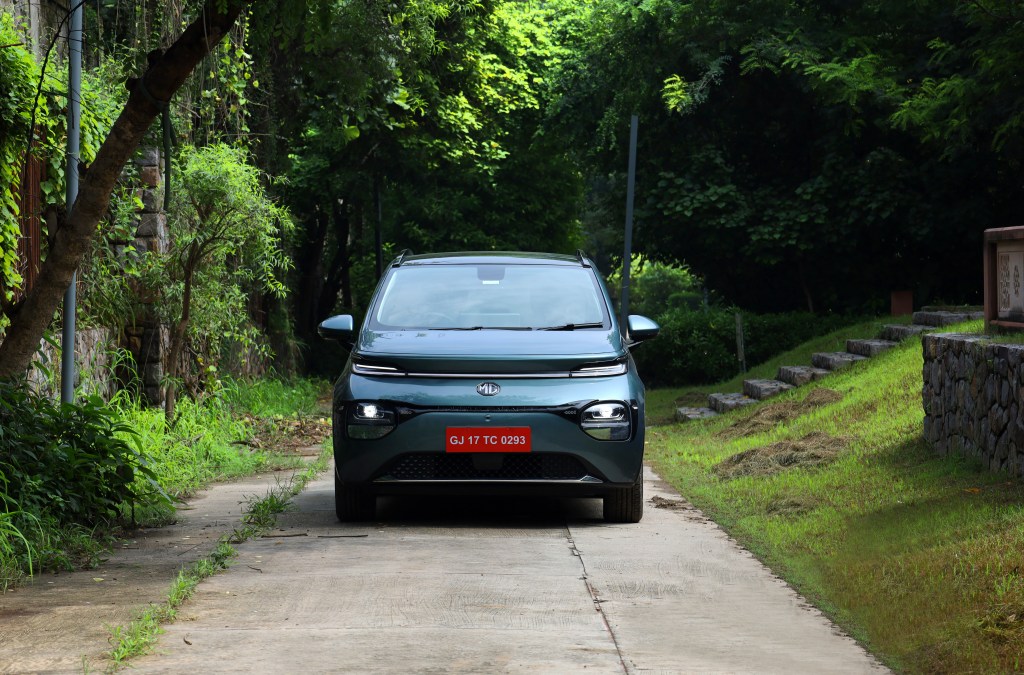
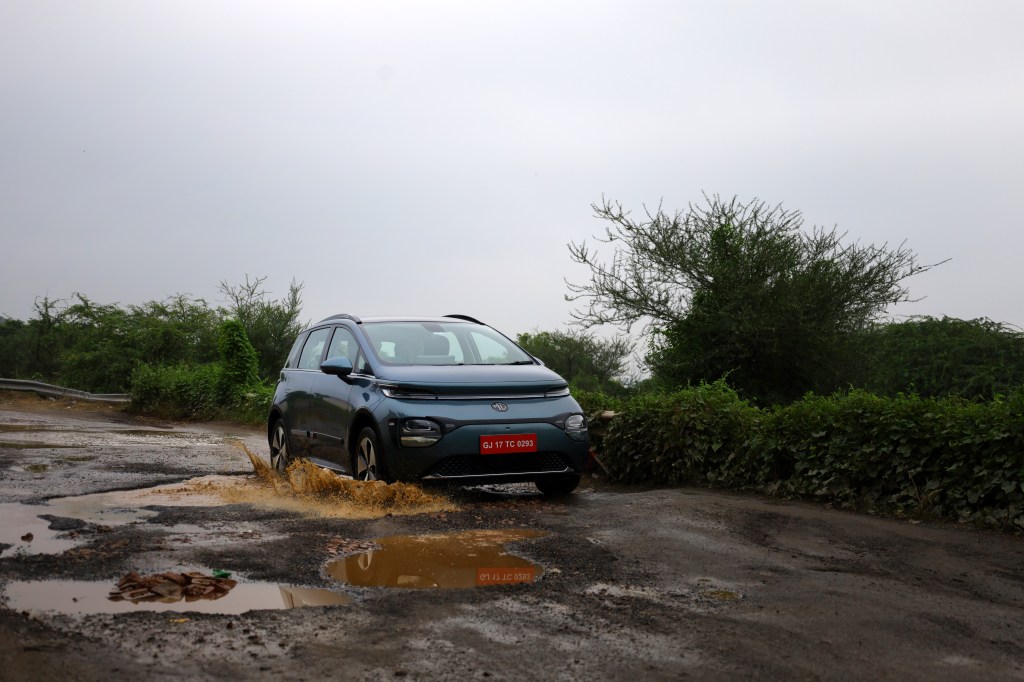
Fast forward to September 2024 and JSW MG Motor India has launched their first car since the formation of the JV – the MG Windsor EV. Launched at the price of a manual compact SUV, the Windsor, combining the comfort of a sedan and the expanse of an SUV, will be offered with innovative aerodynamic design, spacious and premium interiors, smart connectivity, driving comfort, and many hi-tech features.
Built on a ‘Pure EV Platform’ with BaaS – a unique ownership program, MG Windsor is being offered at an industry disrupting price of Rs 9.99 lakhs + Rs 3.5 per kilometre of battery usage – a path-breaking ownership concept introduced by a carmaker for the very first time in India.
And for the conventional purists who believe in the age-old concept of outright purchase, the Windsor comes at an unbeatable ex-showroom price of Rs. 13.49 lakhs for the base variant going upto Rs 15.49 lakhs for the top trim.
Recently, we were invited for the national media drive of the MG Windsor. Read on to find out all that you want to know about the newest kid in the block.
Design and Engineering
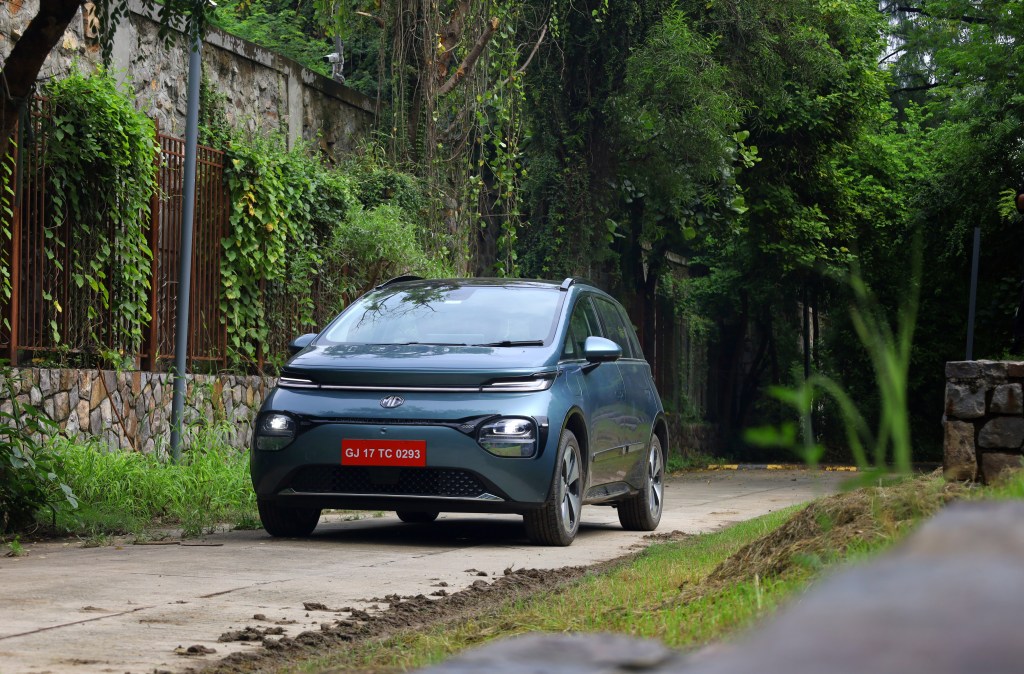
The MG Windsor is being positioned as a CUV or Crossover Utility Vehicle. It is an interesting cross between a sedan and a compact SUV. From the engineering standpoint, balancing and blending two different body styles isn’t an easy task, however, the designers at MG deserves a pat on their back for pulling it off well.
The MG Windsor measures 4,295mm in length, 2,126mm in width, and stands 1,677mm tall. The best-in-segment 2,700mm wheelbase ensures that the MG Windsor offers a great balance between ride & handling and comes with a specious passenger cabin.
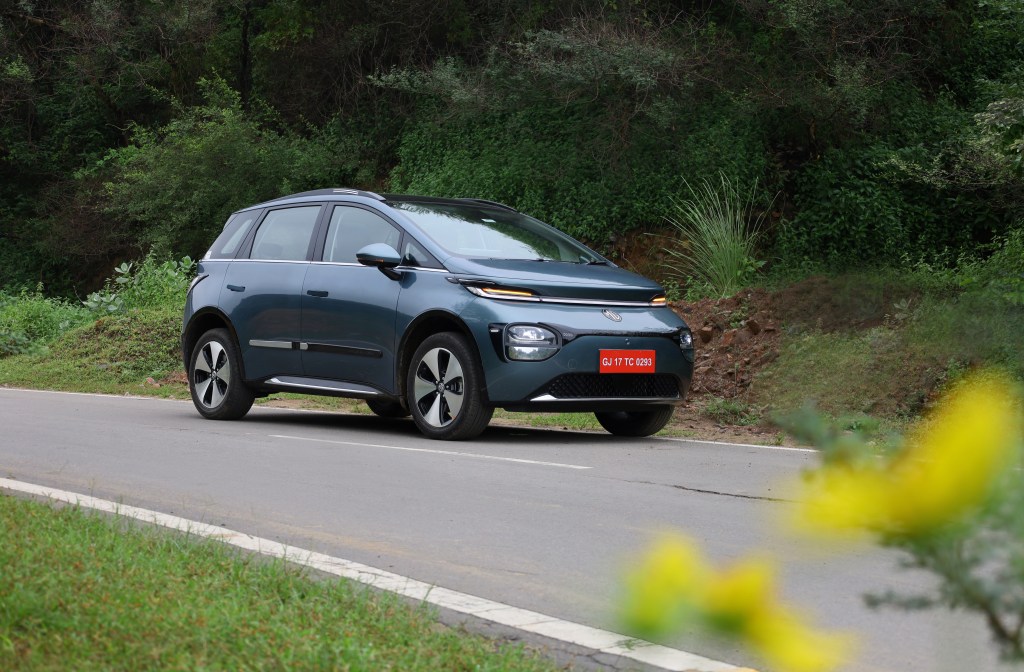
The MG Windsor features an AeroGlide design language, which is futuristic and transcends the concept of traditional segmentation. The nose and bonnet have a distinct two-deck layout. The horizontal daytime running lamps strip forms the base of the bonnet, while the headlights sit below in the bumper. Integrated into the headlight area is a mirror-like panel that reflects images with clarity. MG has added some black trim bits bracketing the headlights, with the one inside connecting the two units and carrying the Morris Garages lettering, above which sits an illuminated MG logo.
MG’s AeroGlide design language is more prominently visible when viewed from the side. The MG Windsor features smart flush door handles which look very trendy. The R18 diamond cut alloy wheels further enhances the striking good looks of the MG Windsor. At the top, the roof rails add to the aesthetics.
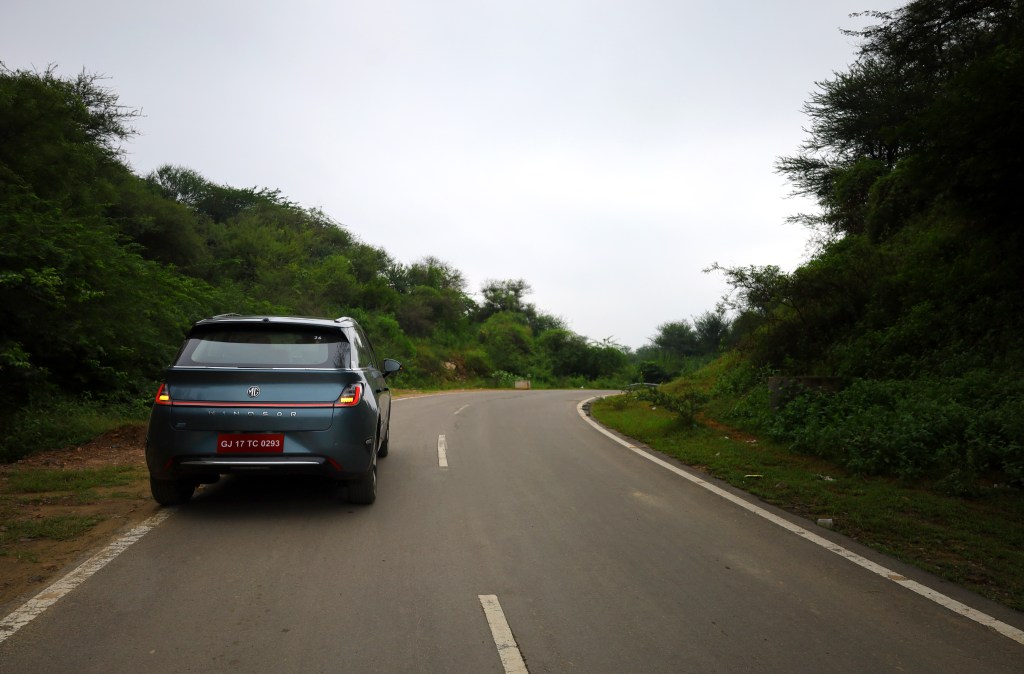
At the rear, the LED tail lights look sleek, and the lower bumper edge is finished off with a nice diffuser-style contrasting black panel. Topping the rear is a spoiler with an integrated stop light. Overall, the MG Windsor EV looks impressive and is sure to turn heads on the road.
The NVH levels are also well contained. The MG Windsor is being offered in three variants: base trim Excite, mid-level variant Exclusive, and top-of-the-line Essence; and four colours: Starburst Black, Pearl White, Clay Beige, and Turquoise Green.
Interior and Comfort
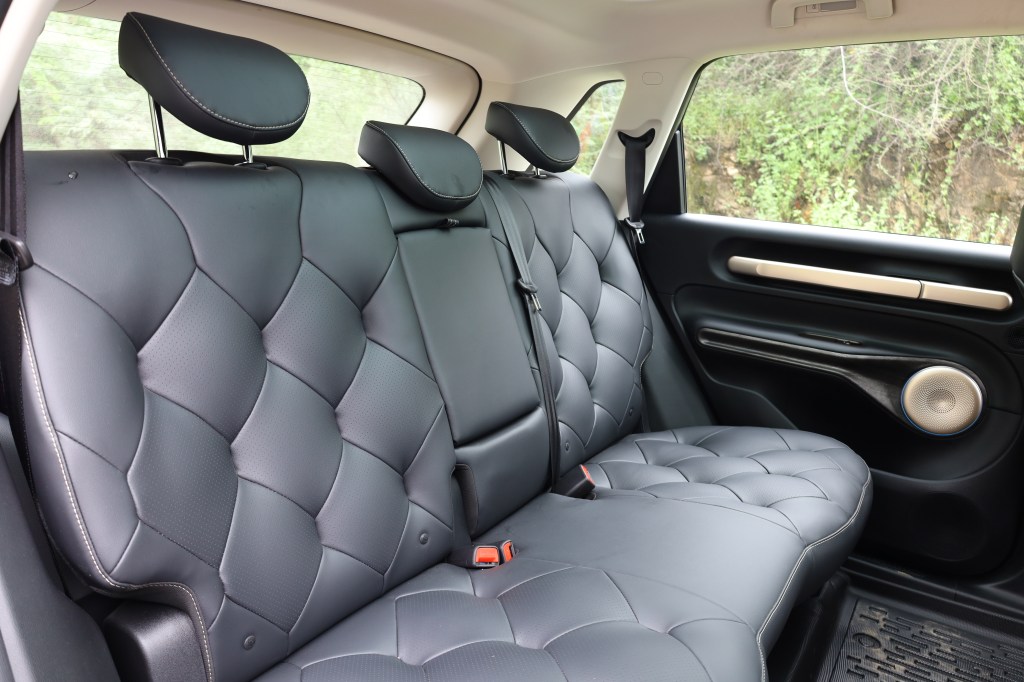
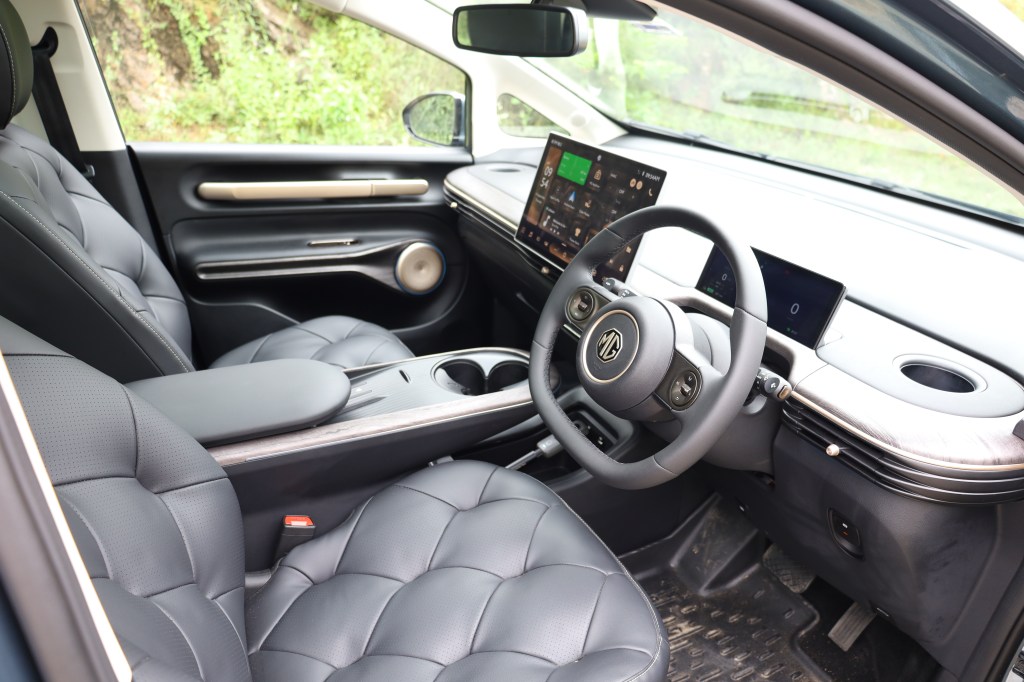
Step inside the MG Windsor EV and you will be welcomed into a premium passenger cabin with aero lounge seats that can be reclined upto 135 degrees, coupled with the expansive infinity view glass roof, adding to the business class experience.
The cabin is spacious with adequate head, shoulder and knee room for both front and rear passengers along with easy ingress and egress. The seats are well bolstered & comfortable and wear an opulent look. The front seats are ventilated with the driver’s seat coming with a 6-way adjustable option.
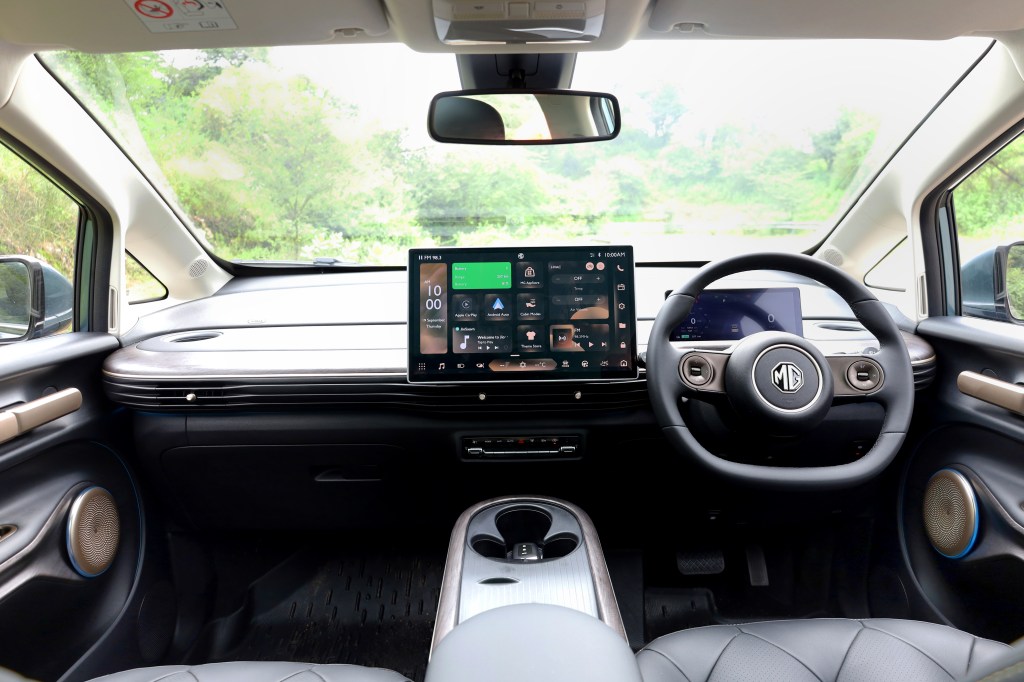
Immersive entertainment and smart connectivity features are powered by a massive 15.6-inch Grand View Touch Display in the central console. For music lovers, the MG Windsor also comes equipped with nine speakers (4 speakers, 4 tweeters, 1 subwoofer) that make your listening experience more pleasurable.
The MG Windsor also allows you to choose from an array of 256 ambient lighting options with auto change technology and make your drives express the way you feel. Other features in the MG Windsor includes Wireless Android Auto & Apple CarPlay, multi-function steering controls, wireless smartphone charger, wooden finish highlights, driver armrest storage, rear-centre armrest with cupholders, and 604 litres of boot space – all of which makes the MG Windsor an attractive proposition.
Performance and Handling
The MG Windsor comes equipped with the powerful PMS Motor which is IP67 certified. Impressive performance is derived through a 38 kWh Li-ion battery pack and four driving modes (Eco+, Eco, Normal and Sport) that deliver 100KW (136PS) power and 200Nm of instant torque, offering a range of 331 kilometres. The battery can be charged in 40 minutes at any DC fast charger. The prismatic cells battery meets the optimal safety standards and is certified to operate with durability and stability.
The throttle response in great with almost no power lag. Driving the Windsor both within the city or on the highway feels like a breeze. The MG Windsor stays firmly planted on the ground even while navigating tight corners. The engineers at MG has achieved a commendable balance between good ride and handling. The suspension set up featuring MacPherson strut in the front and torsion beam at the rear is well tuned for Indian road conditions and absorbs the undulation on the road with relative ease. On the whole, the MG Windsor promises to be a good city car while also proving its worthiness on the highway.
Safety
With growing awareness among consumers, safety has emerged as one of the top priorities of carmakers around the world. The MG Windsor comes with 6 airbags (dual front, side & curtain) as standard across all variants. It also features 360° surround view cameras and rear parking sensors to ease your parking woes in tight spaces especially in the crowded neighbourhood within the city. Electronic stability programme, electric parking brake auto hold, hill-start assist control, auto dimming inside rear view mirror, hill descent control, rain sensing wipers, and tyre pressure monitoring system are some of the other features in the MG Windsor EV which assures you of great all around safety.
Battery-as-a-Service (BaaS)
For the first time in India’s passenger vehicle segment, JSW MG Motor India is introducing an innovative ownership plan through Battery-as-a-Service (BaaS) offering, which makes owning an electric CUV at the price of a manual engine-based compact SUV possible. This flexible ownership program eliminates the upfront cost of the battery, enabling customers to pay only for its usage. Essentially, buyers pay a nominal fee per kilometre driven, which is 40% of the fuel costs of conventional vehicles. This model significantly reduces the initial acquisition cost and lowers the per-kilometre expense, ensuring an economical and hassle-free ownership experience.
In addition, the company is offering a first-of-its-kind lifetime battery warranty to the first owner of MG Windsor. With the eHUB by MG app, the company is offering one year of free public charging, making it easier than ever for Windsor owners to power up anytime, anywhere. JSW MG Motor India is also introducing its 3-60 assured buyback plan for the Windsor which ensures that it will retain 60% of its value after 3 years/45,000kms.
Verdict
The MG Windsor is the first car that has come out of the JV between JSW & MG Motor India. The whole team has worked very hard to bring this car to India. As a crossover utility vehicle, the Windsor successfully manages in merging the comfort of a sedan with the expanse of an SUV, making it an ideal car for the Indian household. With its delightful features and easy to drive dynamics, MG Windsor will certainly invite newer sets of customers to try EVs. It is an ideal vehicle for customers looking to beat the bustling urban roads and tighter spaces in smaller towns, in comfort and style. With its advanced features, innovative design, and disruptive pricing, the Windsor most definitely sets a new benchmark.
Nissan today announced it will launch affordable on-board bi-directional charging on selected electric vehicles from 2026. The initiative forms a key step towards its vision of creating a sustainable energy ecosystem.
The project progresses the commitment made in Nissan’s business plan, The Arc, delivering differentiated innovation that enables the EV transition, while unlocking new revenue streams. It also supports the company’s long-term vision, Ambition 2030, to create a cleaner, safer, and more inclusive world.
The Vehicle to Grid (V2G) technology, which allows EV owners to use electricity stored in their car’s battery to power their homes, or sell it back into the grid, will launch in the UK initially, followed by other markets in Europe.
The project is underpinned by Nissan’s extensive experience in V2G, with around 40 pilot projects conducted worldwide throughout the past decade.
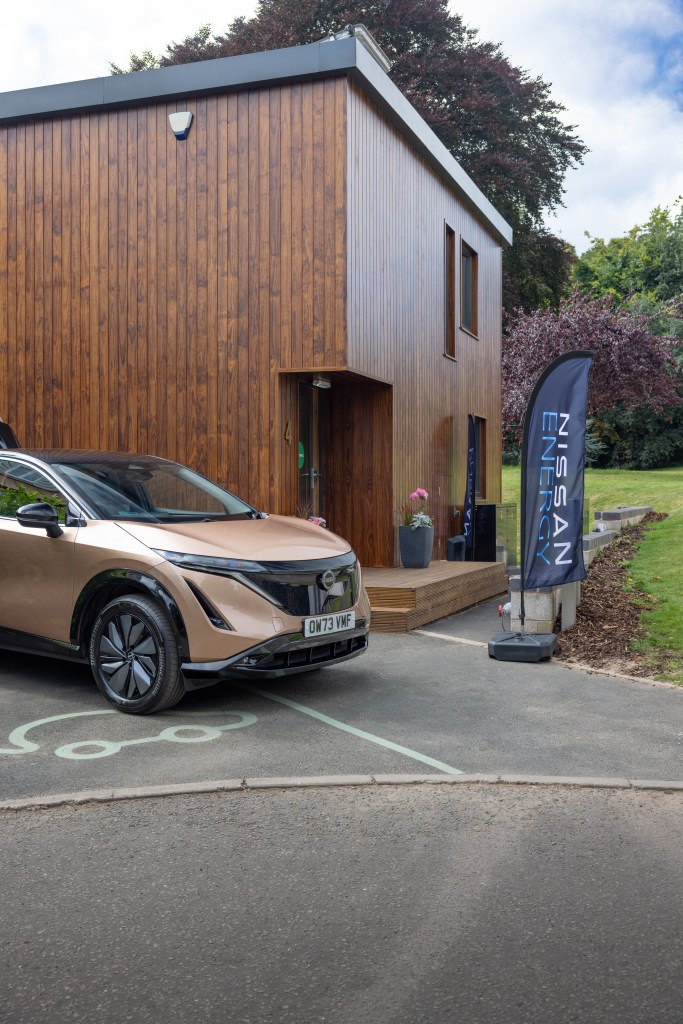
Following a successful year-long project at The University of Nottingham, UK, Nissan has become the first car company to gain G99 Grid code certification with an AC-based solution, needed to supply electricity into the UK national energy supply.
Under the banner of Nissan Energy, the company’s aim is to roll-out V2G technology across markets in Europe and beyond, empowering consumers with either AC or DC-based V2G solutions, in alignment with local infrastructure and regulatory requirements.
Benefits of Vehicle-to-grid technology By using Nissan’s on-board bi-directional V2G technology, customers can cut the annual cost of powering an EV by 50%. The same technology can also reduce net CO2 emissions from charging by 30% per year, per EV for the average UK household.
EVs equipped with V2G technology can play a crucial role in integrating and increasing the mix of renewables into the energy supply, by storing electricity generated by wind or solar, and directing it back into the grid when needed, reducing dependency on fossil fuels.
As one of the bi-directional systems Nissan plans to offer, this AC-bidirectional system certified in the UK will leverage an integrated on-board charger to deliver a lower cost of entry, allowing the technology to be accessible to more people. Nissan aims to offer its AC bi-directional charger at a price comparable to a mono-directional charger available today.
As well as lowering the cost of entry, Nissan’s V2G system will give customers complete control and flexibility over their energy via a dedicated App.
The launch forms part of Nissan’s strategy to create a fully integrated energy ecosystem – sustainably manufactured EVs providing zero emission motoring, charged using clean energy and capable of providing power back to the home as well as to the grid.
Hugues Desmarchelier, Nissan Vice President, Global Electrification Ecosystem & EV Programs, said: “The technology we are bringing to customers is a potential game-changer for how we view the car. Not just as a means of getting from A to B, but as a mobile energy storage unit, capable of saving people money, supporting the transition of our energy systems away from fossil fuels and bringing us closer to a carbon-free future.
“Nissan is proud to democratise technology for the benefit of society. The breakthrough in an on-board solution for two-way charging will be a substantial reduction in the cost of integrating a future EV into your energy supply, and the ability to leverage the car as a source of income over its lifecycle.”
Nissan aims to become a truly sustainable company, and in the Africa, Middle East, India, Europe and Oceania region (AMIEO) is using its unique diversity to drive locally-focussed action and scalable solutions that contribute to a cleaner, safer and more inclusive world for everyone.
Strong partnerships support successful UK trial The V2G UK trial has been partly funded by the UK Government’s Advanced Propulsion Centre, a body established to support and accelerate the automotive industry’s transition towards net zero. The V2G UK trial has been partly funded by the UK Government’s Advanced Propulsion Centre UK (APC), a body established to support and accelerate the automotive industry’s transition towards net zero.
APC Chief Executive, Ian Constance, said: “This is a significant milestone for the collaborative research and development project, led by Nissan Technical Centre Europe and supported by the Department for Business and Trade through the APC. Investing in pioneering vehicle-to-grid technology and R&D in the UK is part of a system-level approach to decarbonisation.”
Future of Roads Minister Lilian Greenwood, said: “Vehicle to grid technology is a fantastic innovation which has the potential to save people money and accelerate the UK’s transition to electric vehicles.
“A greener transport network is a key priority for this Government, and by working together with industry we will boost consumer confidence and achieve our shared goal of getting more EVs on the road.”
During the trial, Nissan worked with several partners including Dreev and Enovates. Dreev, a joint venture between EDF and NUVVE, was responsible for data collection, customer profiling and setting the charging and discharging plan by analysing information from the wall box.
Eric Mévellec, CEO for Dreev commented: “We have been working alongside Nissan for years on this revolutionary technological adventure, and we are thrilled to be a part of this new chapter. We are convinced that, by reducing the electricity bill for the customers while providing huge storage capabilities for the electrical system, V2x technology has a major role to play in the energy transition”
Enovates, a Belgian-based mobility technology company, developed the wall box, or Electric Vehicle Supply Equipment (EVSE), including set-up and test certification.
The wall box acts as the system hub, sending and receiving information on energy demand and supply from the Dreev cloud, and directing the car to charge or discharge electricity at a set amount to the home or grid.
Bart Vereecke, CEO of Enovates, said: “Enovates is proud to partner with Nissan in demonstrating through the Field Operating Test the real-world benefits of AC V2G technology. This test marks an important step in creating a sustainable, interconnected energy future where electric vehicles play a central role in sustainable mobility solutions and resolving energy grid congestions.”
“Enovates has always been committed to pushing the boundaries of V2G technology, and we are excited to bring our expertise in AC charging to this project,” added Stijn Vispoel, R&D Manager. “Our certified AC V2G chargers represent the next generation of energy technology, offering accessible, efficient, and smart solutions for the future of transportation and energy.”
The University of Nottingham was also pivotal in the trial, providing a base of operations at its on-campus Creative Energy Homes and supporting academic research.
Nissan is continuing to work with these, and other partners, to achieve the necessary grid certification in other markets, develop a seamless user experience and expand the technology availability to more customers.
Chairperson of Nissan’s Africa, Middle East, India, Europe and Oceania region, Guillaume Cartier, commented: “One of the big challenges faced by society today is energy supply – how do we make it affordable, reliable and clean.
“At Nissan, we see a future for our customers where their energy comes from the car on the driveway – not only the power station – fully integrated, flexible and cleaner.”
Hyundai Motor Company is marking its historic achievement of producing 100 million vehicles worldwide with the grand opening of its ‘One step further’ exhibition at Hyundai Motorstudio Seoul. The exhibition showcases the driving forces behind the 100-million-unit production milestone and conveys Hyundai’s gratitude to those customers who have been part of the journey.
This exhibition is a continuation of the 100 million production celebration held at Hyundai Motor’s Ulsan Plant on September 30. At that event, the company delivered the 100 million and first vehicle, an IONIQ 5, to its new owner, representing the brand’s gratitude to its customers for their unwavering support.
“It takes thousands of parts and pieces to build a car, with combined efforts of millions of people involved in R&D, design and manufacturing over many years,” said Sungwon Jee, Senior Vice President and Global Chief Marketing Officer at Hyundai Motor Company. “We wanted to shed light on these behind-the-scenes efforts that went into producing 100 million vehicles and tell the story of Hyundai Motor’s transformation from a traditional automaker to a leading smart mobility solutions provider.”
Spanning five floors, the exhibition begins on the first floor by introducing the journey to 100 million units, featuring the Cortina Mark 2, Hyundai Motor’s first production model; and the Pony, Hyundai Motor’s first independently developed model.
The second floor offers a retrospective on how Hyundai has helped its customers’ lives and showcases the history of major Hyundai Motor plants, including the evolution of production processes over time.
The exhibition’s third floor highlights key drivers in achieving the production milestone of 100 million vehicles globally, focusing on three iconic models: the first-generation Sonata, the first-generation Elantra and Scoupe. These vehicles exemplify Hyundai Motor’s relentless pursuit to go ‘one step further’ in driving its incredible achievement.
The first-generation Sonata showcased Hyundai’s craftsmanship and dedication to enhancing product quality. The first-generation Elantra, a steady seller, laid the foundation for the company’s 100-million-unit production capability with the introduction of an automated production line. The Scoupe – equipped with the Alpha series, Hyundai’s first proprietary engine – pioneered the sports car segment in Korea and demonstrated the company’s engineering prowess.
The exhibition’s fourth and fifth floors feature the brand’s modern SUV lineup – Santa Fe, Kona and Inster; and electric vehicle (EV) lineup – IONIQ 5, IONIQ 5 N and IONIQ 6. This final section looks ahead to Hyundai Motor’s future as it moves ‘one step further’, transforming from a traditional automaker to a smart mobility solutions provider.
The exhibition is testament to Hyundai Motor’s unwavering commitment to innovation, customer satisfaction and a future of continued growth and success. Held from October 10 to November 10, admission is free to all visitors.






 Power Drive