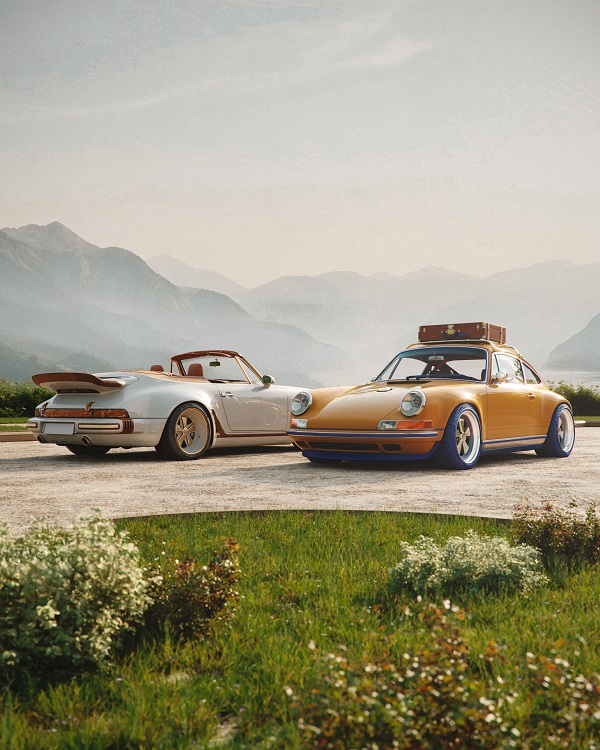
Guided by its Art of Travel philosophy, Louis Vuitton brings its expertise and savoir-faire to an exceptional automotive project. In a close collaboration, Louis Vuitton and Singer, the Californian atelier renowned for its highly personalized restorations of classic Porsche 911s, jointly reveal two extraordinary cars today.
The first, a Porsche 911 Reimagined by Singer – Classic, showcases an exclusive livery in the House’s iconic colours – saffron, cobalt blue and yellow – specially crafted with and for Louis Vuitton. Its counterpart, a Porsche 911 Reimagined by Singer – Classic Turbo, conceived by Louis Vuitton’s Artistic Director of Women’s Collections Nicolas Ghesquière, is a cabriolet finished in Calcaire Lutétien white and complemented by exquisite precious-wood trim. Both vehicles are enhanced with made-to-measure Louis Vuitton creations, transforming every journey into a true celebration of the art of living.
A Tambour dashboard clock: the genesis of an unprecedented automotive adventure.
The automotive restorations born of the collaboration between Louis Vuitton and Singer emerged from a conversation with the Californian company – a visionary in the world of exceptional automobiles and renowned for its exacting approach to vehicle personalisation.
“This unique and remarkable adventure began with a request for a dashboard clock for a car reimagined by Singer. In addition to the design and production of this clock by La Fabrique du Temps Louis Vuitton workshops in Switzerland, it quickly became apparent to us that this collaboration with Singer could extend to the personalisation of every functional element of the vehicle, enhancing them through our expertise in leather craftsmanship and watchmaking,” shares Jean Arnault, Louis Vuitton Watch Director.
Rob Dickinson, Founder and Executive Chairman at Singer explained: “The specifications chosen by Louis Vuitton exposed us to techniques and methods developed over decades of experience. They trusted us with their esteemed brand, their traditions and their vision and it was a joy to bring our two worlds together.
At the heart of the project lies a detachable, mechanical timepiece, which can be converted into a desk clock, and whose design is inspired by the iconic Tambour watch, recognisable by its distinctive shape and its twelve polished and engraved letters forming the name of the House on the bezel. Once integrated into the cockpit, it soon became clear that Louis Vuitton’s involvement could not be limited to this single timepiece. The redesign of the instrument display, a major technical and aesthetic challenge, then became essential to ensure absolute coherence within the interior. What might seem trivial represented an entire year of relentless work. The House’s designers reimagined every detail, including the speedometer, rev counter and gauges, to ensure they adopted the iconic graphic codes of the Tambour line, particularly through their hands, terminations on the dials and index systems. The chosen design language speaks for itself: a vivid cobalt blue hue accented with bursts of bright orange for the lettering, striking a perfect balance between horological expertise and the rigorous demands of the automotive industry.
Inspired by Louis Vuitton’s philosophy around the Art of Travel, the project resulted in a vehicle being completely reimagined. “The aim was to create a true synthesis between Singer’s architectural and timeless language and the Louis Vuitton culture, characterised by refined materials, travel and expression of style,” explains Octave Chany, Project Lead Designer at Singer. This unique creative partnership marks a historic first for Louis Vuitton. The House is, for the very first time, creating a co-branded item, an equally unprecedented move for Singer.
For Louis Vuitton, the car transcends its role as a mere means of transport; it becomes an intimate world, an expression of personality and a pillar of the art of living. Louis Vuitton has chosen to express its vision in the form of a coupé reimagined through Singer’s Classic services, and a cabriolet reimagined through their Classic Turbo services, inspired by light and a nomadic spirit. Drawing on California’s ethos of freedom, these creations are deeply rooted in the House’s heritage and DNA, offering an experience in which the journey itself becomes a work of art in motion.
“This collaboration brought together two organizations with a shared belief that true luxury is defined by craftsmanship, authenticity and an uncompromising attention to detail. It has been a privilege for everyone at Singer to be trusted with Louis Vuitton’s remarkable 172 years of tradition and savoir-faire and to incorporate those techniques into our own work.
Louis Vuitton brought an exceptionally bold and refined design vision focused on expressing the Art of Travel. Together, our teams combined that vision with Singer’s approach to engineering, craftsmanship and execution, challenging one another to achieve a level of precision worthy of both organizations. I couldn’t be prouder of how our mutual teams embraced that challenge. Along the way, what began as a creative partnership became a genuine friendship, both professionally and personally, built on mutual respect and a shared pursuit of excellence. These two automobiles are the result of that relationship, and neither could have been created without it,” explains Mazen Fawaz, Chief Strategy Officer, Singer.
A Porsche 911 Reimagined by Singer – Classic: Louis Vuitton’s most contemporary expression of the Art of Travel
In its saffron and cobalt blue livery, fitted with a specially designed roof rack, which can accommodate a trunk, a surfboard or a pair of skis, this Porsche 911 was reimagined by Singer to the specification envisioned by Louis Vuitton and immediately declares its purpose: this car has been designed for epic journeys. Its fluid, aerodynamic silhouette naturally gives a hint at its performance capabilities. However, it is above all the details that fully express what Louis Vuitton means by the Art of Travel. The result of careful and meticulous creative work, every element and component has been reimagined to meet standards of savoir-faire rarely encountered in the automotive industry, with a focus on conveying real meaning.
The saffron shade, present in the House’s archives for over a century and a half and used across its packaging for more than twenty years, also resonates with Bahama Yellow, a hallmark hue closely associated with Singer’s earliest commissions. Notably, it has a particular connection with the automotive world, paying homage to the travel trunks designed for Citroën in 1924. These types of travel cases already featured cobalt blue interior reinforcements. This two-tone colour combination therefore embodies Louis Vuitton’s identity particularly well, as does the bright yellow thread used for the saddle-stitch seams on the brand’s leather goods and trunks.
In motor racing, colours have been a key means of identification since 1900, when the Gordon Bennett Cup introduced a system of national colours for competitors. The classic car features distinctive cobalt blue demonstration tyres, inspired by the handles and ribbons of the House’s packaging, and completing a visual signature that remains defined by subtlety. This approach is echoed in the rear engine air intake grille, which discreetly incorporates a geometric motif formed by the initials L and V.
Louis Vuitton has, naturally, adorned the interior of the car with its signature; the cabin is entirely upholstered in leather with a natural hue inspired by VVT leather, one of the House’s most utilized leathers. Used for the handles, shoulder straps, edging, and labels of the brand’s exceptional luggage and on its coated canvas bags, the leather is one of Louis Vuitton’s most iconic signatures. Louis Vuitton’s expert artisans chose their preferred leather for the seats, selecting the appearance and colour to perfectly complement the VVT-inspired leather trim that adorns the interior. The interior leatherworking was then executed by Singer’s team. Meticulous attention has been paid to every detail. The edges of the door handles feature the same edge-dyeing technique used on Louis Vuitton bags, while the stitching is executed in yellow thread. The diamond-patterned embossing on the seats and the front boot trim, as well as the engine compartment at the rear, echoes the “malletage” motif characteristic of the inside of Louis Vuitton trunks. To ensure comfort for the driver and passenger, the seats are fitted with ventilation eyelets. Each one crafted and finished by hand, they bear the iconic Louis Vuitton Monogram flower designs; a motif that also appears on the sun visor and headrests, echoing the windscreen.
This attention to detail has been the guiding principle for the artisans at Louis Vuitton and Singer. Every component of the vehicle embodies an aesthetic ambition rarely achieved in a contemporary automotive design. The plastic fittings found in a typical car interior have been replaced throughout by hand-crafted components made from premium, natural materials.
Adjustment knobs, control switches, locks, pull-tabs and air vents have thus been crafted in metal, predominantly rhodium-plated, using traditional artisanal techniques. Each component has been individually hand-finished using techniques comparable to those employed in the creation of a fine timepiece. The tactile sensations, as well as aspects such as reflections and the play of light, have been carefully considered and adapted, drawing on watchmaking savoir-faire in polishing and satin-finishing. The specific colours have been achieved through anodising or electroplating.
“What makes projects like this one particularly exciting is precisely the opportunity to challenge these constraints and explore new approaches to aesthetics, identity and craftsmanship within the realm of automotive engineering. Projects of this scale and exclusivity allow for a level of attention to detail that is unusual in the automotive world. Every transition between materials, every metallic reflection, every knurled surface, every mechanical interaction and every graphic element has been meticulously considered, often at an almost microscopic level,” explains Octave Chany, Project Lead Designer at Singer.
This attention to the tiniest detail has been applied to the entire vehicle, including the finishes on the engine’s technical components, which have been executed by the Singer team to an unprecedented standard of finish and refinement. The fuel and oil caps, for instance, incorporate the distinctive typography used on Louis Vuitton watch components within their markings. Step by step, every element of the car has been meticulously designed and crafted to order. This approach was naturally extended to the passenger amenities that feature in this extraordinary vehicle.
“With the creation of both cars, Louis Vuitton has, for the first time, drawn upon the full breadth of its savoir-faire, bringing together the expertise of every House métier in a unique and exclusive automotive project. Every department at Louis Vuitton has contributed to this unprecedented cross-disciplinary endeavour, from trunk makers and leather goods artisans to the fashion and footwear teams, and even the watchmakers from La Fabrique du Temps Louis Vuitton,” highlights Jean Arnault.
An exclusive capsule for the Porsche 911 Reimagined by Singer – Classic: a collection crafted for travel
To truly celebrate the Art of Travel, Louis Vuitton has dressed the classic car’s owner as carefully as it dressed the car. The pieces are cut from a Millésime leather echoing the cabin and finished in the car’s own saffron, cobalt and yellow, so the capsule reads as an extension of the interior rather than a wardrobe set beside it.
The look begins with the driver: a racing jacket crafted from naturally grained leather, featuring a perforated LV zip closure and three Monogram Flower eyelets across the chest—a motif directly drawn from the car’s seats and sun visor. The silk lining discreetly repeats the embroidered flower, a detail visible only to the wearer. Beneath it, straight-cut jeans in a heavy cotton-and-silk denim are washed for a worn-in aesthetic, subtly detailed with contrast topstitching, an aged-gold engraved button and a Louis Vuitton x Singer tab at the rear waist. Footwear for the drive is presented in two distinct options: the LV Rally, a car-shoe adorned with LV initials on the side and featuring a rubber-pad sole, or the LV Remix Derby, a hiking silhouette infused with heritage accents, with a deep blue key bell decorated with the ‘Louis Vuitton Singer’ project and Monogram Flower eyelets. Driving gloves come perforated, in a natural hue or cobalt blue. Finally, a jet helmet made of carbon and glass fiber, trimmed with calfskin leather and finished with a riveted peak, completes the figure.
Even the keys receive bespoke treatment. A folder sized for six keys opens to reveal a Louis Vuitton x Singer stamp. Alternatively, a cloche key holder, is highlighting the House’s signature blue, can loop around a bag handle or be worn around the neck. A pochette for the car’s documents, built on the lines of a 1950s business sleeve, includes a contrasting blue interior and a zipped pen compartment.
The luggage is custom-fitted to the car. A 1950s-inspired helmet bag holds the bespoke helmet, its hardware tuned to the fuel cap’s shade. The Bisten, a direct descendant of the suitcases the House first catalogued in 1892, adorned with a blue handle and a name tag, keeps the wardrobe flat and crease-free. The Keepall, a House icon since 1930, packs a week’s wardrobe into the cabin, and a pair of front-trunk bags is shaped so the two sit perfectly in the nose of the car.
As early as 1897, the visionary Georges Vuitton was offering trunks designed specifically for cars, capable of being secured to the rear or on the roof of vehicles. They were equipped with specialised, patented locks, a true revolution for the time. The innovation lay not only in their functionality but also in their design: the trunks were made flat for easier stacking, thereby maximising space and enhancing practicality. This design expertise was complemented by an innovative material, “Vuittonite” canvas, which was both waterproof and supple, and could also be dyed to match the colour of the car, for a completely bespoke offering. Lightweight and adaptable, the Louis Vuitton Auto Trunks closely followed the contours and curves of the car bodies. From 1905 onwards, a comprehensive range of accessories became available, including specialized kits for roadside lunches, or the ingenious waterproof “Sacs Chauffeurs”, which made clever use of the space between the spare tyres to hold hats and personal effects.
Designed to perfectly fit the car’s shape, the bespoke roof rack carries everything the journey needs and features a Louis Vuitton surfboard. Handcrafted in Angers before travelling to the Atlantic coast for its resin coating and fins, it features a Monogram marquetry in blond oak and rich walnut requiring countless hours of craftsmanship. A pair of skis rounds out the range. Created in the French Alps from wood, titanal and steel, the combination of natural and technical materials ensures strength, responsiveness and agility.
Together, these accessories embody a complete contemporary expression of Louis Vuitton’s historic expertise in designing functional equipment for motoring and travel.
A Porsche 911 Reimagined by Singer – Classic Turbo: where fashion meets automotive design
Once the design of the coupé was finalised, the creative collaboration between Louis Vuitton and Singer was strengthened and extended by another complementary project: the development of a turbocharged cabriolet under the visionary leadership of Nicolas Ghesquière, Artistic Director of Women’s Collections at Louis Vuitton. Featuring bodywork in white, subtly enhanced with touches of brown, it reveals an interior where leather and wood harmonise in a sophisticated tribute to the elegance of classic motorboats. “Automotive design is a passion that has always lived within me. My collaboration with Singer has been a chance to reconnect with this fascinating world – a magnificent opportunity to explore truly exceptional automobiles,” highlights Nicolas Ghesquière. The Porsche 911 Reimagined by Singer – Classic Turbo embodies Nicolas Ghesquière’s vision through his desire to blend two distinct worlds: the nautical and the automotive. This fusion directly reflects the designer’s approach, as he frequently incorporates contrasting worlds into his collections. The use of wood lends this cabriolet a unique and decidedly contemporary feel, much like Nicolas Ghesquière’s long-standing creative vision. The automobile, an inexhaustible source of inspiration, has been a recurring theme in his collections since he joined Louis Vuitton, as illustrated by the iconic photoshoot for his first campaign.
Working closely with the teams at Singer, Nicolas Ghesquière realized his vision for the ideal car: a vehicle open to the world, to nature and to the fullness of life, fostering direct contact with the sun and a profound sense of sensuality. The choice of a cabriolet was an obvious one. Right from the beginning of the project, he imagined it as the embodiment of the Louis Vuitton spirit: elegant, modern and assertive. The cabriolet is therefore as sensuous as it is powerful, combining sophisticated styling with exceptional prowess. While the large rear spoiler, typical of turbocharged models, underscores its capabilities, the rear-opening luggage compartment stands as an impressive feat of engineering, revealing a teak-inspired wooden deck that extends the dialogue with the timeless beauty of motorboats. The colour scheme, combining an echo of Calcaire Lutétien – the white limestone that has shaped the Parisian landscape, including the House’s historic headquarters at Pont Neuf overlooking the Seine – with exquisite gold accents that adorn the car like subtle jewels, and the natural hues of the leather and wood, reflects Nicolas Ghesquière’s sense of refinement and a way of life intrinsically bound to the Louis Vuitton Art of Travel.
As with the coupé, every element of the vehicle, whether functional or decorative, has been reimagined by the teams at Louis Vuitton and Singer, with the same attention to the finest details, materials, savoir-faire and finishes. Each component is unique, integrating various wooden features, including the bumpers, which presented an additional challenge for the designers and engineers involved in this project. “The depth of dialogue established between the worlds of automotive design, fine watchmaking and leatherwork makes these two cars particularly remarkable. The collaboration with Nicolas Ghesquière was just as fundamental to elevate the concept. Nicolas Ghesquière’s sensitivity to proportions, silhouettes and cultural expression has brought a perspective that has propelled the cars beyond traditional automotive design,” notes Octave Chany, Project Lead Designer at Singer.
The bespoke dashboard clock is not integrated into the instrumentation behind the steering wheel. Instead, it occupies the center of the console, upholstered in natural leather, where warm golden gauges, a dial finished in the exact shade of the exterior bodywork and a matching golden ignition key create a seamless dialogue between the interior and exterior. The dashboard bears the Louis Vuitton signature, echoed after dark within the Tail Lamps, while a distinctive leather patch on the steering wheel—one of Nicolas Ghesquière’s signature details—subtly reinforces the House’s identity. All functional elements are crafted in metal, with the same meticulous attention to finishes and surface treatments as the Classic car, in harmony with the precision of fine watchmaking. Beneath the dashboard clock, the gearshift trim evokes the silhouette of the Noé bag through its natural leather drawstring.
Behind the seats, upholstered in leather over a technical wooden shell, lies a luggage compartment developed specifically for the car’s unique form. It is crafted from varnished wood using the same technique employed for runabout decks. There is ample space for bespoke Louis Vuitton luggage fitted to the car, as well as for the lightweight soft top, which is itself inspired by the nautical world. Wood panelling also lines the rear engine compartment and the front boot, which houses a bespoke trunk composed of three cases that slot together to form storage compartments that are both highly functional and elegantly crafted. Leather fastening straps on the front and rear hoods, equipped with pin buckles, subtly recall references to motorsport, the traditions of trunk making and watch straps.
An exclusive capsule for the Porsche 911 Reimagined by Singer – Classic Turbo: a bespoke collection for refined travel
To enhance the driving experience of this exceptional turbocharged cabriolet, Nicolas Ghesquière has designed an exclusive capsule in which every piece answers to the car. It takes its cue from the cabriolet’s own register, the white bodywork, the wood, the gold worn like jewellery, so that what the driver carries and wears extends the car rather than accompanies it.
Time is kept in more than one place. The dashboard clock, already at the center of the console, finds its echo on the wrist in the Tambour Automatic, a forty-millimeter piece in ceramic and yellow gold whose bracelet runs unbroken, without a visible pin. When neither is worn, both rest in the Coffret Tresor, first made by Georges Vuitton in 1896 and reissued here as a pair: one cradles the watch on its cushion, the other holds the dashboard timepiece ready to clip back beside the gear lever. A smaller case, dual-flapped and closed with a magnetic snap, carries the watch alone.
For the driver, a made-to-measure suit in parachute silk works the House’s second initial into raised, V-shaped seams rather than any badge, its zip pulls and snaps discreetly engraved. The driving gloves follow the hand in braided leather and a single hand-painted Monogram snap, echoing the wood that lines the cabin. The LV Sneakerina sits low and light underfoot, its signature read only in a cut-out at the side. Completing the look, sunglasses in gold and acetate hide a Monogram flower beneath one lens, augmented by a helmet in carbon, glass fiber and varnished cream, finished with a tan visor.
What the car carries is considered as closely as what the driver wears. A garment bag folds flat against the cabin with a hanger and name tag inside. The Alma softens into a travelling shape and the Express returns the malletage of a trunk lining to its interior, while the Noé carries the drawstring silhouette the gearshift borrows. The Cruiser is sized for little more than a pair of gloves and sunglasses, with a loop to hold its own handle open. The Petite Malle is cut from a wood that mirrors the vehicle’s finest details, drawing on a species whose warm hue resonates in perfect harmony with the car’s signature palette and the papers for a one-of-a-kind automobile travel in their own flat case.
The larger luggage is built to the car. The three-part trunk already fitted to the front boot lifts out as three individual cases when the journey calls for it, and the Keepall 45 wears a removable cover that doubles its protection and changes its face, the way a car waits beneath its own fitted sheet.
The keys are given the same weight as the car they open. A key holder carries the LV Blazon, the emblem of the collection, and the Monogram Heritage necklace hangs a leather key bell and medallion from chain, the vehicle’s key worn close. Even the smallest pouch, sized precisely for the keys to come, is finished with contrasting yellow stitching.
Louis Vuitton and automotive elegance: a return to the future
Indeed, since its inception in 1854, Louis Vuitton has been intrinsically linked to the world of travel and synonymous with developments in modes of transport. From the late 19th century onwards, the rise of the motor car became a breeding ground for innovation at the House, offering drivers an array of trunks, luggage and accessories designed to be as practical as they were refined.
In 1909, the twins Pierre and Jean Vuitton, grandsons of Louis Vuitton, went a step further and designed their own car, built on a sports chassis produced by the manufacturer Stabilia, to showcase the products of the House then led by their brother, Gaston-Louis Vuitton. After equipping the teams participating in the great Paris–Beijing and New York–Paris race, passing through Moscow, the House went on to supply ambulances during the First World War. It later worked with the most prestigious automotive designers and leading car manufacturers throughout the interwar period, notably providing luggage for some of their most iconic models. While industrial standardisation, from the 1940s onwards, brought an end to the era of bespoke bodywork, and with-it bespoke trunks, Louis Vuitton continued to receive special orders, particularly for custom-made luggage designed to fit perfectly into a car boot.
Louis Vuitton’s connection with the automotive world continued throughout the 1980s and 1990s, thanks to a series of landmark initiatives that celebrated both design and heritage. The House developed contemporary, bespoke trunk and luggage for concept cars. The automotive Concours d’Élégance organised by Louis Vuitton, in Paris, with events at Bagatelle and later at Saint-Cloud, as well as in England, notably London, and at New York’s Rockefeller Center, attracted large crowds. The Louis Vuitton Design Award recognised the most innovative concept cars. The major international Louis Vuitton Classic Run rallies captivated discerning collectors and admirers of the golden age of the automobile, embodying the very essence of travel.
The relationship between Louis Vuitton and the automotive world, characterised by creativity, modernity and a constant pursuit of excellence, has naturally fostered a close dialogue with Singer throughout the execution of both cars.
Singer: reimagining the most important sports cars in the world
Founded in California in 2009, Singer represents a philosophy expressed as ‘A Relentless
Pursuit of Excellence’. The company has become renowned for its collaboration with owners of classic Porsche 911s to reimagine their cars. The company’s approach is defined by three guiding principles: beauty, craftsmanship and engineering; a celebration of the world’s most iconic sports cars; and a deep connection with California and its automotive culture.
Singer’s services enable owners to restore and personalize captivating, analogue sports cars for the road and track. The company operates two facilities; one in California, where the Classic car was restored, and the other in England, where the Turbo Cabriolet was crafted.
Today, the Singer brand is followed by a global community of enthusiasts. This year, its influence on the automotive world was recognized as Singer was celebrated as the Central Feature Marque at the prestigious Goodwood Festival of Speed in the UK. The partnership between Louis Vuitton and Singer has resulted in two exceptional cars, in which every detail carries significance.
A union of skills, creating exceptional synergy
The collaboration between Louis Vuitton and Singer, singular and unprecedented, transcends a simple partnership. It represents a meeting of two worlds of excellence, where the depth of exchange has profoundly shaped the distinct identities of each House.
“This collaboration has been a unique experience of mutual growth. The project has provided us with new insights and fresh perspectives. A fruitful collaboration that has also highlighted the synergy and enthusiasm across all departments of the House,” explains Jean Arnault.
Driven by the ambition to achieve an exceptional level of craftsmanship, without compromising the integrity or functionality of the vehicles, the teams at Louis Vuitton and Singer have reimagined the two cars. They have imbued them with a unique, futuristic feel, whilst retaining the timeless character and technical authenticity of the iconic automotive architecture of the two classic Porsche 911s that formed the basis of Singer’s work.
Each design decision was the result of a delicate balance between bold innovation and considered homage. It was imperative that every choice remain feasible, in perfect alignment with the strict requirements of engineering, durability, ergonomics and design.
“It was important to remain faithful to the idea of a functional and useful vehicle. Beyond aesthetics, the car had to continue to express the emotional notion of travel, so deeply rooted in the DNA of Louis Vuitton, while preserving the purity, handling and technical integrity that define Singer,” adds Octave Chany, Project Lead Designer, Singer.
The two cars reimagined by Louis Vuitton and Singer, uniting the full breadth of their respective savoir-faire, stand as a manifesto of an ongoing pursuit for perfection, embodying an art of living driven by performance, quality and beauty.