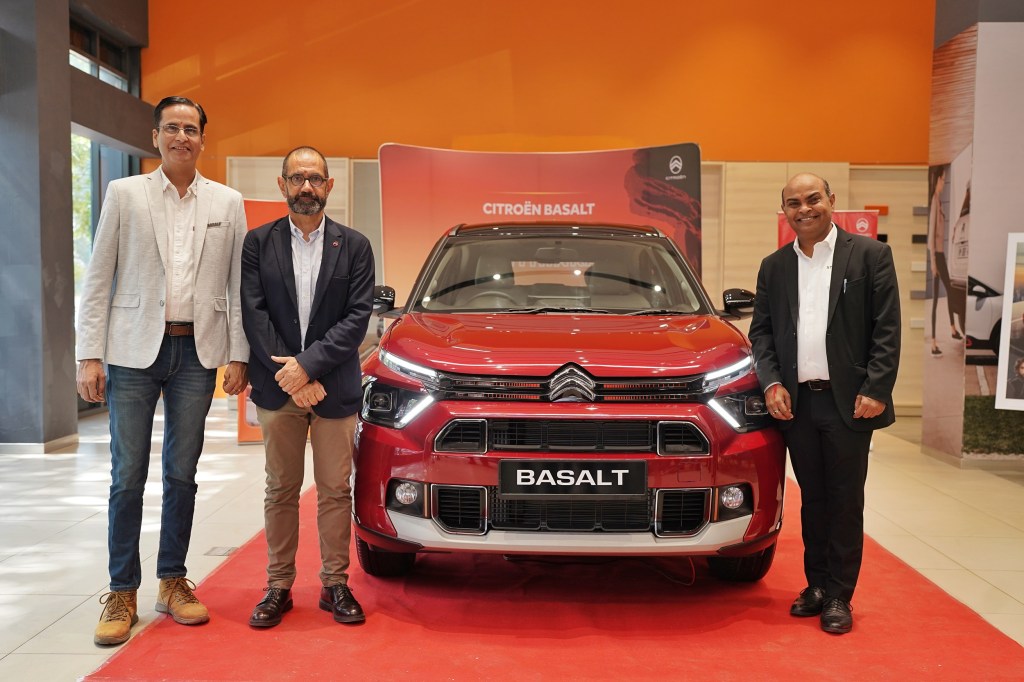
Citroën India has announced the delivery of India’s first mainstream ICE SUV Coupé- the Basalt to its first customer at the La Maison Citroën dealership in Delhi. This event marks a significant milestone in Citroën’s journey in India, reaffirming the brand’s commitment to bringing innovative and stylish vehicles tailored to the evolving needs of Indian consumers.
Theirry Koskas, Citroën Brand CEO graced the occasion and handed over the keys to the delighted customer, also present on the occasion were Shailesh Hazela, MD & CEO -Stellantis India and Shishir Mishra, Brand Head – Citroën India. The Basalt, India’s first mainstream ICE SUV Coupé has drawn widespread attention for its bold design, cutting-edge technology, and exceptional comfort, setting new benchmarks in its segment.
Speaking at the handover ceremony, Thierry Koskas, Citroën Brand CEO, said, “Today is a landmark moment for Citroën in India as we deliver the very first Basalt to our esteemed customer in Delhi, giving Indian roads its first mainstream ICE SUV Coupé. The Basalt embodies our commitment to bringing innovative and stylish mobility solutions to the Indian market. This handover not only represents the start of a new journey for our customers but also highlights our dedication to India’s growing automotive market, where we see immense potential for continued growth. We are continuously updating our products and expanding our network to reach closer to customers.”
Shailesh Hazela, MD & CEO -Stellantis India said, “The Basalt has already received an overwhelmingly positive response from customers, reflecting their appreciation for the innovation, comfort, and style that Citroën is known for. By actively listening to their needs and feedback, we ensure that every update in our product portfolio meets their evolving demands. We invite more people to experience the Basalt firsthand and discover what makes it a true representation of Citroën’s unique approach to automotive excellence.”
The excitement generated by the Basalt’s launch will soon extend to customers across India, with additional handover ceremonies planned in various locations. Further customer deliveries have already begun. Citroën remains focused on offering products that meet the diverse needs of Indian consumers, with the Basalt serving as a prime example of the brand’s innovative approach.
Citroën India’s latest offering, the Basalt ICE SUV Coupé, seamlessly blends the sophistication of a Coupé with the practicality of an SUV, delivering a truly unique driving experience. With its advanced comfort features, intuitive technology, and striking design, the Basalt is poised to redefine its segment for Indian customers.
A fabulous 1957 Ferrari 335 S has won the coveted Best of Show award at this year’s Salon Privé Concours. Entered by American enthusiast Brian Ross, the Maranello sports-racer thrilled onlookers when it took part in the Tour Privé on Tuesday 27 August, and it proved to be just as popular with the expert judging panel when it appeared on the concours field the following day.
Chassis number 0674 was raced by Scuderia Ferrari during the 1957 season, and by a stellar driver line-up. In March that year, dashing young Englishman Peter Collins took the Ferrari to sixth place in the Sebring 12 Hours, sharing with French veteran Maurice Trintignant. Two months later, Wolfgang von Trips finished second in the gruelling Mille Miglia – the very race that has recently been immortalised in the Michael Mann blockbuster Ferrari.
Having been upgraded to 4.1-litre specification at the factory, the Ferrari was back in action in June 1957 at the Le Mans 24 Hours. Mike Hawthorn and Luigi Musso shared driving duties at La Sarthe, and although they failed to finish, ‘0674’ set the fastest lap of the race.
Its final outing as a works car was at the 1957 Caracas 1000km, when Hawthorn and Musso finished second. The car then passed to Luigi Chinetti – a hugely significant figure in Ferrari history, and founder of the North American Racing Team. Chinetti entered it for the Cuban Grand Prix in February 1958, when it was driven to victory in the shortened race by none other than English ace Stirling Moss.
After its period competition career, the Ferrari spent a number of years in the collection of renowned marque enthusiast Pierre Bardinon.
Second place overall in the Salon Privé Concours was presented to Lord Bamford’s magnificent Rolls-Royce Phantom II Sport Saloon by Freestone & Webb. Ordered new to the bespoke specification of cotton magnate Sir John Leigh in August 1933, it was built for fast touring in the UK and on the continent.
Sir John later sold the Phantom II after apparently ordering four brand-new Phantom IIIs in a single day! Having remained in the UK until the late 1950s, the Rolls-Royce subsequently spent 35 years in the ownership of an American enthusiast who lived in Toledo, Ohio.
The Phantom II was bought by Lord Bamford in 2013 and returned to its original two-tone paint scheme. A regular concours prize-winner, it was awarded the Churchill Cup for Most Exceptional Design at Salon Privé in 2022.
Third place overall in the 2024 Concours was presented to the 1927 Isotta Fraschini Tipo 8AS Fleetwood Roadster of Nic and Shelley Schorsch. This hugely significant car was ordered new by movie heart-throb Rudolph Valentino, with unique roadster coachwork that was designed by LeBaron of New York and built by the Fleetwood Metal Body Company.
With its long, flared open fenders and low-slung lines, it was a showstopper deserving of a Hollywood icon, but sadly Valentino died before his Isotta Fraschini was completed. It was nonetheless exhibited at the New York Auto Salon, then put on display in the front window of Isotta Motors, to be admired by throngs of Valentino’s adoring fans.
“We are truly delighted with this year’s Best of Show Ferrari 335 S by Scaglietti,” said Andrew Bagley, Chairman of the Salon Privé Concours. “You only have to look at the great names who raced it to realise how significant sports car it was and appreciate what a cherished place it holds in Ferrari history. This beautiful Ferrari competed in a golden period for sports-car racing, and we all now look forward to its entry into the Peninsula Classics Best of the Best Award.”
This year’s Salon Privé Concours presented by Aviva Private Clients was the largest and most prestigious to date, with 72 cars being entered across 14 different classes. They ranged from the ever-popular Pre-war categories to celebrations of Bugatti, Rolls-Royce and Ferrari. Fan favourites included Legendary Liveries – which showcased iconic colour schemes such as a Silk Cut Jaguar XJR 8/9, an Alitalia Lancia Stratos HF and a 555 Subaru Impreza WRC97 – while a new class for 2024 honoured the 60th anniversary of the Ferrari 275.
All entries gathered on the beautiful South Lawn at Blenheim Palace, having come from as far afield as the USA, Thailand and even New Zealand. They were judged by an unrivalled panel of international experts, with all entries being adjudicated by the International Chief Judge Advisory Group (ICJAG). Salon Privé is one of four ICJAG Plus-designated events in the world, and the only one to be held in the UK.
FULL LIST OF WINNERS 2024 Salon Privé Concours presented by Aviva Private Clients
Best of Show 1957 Ferrari 335 S by Scaglietti entered by Brian Ross
Best of Show Runner-up 1933 Rolls-Royce Phantom II Sport Saloon by Freestone & Webb entered by Lord Bamford
Best of Show Third Place 1927 Isotta Fraschini Tipo 8AS Fleetwood Roadster entered by Nic & Shelley Schorsch
Chairman’s Award 1923 Rolls-Royce Springfield Silver Ghost Pall Mall entered by Jack Boyd Smith Jnr
Duke of Marlborough Award 1993 Lamborghini Diablo entered by Lars Nielsen
Most Iconic – The George Barry Gregory Trophy 1965 Rolls-Royce Phantom V by Mulliner Park Ward entered by Jody Klein
Class A: Pre-War Open Winner: 1927 Isotta Fraschini Tipo 8AS Fleetwood Roadster entered by Nic and Shelley Schorsch Honourable Mention: 1937 Cord 812 SC Convertible Phaeton entered by Yohan Poonawalla
Class B: Bugatti – Grand Prix to Grand Touring Winner: 1939 Bugatti Type 57 Cabriolet by Saoutchik entered by Anne Brockinton-Lee Honourable Mention: 1927 Bugatti Type 38 Philadelphia by Figoni entered by Luc Slijpen
Class C: Pre-War Closed/Elegance Winner: 1938 Bentley 4¼ L Brougham de Ville by James Young entered by Axel Schroeter Honourable Mention: 1930 Bentley 4½ L Sports Saloon by Freestone & Webb entered by Peter Little
Class D1:Inspiring Greatness – 120 Years of Rolls Royce (Pre-War) Winner: 1933 Rolls-Royce Phantom II Sport Saloon by Freestone & Webb entered by Lord Bamford Honourable Mention: 1911 Rolls-Royce Silver Ghost ‘London-Edinburgh’ by Holmes entered by John Snook
Class D2: Inspiring Greatness – 120 Years of Rolls-Royce (Post-War) Winner: 1954 Rolls-Royce Silver Dawn DHC by Park Ward entered by Volker Schumann Honourable Mention: 1988 Rolls-Royce Silver Spirit 2-door by Hooper & Co. entered by Tony Robinson
Class E: Post-War Open Winner: 1951 Mercedes-Benz 300S Cabriolet A entered by Albert Streminski Honourable Mention: 1960 Maserati 3500 GT Spyder by Vignale entered by Claudio Mosconi
Class F1: Post-War Closed (International) Winner: 1960 Maserati 3500 GT by Touring entered by Greg Newman Honourable Mention: 1968 Lamborghini Islero GT by Marazzi entered by John Day
Class F2: Post-War Closed (British) Winner: 1952 Jaguar XK 120 Supersonic by Ghia entered by Bill Heinecke Honourable Mention: 1986 Aston Martin V8 Vantage X Pack entered by Lee Malpass
Class G: Sports-Racers Winner: 1957 Ferrari 335 S by Scaglietti entered by Brian Ross Honourable Mention: 1954 Jaguar D-type entered by Vijay Mallya
Class H: Ferraris of the 1950s & ’60s Winner: 1953 Ferrari 166 MM Spider by Vignale entered by Lord Bamford Honourable Mention: 1963 Ferrari 400 Superamerica Coupé Aerodinamico by Pininfarina entered by Michael Korecky
Class I: 60th Anniversary of the Ferrari 275 Winner: 1965 Ferrari 275 GTB/C by Scaglietti entered by Private collector Honourable Mention: 1965 Ferrari 275 GTB 6C by Pininfarina entered by James Cottingham
Class J: Legendary Liveries Winner: 1996 Subaru Impreza WRC97 by Prodrive entered by Richard Coar Honourable Mention: 1974 Lancia Stratos HF by Bertone – Alitalia, entered by Christian Gläsel
Class K: Supercar Icons – Prancing Horse Winner: 1996 Ferrari F50 by Pininfarina entered by Karim Said Honourable Mention: 1985 Ferrari 288 GTO by Pininfarina entered by Martin Allmand-Smith
Class L: Supercar Icons to 2005 Winner: 2004 Porsche 996.2 GT2 entered by Rob Howarth Honourable Mention: 1993 Lamborghini Diablo by Gandini entered by Lars Nielsen
Honorary Awards Spirit Award – The Margaret Bagley Trophy 1960 Maserati 3500 GT Spider by Vignale entered by Claudio Mosconi
Most Exceptional Coachwork 1966 Ferrari 500 Superfast by Pininfarina entered by Andrew Bagnell
Most Opulent 1969 Rolls-Royce Phantom VI Park Ward entered by Murad Salikhov
Coup de Coeur – The Matt Pearce Trophy 1958 AC Ace entered by Mike Dacre
Best Interior 1939 Rolls-Royce Wraith by Mann Egerton entered by Edward Iliffe
Most Elegant 1932 Bugatti Type 55 by Gangloff entered by Shane Houlihan
Best Works Car 1956 Lister-Maserati entered by Christian Jenny
Best Liveried Race Car 1967 MGC GTS Lightweight entered by Martin Block
Best Open Car 1965 Ferrari 275 GTS by Pininfarina entered by Joe Macari
People’s Choice 1996 Ferrari F50 by Pininfarina entered by Paul Hogarth
The first updated Škoda Octavia built at the Kvasiny plant has rolled off the production line. The production of additional units of the brand’s bestseller in Kvasiny has been made possible thanks to the manufacturing of the new-generation Superb moving to the Volkswagen plant in Bratislava. At the same time, production of the Octavia continues at Škoda’s main facility in Mladá Boleslav. Around 7.5 million units have been produced since the first modern-generation Octavia was introduced in 1996.
Andreas Dick, Škoda Auto Board Member for Production and Logistics, says: “By producing additional units of the Škoda Octavia at our Kvasiny plant we are making efficient use of our flexible production network and fully utilising the capacities of our plants. In addition to comprehensively preparing for the production launch of additional Octavia units at Kvasiny, we have established a training centre providing the ideal setting to further train and upskill our team. I sincerely thank everyone involved in this project for their effort and dedication throughout the process.”
The additional units of the updated fourth-generation Škoda Octavia are produced on the same production line as the Karoq at the Kvasiny plant and where the Kodiaq SUV is also built. While preparing for the production launch of the updated Škoda Octavia, the carmaker opened a training centre in Kvasiny equipped with state-of-the-art technology, three robotic workstations for practical training and two classrooms for advanced theoretical instruction.
The first modern-generation Škoda Octavia rolled off the Mladá Boleslav production line in 1996. It was the first model to be developed entirely under the umbrella of the Volkswagen Group. In March 1998, Škoda introduced the even more spacious Octavia Estate and the first all-wheel-drive variant followed in 1999.
Produced between 2004 and 2013, the second-generation Škoda Octavia offered an upgraded engine range, enhanced technology, a more robust body compared to its predecessor and the large radiator grille took on a trapezoidal shape.
The third generation model was built on the Volkswagen Group’s then-new MQB A platform and offered a standard boot capacity of 590 litres for the hatchback and 610 litres for the estate. In 2017, the updated model came with split headlights featuring optional LED technology.
The current fourth generation of the Škoda Octavia debuted in November 2019. It is built on the updated MQB platform. Some of the petrol engines can be paired with mild-hybrid technology or all-wheel drive. The Octavia was comprehensively updated in spring, bringing a refreshed design, second-generation Matrix-LED headlights, further enhanced safety and comfort features, and new functions, including the integration of ChatGPT into the voice assistant Laura.
Across the four modern generations, approximately 7.5 million Octavias have been produced, continuing the legacy of the popular historical model, the first units of which were produced 65 years ago. Available as a two-door saloon or a practical estate, a total of 360,000 vehicles were produced between 1959 and 1971.
Ariel Motor Company, the UK-based low-volume manufacturer of ultra-lightweight road, track, and off-road vehicles, has unveiled the E-Nomad concept – a fully-electric version of its ultimate go-anywhere sportscar.
Matching the acceleration of its internal combustion engine sibling, the new e-Nomad concept can hit 60mph in just 3.4 seconds and retains the Nomad’s all-terrain high-performance capabilities. Weighing just 896kg, the E-Nomad features all-new natural fibre bio-composite bodywork that is recyclable and enhances aerodynamic efficiency to enable range of up to 150 miles (240km).
Ariel’s engineers designed, developed, and manufactured the zero emission E-Nomad concept at the company’s headquarters near Crewkerne in Somerset. Based on the recently launched Ariel Nomad 2, the new model is powered by a 41kWh 450-volt battery that feeds power to a rear integrated motor, gearbox, and inverter unit producing a maximum power output of 210kW (281bhp).
Delivered through a single speed gearbox, this power, along with 490Nm of torque, enables the rear-wheel drive car to achieve exceptional performance on-road, while remaining stable and controllable on challenging terrain. With constant torque on tap, the E-Nomad offers the same extreme on- and off-road performance as its petrol-powered sibling, showing that Ariel’s SERIOUS FUN ethos can also translate to SERIOUSLY CLEAN FUN.
Simon Saunders, Ariel Director: “While the E-Nomad is a concept, it does show production intent for the vehicle and hints at just a small part of Ariel’s future. Once it has been through our usual, gruelling testing regime we could opt to add E-Nomad alongside its ICE Nomad 2 sibling, so we’ll take great interest in customer feedback on the concept car.”
Developed with partners Rockfort Engineering and Bamd Composites, the Ariel ‘Zero Emission for Low Volume’ programme was grant supported by the UK’s Department of Trade, via the Advanced Propulsion Centre, and Niche Vehicle Network. A fully working prototype, the E-Nomad flags the direction and possibilities for future Ariel models as well as showcasing innovative technology applications at low production volumes.
Battery The 450-volt E-Nomad battery pack, developed specifically for the car by Rockfort Engineering, features the company’s all-new, adaptable Pegasus V3 modules that use high energy lithium-ion pouch cells. These modules offer best-in-class energy density to prioritise performance and range without compromising weight. The E-Nomad uses twelve Pegasus V3 modules with a total capacity of 41kW and power output of 210kW.
Weighing under 300kg, the lightweight, high-power battery unit contributes to minimising mass throughout the E-Nomad. It features integrated cooling and heating systems to extend battery life by maintaining optimum temperature both on- and off-road, as well as on track. A high-capacity, front-mounted, split-circuit radiator provides independent cooling to the battery, while a 5kW internal high-voltage heater can also pre-warm the battery in cold conditions to establish and maintain the most efficient working temperature.
Situated behind the driver / passenger bulkhead, the single battery pack is capable of AC (Type 2) and DC (CCS2) fast charging. This enables the E-Nomad to be charged at home on a normal domestic supply, or via a dedicated fast charger in under 25 minutes from 20% – 80%.
The powertrain is managed via a Rockfort Engineering tuneable control system allowing for changes in power delivery, regen, and different performance maps to suit the usage and driving characteristics. Driver adjustability will feature in further developments of the car, maintaining Ariel’s ethos of allowing the driver control over vehicle systems.
Drivetrain The E-Nomad uses a Cascadia Motion IDM90 combined motor, gearbox, and DX inverter drive unit weighing only 92kg. Powering the rear wheels, the unit features a Borg Warner eDM motor spinning to 12,000rpm and single speed transmission with reduction gearing of 8.28:1. A limited slip differential and parking lock are also part of the E-Nomad specification. The drive unit is water cooled via a secondary system, independent of the battery, from the front mounted, split-circuit radiator.
Body Re-enforcing the carbon reduction qualities of the E-Nomad, Bamd Composites produced all-new, lightweight, aerodynamic bodywork made from natural flax fibres. Selected for its mechanical and structural qualities, the prepreg material is made with northern European flax fibres from SHD Composites. The long, continuous, cellulose fibres of flax plants have excellent tensile strength and stiffness, as well as the plant itself being carbon capturing.
To give additional strength and further weight saving, the panels are backed by reinforcing ‘Power Ribs’ made from more bio-composite natural fibre. Manufacture of the material represents a 73% saving in CO2 when compared to carbon fibre and is 9% lighter than the equivalent carbon material.
CO2 savings were also maximised in the tooling manufacture of the prototype bodywork panels. Direct tooling resulted in a saving of over 50% in CO2 emissions over conventional moulding methods, using Ru-bix Halo-S tooling material and saving over 5,000kg of CO2 just in the production of the tools. Both tooling and bodywork are recyclable at end-of-life.
Development of the experimental bodywork fitted to the E-Nomad utilised the cloud-based Bramble CFD software, enabling Ariel to explore multiple aerodynamic possibilities. With an emphasis on maximising range as well as performance, the bodywork gives a 30% reduction in drag over the standard Nomad, while maintaining downforce and balance. Much of the drag reduction is derived from the roof panel, which also houses a full-size spare wheel.
General E-Nomad is fitted with Ariel’s new ABS system with driver selectable on- and off-road modes and has regenerative braking, feeding energy back to the battery and allowing one pedal driving. Two drive modes are available, ECO and Sport. The Sport mode allows full power and performance, while ECO reduces power and torque with different throttle and regen characteristics, for increased range.
A central switch panel allows selection of drive, neutral, reverse, and park settings with secondary functions to activate battery heater, charge system and switch between driving modes. In addition to displaying speed and air temperature, the AIM Technologies TFT instrumentation incorporates EV specific data including battery and inverter information, powertrain temperatures; drive mode; and battery charge status. The concept car also features a full data logging system and a host of other readouts that Ariel will use as part of its evaluation and development programme.
A revised Power Delivery Management (PDM) whole vehicle electrical system manages battery power states allowing automatic system ‘wake up’ or ‘sleep’ for charging and battery management, while minimising low battery drain during periods without use.
Ariel will debut the E-Nomad concept at the Cenex Expo 2024 on 4 September at UTAC Millbrook. While E-Nomad is not for sale, Ariel will monitor consumer reaction to inform its future plans. The Ariel team will test the prototype extensively to explore the full spectrum of potential future applications.
The name ‘Magnite’ is a portmanteau of the words ‘magnetic’ and ‘ignite’. Whereas ‘magnetic’ highlights the design and the product attributes that essentially attract customers, ‘ignite’ emphasises on the beginning of a new era that Nissan has successfully brought to India with products such as the Magnite.
Built on the philosophy of ‘Make in India, Make for the World’, Nissan India recently unveiled their much-awaited B-SUV with an AMT gearbox, in the avatar of the new Nissan Magnite EZ-Shift.
Earlier this month, we got an opportunity to get up close and personal with the Nissan Magnite EZ Shift. So buckle up and join us for the ride as we tell you everything you want to know about the new Nissan Magnite EZ-Shift AMT.
Design and Engineering
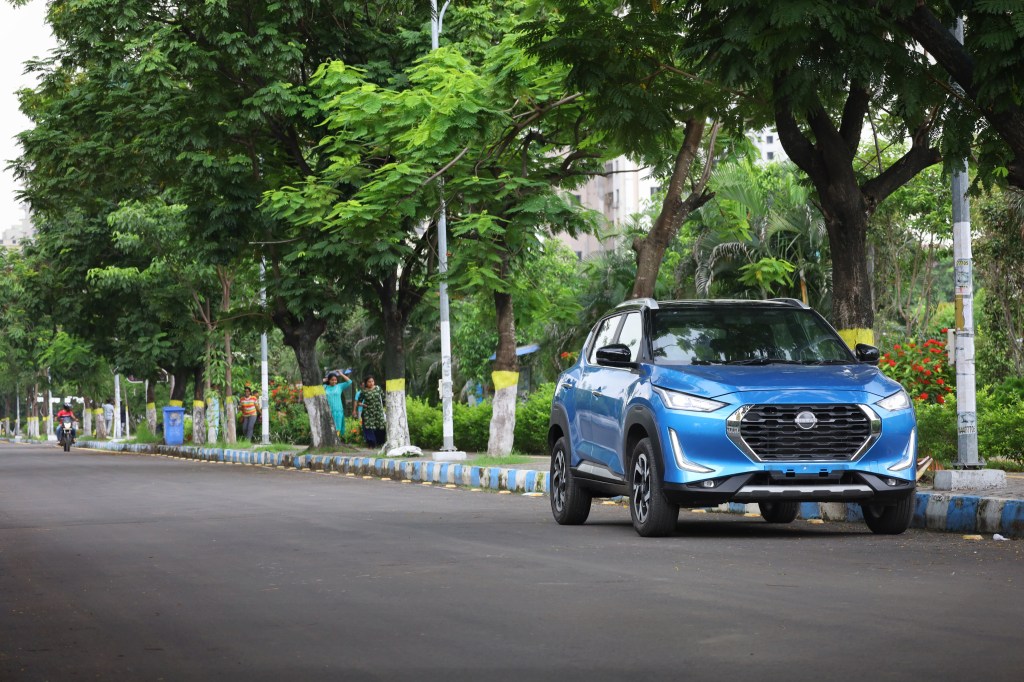
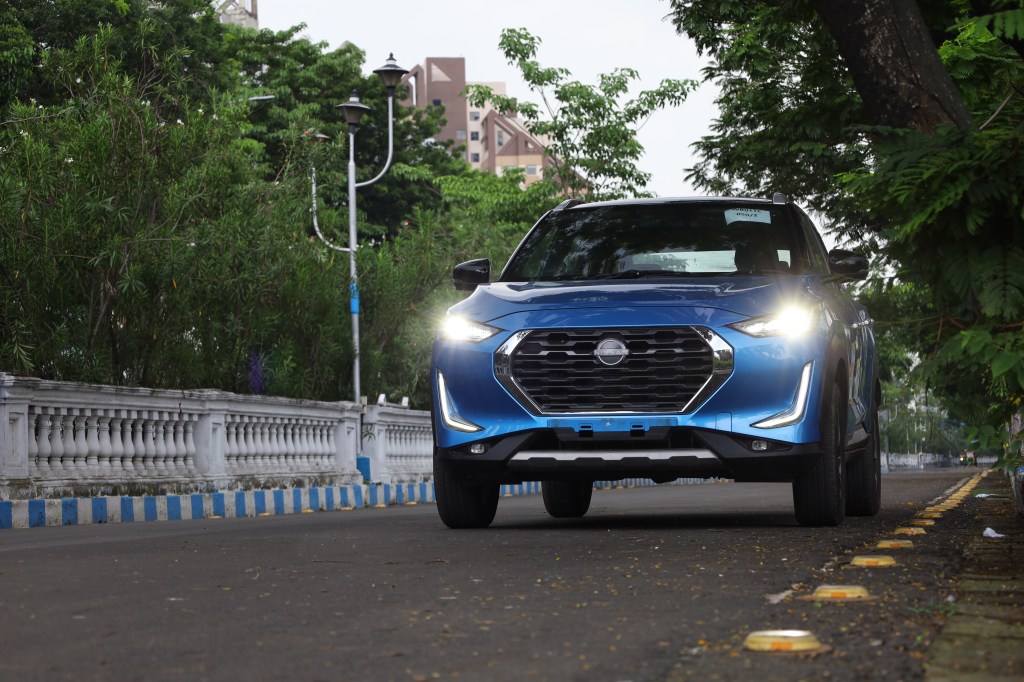
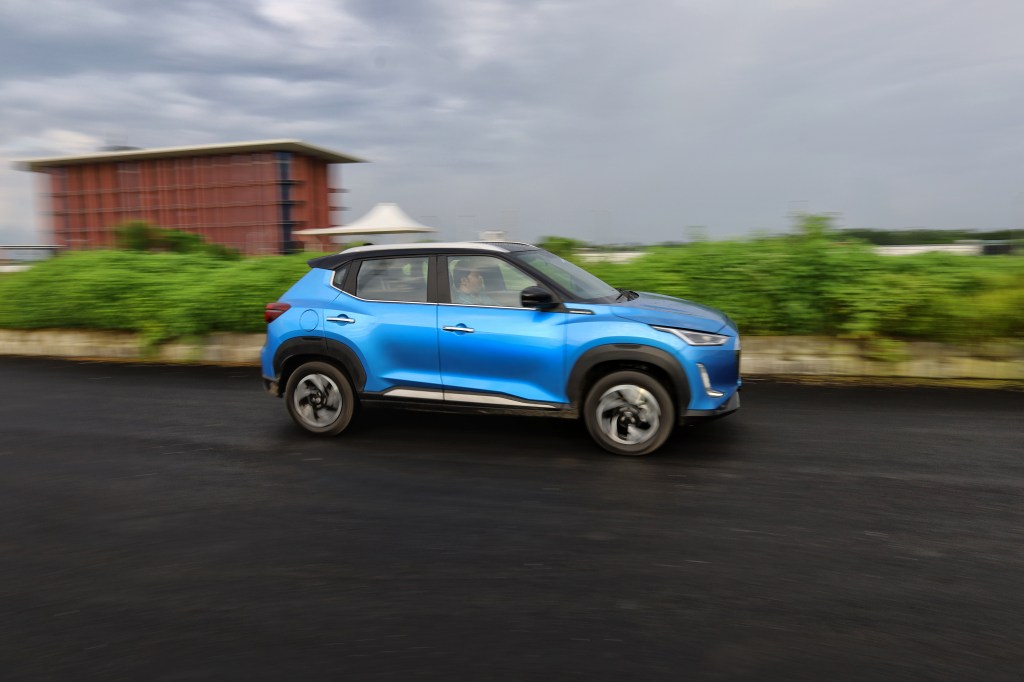
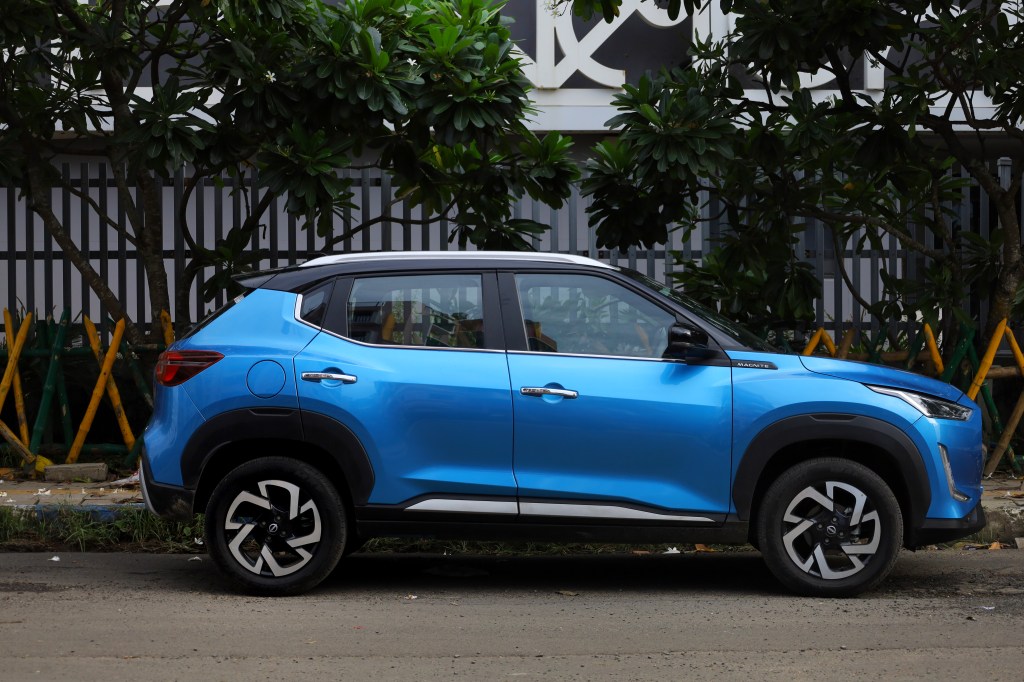
The Nissan Magnite EZ-Shift boasts of a futuristic and dynamic design. Set your eyes on the Magnite and the first thing that will catch your attention is that dominating front chrome grille which makes a bold statement and helps the Nissan Magnite to stand out as you drive-in anywhere.
Its muscular lines and dynamic styling ensure that the Magnite looks macho yet agile. Nissan has also added substance to the Magnite with the full beltline chrome strip running on the side below the windows.
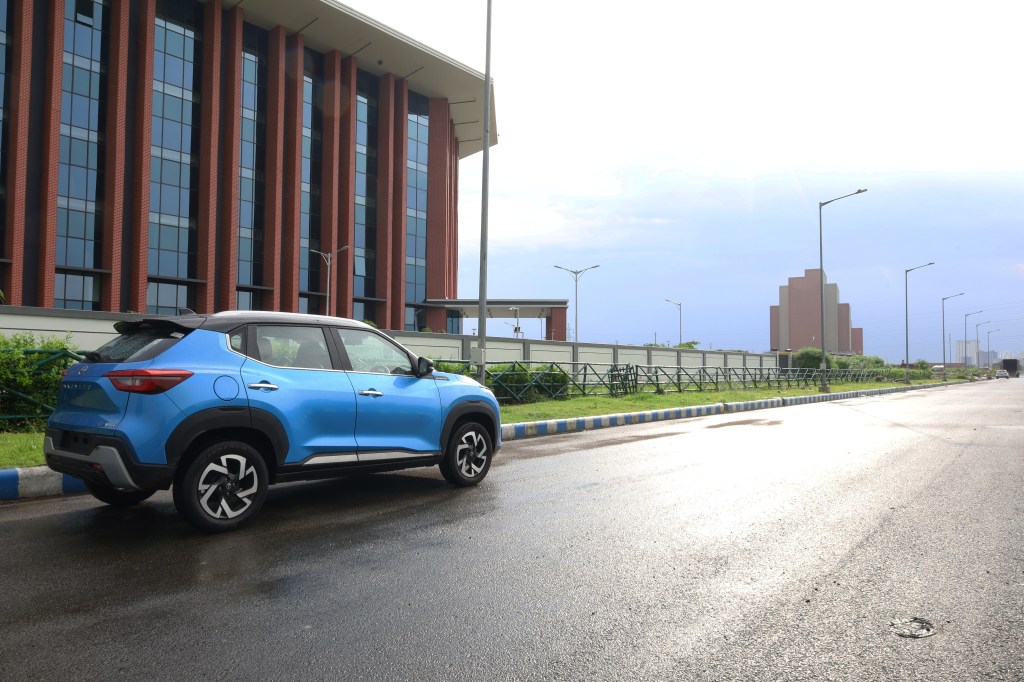
The car has sleek headlamps assembled with lightsaber-style turn indicators, L-shaped Daytime Running Lamps (DRLs) and LED fog lamps which help the Magnite to make style statement and effortlessly lights up the carriageway in the dark. The rear too looks stylish with the sporty and sharp wide split signature tail lamps.
Bold square design of the wheel arches add to the dominating SUV look of the Nissan Magnite. The wider gap between the fender and the wheels helps reduce the bumpyness inside the cabin while driving through rough roads and uneven stretches. The 205 mm ground clearance of the Nissan Magnite ensured that we didn’t kiss even a single speed breaker while cruising in & around Kolkata and New Town. The sporty design of the alloy wheels adds to the style quotient and masculinity of the Magnite.
Interior and Comfort
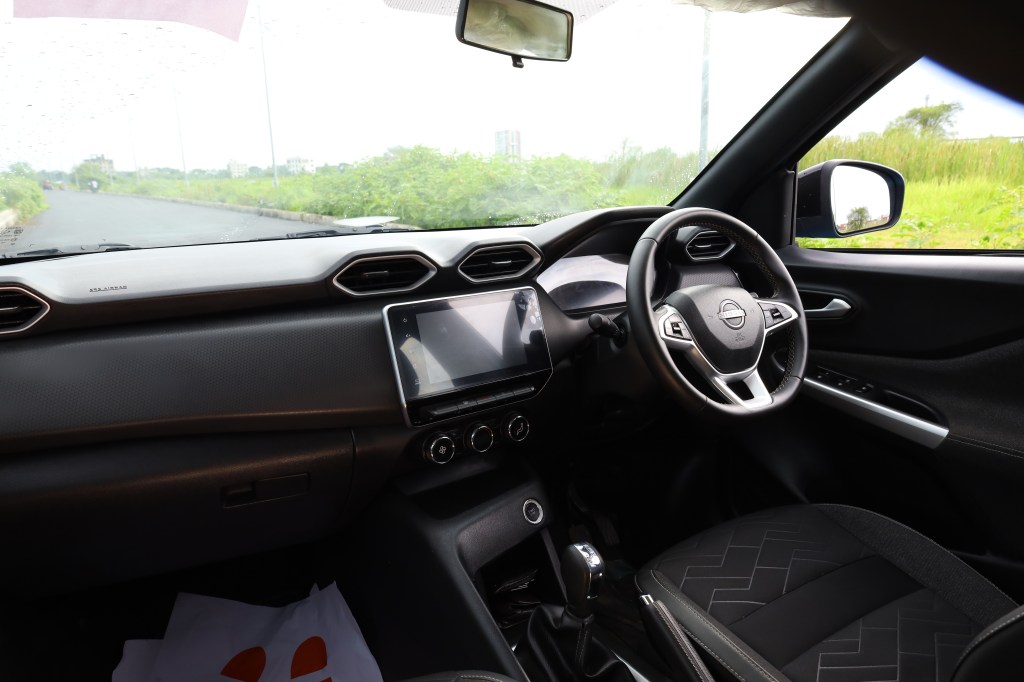
On the inside, the Nissan Magnite EZ-Shift is both spacious and premium. Nissan has achieved a good balance of packaging and seating comfort. With 60-40 split foldable rear seats that offer flexibility, it is a spacious B-SUV, which has a decent ‘couple distance’ (distance between the driver and side passenger) of 700mm + rear knee room of 593mm + rear headroom of 76mm. The front seats are designed to create an open interior space, delivering the spaciousness that one would experience while sitting in the rear, also known as the ‘one-class-above’ knee room. The seats are well bolstered and even after a long drive, one wouldn’t experience any fatigue.
Intuitively designed, the interface and information cluster and the centre-stack are well-thought out for better accessibility without you having to take your eyes off the road. Its horizontal instrument panel structure double deck console makes it wider, spacious and provides plenty of functional storages. Along with that, the Nissan Magnite also has a tech pack which has a wireless charger, air purifier, puddle lamps and ambient /mood lighting, premium speakers (JBL powered by Harman).
The Nissan Magnite EZ-Shift is equipped with a 7-inch TFT meter with welcome animation and tyre pressure monitoring system and 8-inch infotainment display with full flush touch screen, wireless Apple CarPlay and Android Auto and built-in voice recognition. It also comes with Nissan Connect that offers 50+ features (geo fence, roadside assistance, smart watch connectivity etc.) to transform the car as per customer needs.
The Nissan Magnite EZ-Shift is also equipped the Around View Monitor (AVM), which gives the driver a virtual bird’s eye view from above the vehicle. The Magnite boasts of a luggage room capacity of 336 litre and can comfortably accommodate three suitcases.
Performance and Handling
Nissan Magnite EZ-Shift is powered by the HRA0 1.0-litre Turbo petrol engine mated to a 5-speed EZ-Shift gearbox. The engine delivers maximum power of 100PS and maximum torque of 160Nm, while claiming to deliver fuel-efficiency of 20kmpl (ARAI figure).
The Nissan Magnite’s suspension set up is well tuned to tackle Indian road conditions. It handles both good and bad roads with equal ease. We tested the car over certain broken stretches and the suspension absorbed the undulations without sending much jerks to the passenger cabin resulting in a plush ride quality.
Handling of the Magnite is impressive. The steering feels feather light while trying to maneuver the car in city traffic, but when you push the car on the highway, the steering begins to weigh up giving strong feedback to the driver. Body roll is well contained and cornering even at high speed seemed confidence inspiring with the Magnite remaining firmly planted to the ground.
The only drawback is perhaps the 5-speed AMT gearbox which is slightly sluggish in gear shifts, resulting in delayed throttle responsiveness and slow accelerations making the Nisssan Magnite EZ-Shift not-so-fun to drive.
Safety
The Nissan Magnite EZ-Shift is equipped with safety features such as Anti-lock Braking System (ABS), Electronic Brake-force Distribution (EBD), Hydraulic Brake Assist (HBA), Vehicle Dynamic Control (VDC), Traction Control System (TCS), Hill Start Assist (HSA), speed sensing door lock, central locking and SRS dual airbag system with pretension & load limiter seatbelt for driver and passenger.
Nissan’s unique Vehicle Dynamic Control (VDC) system increases the all-new Nissan Magnite’s stability, allowing the driver to have better control, especially in poor weather conditions. Additionally, the Anti-lock Braking System (ABS) helps improve the driver’s braking ability while maintaining control of the vehicle in an emergency.
Verdict
The Nissan Magnite is well engineered products that ticks most of the right boxes and is scripting the success story for Nissan. With the combination of stylish looks, spacious interior, smart technology, good ride & handling and safety features, it is a car that has already gained immense popularity among the car buyers. And now with the convenience of the AMT gearbox, the Magnite EZ-Shift has become an even more attractive offering in its segment. The only negative in the entire package is sluggish gear shifts that lead to power lag which one has to adjust with. Apart from this, the Nissan Magnote EZ-Shift AMT seems all set to dominate its segment with increased propularity.
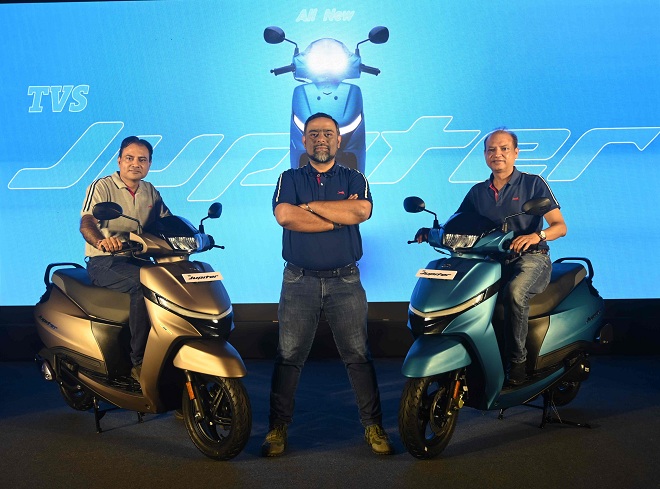
TVS Motor Company (TVSM) has launched the all new TVS Jupiter 110 with prices starting at INR 77,200 (ex-showroom).
The TVS Jupiter 110 is powered by a 113.3 cc, single cylinder, 4 stroke engine which generates a power of 5.9 kW@6500 rpm and a torque of 9.8 Nm@ 5,000 rpm (with iGO Assist) and 9.2 Nm @ 5,000 rpm (without Assist). The scooter encompasses pioneering technology that achieves a 10% increase in mileage compared to its predecessor. This is attributed to the innovative iGO Assist technology. It has an intelligent ignition system with auto Start-Stop functionality and ISG (Integrated Starter Generator) aimed at enhancing performance by harnessing power from the battery during overtaking and climbing. This facilitates additional acceleration precisely when required.
At the launch, Mr. Aniruddha Haldar, Senior Vice President — Head Commuter Business and Head Corporate Brand & Media, TVS Motor Company, said, “TVS Jupiter 110 has been the anchor of the TVS Motor scooter portfolio for the last decade. Over time, 6.5 million households have reposed their faith in this product, making it one of the biggest automotive brands out of India. The core DNA of Zyada Ka Fayda is further reinforced by the reimagined ALL NEW TVS JUPITER. The ability to deliver torque on demand, enhanced fuel-efficiency with loads of usable space, in contemporary design, sets the scooter in a league of its own. This superior proposition will continue to delight customers and build brand love for TVS Jupiter.”
Jawa Yezdi Motorcycles who introduced ‘Neo-Classic’ motorcycles to India, has unveiled the 2024 Jawa 42. This latest avatar, driven by continuous enhancement and tech-advancements cements the Jawa 42’s position as one of India’s most revered neo-classic machine. With its blend of design, performance, and engineering, the 2024 model promises an exhilarating riding experience that sets a new benchmark in its class.
The 2024 Jawa 42 redefines price performance with revolutionary upgrades. Powered by the new 294cc J-Panther liquid-cooled engine delivering 27.32 PS and 26.84 Nm, it features refined NVH levels, gear-based throttle mapping and smoother shifting. With improved ground clearance, retuned suspension, an enhanced seat, and best-in-class braking, this 42 sets a new benchmark in riding dynamics, comfort, and safety.
“The 2024 Jawa 42 is a testament to holistic approach to motorcycle engineering,” says Anupam Thareja, Co-founder of Jawa Yezdi Motorcycles. “We’ve left no stone unturned in our quest for ‘price-performance’ perfection. From upgrading materials to refining our manufacturing processes, we’ve pushed boundaries at every step. We believe in the philosophy of price-performance engineering, and the result is a motorcycle that doesn’t just meet expectations—it redefines them. The authentic neo-classic 2024 Jawa 42 is a trinity of edgy performance, gorgeous design, and precision engineering.”
The Jawa 42’s evolution has been a relentless pursuit of perfecting the ultimate neo-classic motorcycle. From its inception, each upgrade has brought us closer to the perfect synthesis of classic style and modern performance.
Our journey began with a potent, segment-first liquid-cooled engine and 6-speed transmission, laying the foundation for the perfect neo-classic. As we progressed, we enhanced performance, comfort, and versatility while meeting stringent emission standards.
Recent updates have significantly elevated the Jawa 42 experience. We’ve implemented gear-based throttle mapping and an assist & slip (A&S) clutch, enhancing overall riding dynamics. The latest engine improvements include a heavier magneto, larger throttle body and entry duct, and a CP4 cylinder head for superior performance.
For 2024, the company has fine-tuned the experience even further. The 2nd, 3rd, and 4th gears are now optimised for enhanced drivability with shifting smoothness. A redesigned balancer weight and new hub-type balancer gear have reduced vibrations, delivering our most refined and exhilarating ride yet.
The result of this tireless journey is the realisation of our ultimate vision. Today’s Jawa 42 stands as the pinnacle of neo classic performance, offering best-in-class braking, handling, and ergonomics. It’s not just a throwback to the past or a nod to the future – it’s the perfect neo classic, exactly as we envisioned from the start.
The 2024 Jawa 42 speaks to a new generation of riders who demand performance without compromising on style. The expanded palette now offers 14 striking colour options featuring both matte and gloss options.
The iconic Jawa tank and 42’s bold aesthetics, adds a modern twist to the classic silhouette. Whether you prefer the timeless appeal of classic shades or the head-turning allure of our new vibrant options, there’s a Jawa 42 to match every rider’s personality.
Variant, Colour
Price (Ex-Showroom Delhi)
Type
Jawa 42 Vega White (Single channel ABS, Spoke wheels)
Rs. 1,72,942
Gloss
Jawa 42 Voyager Red (Single channel ABS, Spoke wheels)
Rs. 1,74,942
Gloss
Jawa 42 Asteroid Grey (Single channel ABS, Spoke wheels)
Rs. 1,74,942
Gloss
Jawa 42 Odyssey Black (Single channel ABS, Spoke wheels)
Rs. 1,74,942
Gloss
Jawa 42 Vega White (Dual channel ABS, Spoke wheels)
Rs. 1,82,942
Gloss
Jawa 42 Voyager Red (Dual channel ABS, Spoke wheels)
Rs. 1,84,942
Gloss
Jawa 42 Asteroid Grey (Dual channel ABS, Spoke wheels)
Rs. 1,84,942
Gloss
Jawa 42 Odyssey Black (Dual channel ABS, Spoke wheels)
Rs. 1,84,942
Gloss
Jawa 42 Nebula Blue (Dual channel ABS, Alloy wheels)
Rs. 1,95,142
Gloss
Jawa 42 Celestial Copper Matte (Dual channel ABS, Alloy wheels)
Rs. 1,95,142
Matte
Jawa 42 Orion Red Matte (Dual channel ABS, Alloy wheels)
Rs. 1,98,142
Matte
Variant
Price (Ex-Showroom Delhi)
Type
Jawa 42 Sirius White Matte (Dual channel ABS, Alloy wheels)
Rs. 1,89,142
Matte
Jawa 42 All Star Black Matte (Dual channel ABS, Alloy wheels)
Rs. 1,98,142
Matte
Jawa 42 Infinity Black Matte (Dual channel ABS, Alloy wheels), Dual Tone
Rs. 1,98,142
Matte
Jawa 42 Celestial Copper Matte (Dual channel ABS, Alloy wheels), Dual Tone
Rs. 1,98,142
Matte
Jawa 42 Starship Blue (Dual channel ABS, Alloy wheels), Dual Tone
Rs. 1,98,142
Gloss
Jawa 42 Cosmic Carbon (Dual channel ABS, Alloy wheels)
Rs. 1,98,142
Gloss
Jawa 42 Cosmic Rock (Dual channel ABS, Alloy wheels), Dual Tone
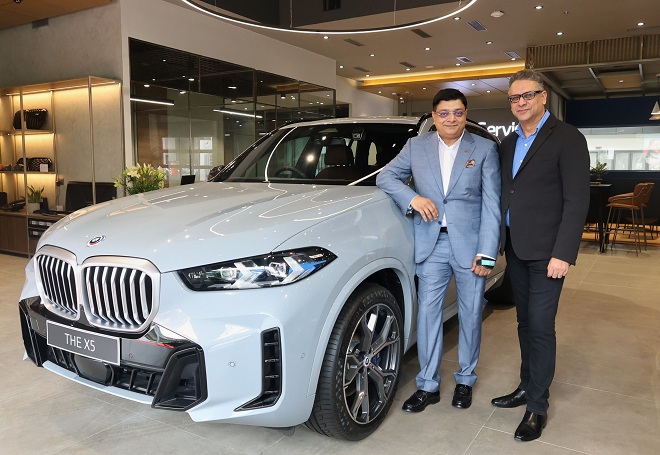
BMW Group India inaugurates its second aftersales facility in Kolkata. The state-of-the art facility also integrates BMW Premium Selection (BMW certified used cars) section and is located at JL No 11, PS-Maheshtala, Anil Nagar, Budge Budge Trunk Road, Kolkata, West Bengal -700141. The dealership is headed by Mr. Charchit Mishra, Dealer Principal, OSL Prestige and exclusively represents BMW Group India with sales and service facilities in Kolkata and Cuttack.
Mr. Vikram Pawah, President and CEO, BMW Group India said, “At BMW Group India, our quest is to redefine luxury for our customers, we are not just elevating their experience; we are transforming it. The launch of a new aftersales and BMW Premium Selection facility by our trusted partner OSL Prestige in Kolkata is a testament to our unwavering commitment to customer satisfaction and excellence. Kolkata, with its vibrant market for luxury vehicles, is a key region for us, and this state-of-the-art integrated facility will ensure that our customers receive the highest standards of service and care. We are certain that OSL Prestige will play an instrumental role in delivering a seamless and rewarding BMW ownership experience.”
Mr. Charchit Mishra, Dealer Principal, OSL Prestige, stated, “We are proud to collaborate with BMW India to establish yet another world-class aftersales and BMW Premium Selection facility in Kolkata. By combining exceptional products with an unparalleled dealership experience, OSL Prestige is committed to delivering the distinguished BMW ownership and aftersales services. The new facility delivers extremely high-quality standards in all processes of Service, Spare-parts and Business Systems. We are excited to further tap into the growing luxury car market in the region and serve our esteemed clientele with even greater dedication.”
The facility is spread over 39,000 square feet, the ultra-modern aftersales facility features completely airconditioned Reception at the Car (RATC). The workshop has 13 service bays (including mechanical, electrical and diagnostic). The BMW certified used car, (BPS) section has a 4-car display area. Additionally, latest range of merchandise and accessories are on display at the lifestyle and accessories zone. The customer interaction lounge offers a relaxed ambience to discuss various aspects of owning a BMW vehicle with sales consultants. Further, customers can avail attractive finance and insurance options for the products of their choice.
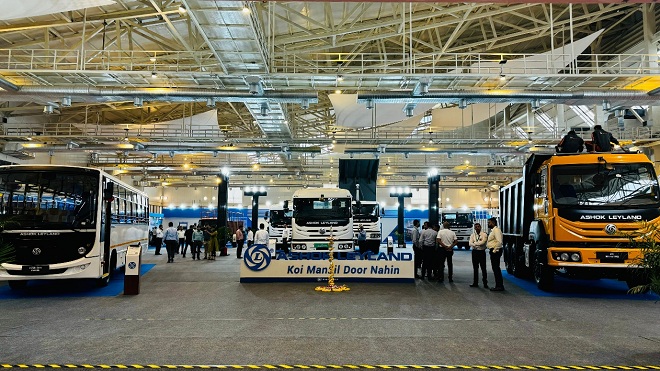
Ashok Leyland Limited, the Indian flagship of the Hinduja Group and country’s leading commercial vehicle manufacturer, has inaugurated two days ‘Mini Expo’ in Kolkata, showcasing its latest innovations in Medium and Heavy Commercial Vehicles (MHCV). Kolkata is among the 11 exclusive locations across India selected for this expo, to demonstrate the company’s commitment to innovation and customer engagement.
The expo, featuring two simultaneous circuits, aims to bring Ashok Leyland’s cutting-edge technologies closer to customers and enthusiasts. Circuit 1, which commenced from Delhi, will progress to Jamshedpur, Bhubaneswar, and Raipur following its showcase in Kolkata.
At the Kolkata expo, Ashok Leyland is showcasing a diverse line-up of vehicles, including the AVTR 5525AN 4X2 AC, AVTR 4825HN AC, AVTR 4825TN HD AC, AVTR 3532TN 8X4, AVTR 1925 TN 10.5 Cu.m, PARTNER SUPER 914 14FT, BOSS 1915 22FT, OYSTER Vi SCHOOL (53 seater), OYSTER Vi STAFF (40 seater), 15 M BUS CHASSIS, and AVTR 55T EV.
Mr. Sanjeev Kumar, President – MHCV, Ashok Leyland said, “The Mini Expo in Kolkata marks a significant milestone as we continue to lead the way in the commercial vehicle segment. West Bengal and Eastern India at large, has been a key market for us. We have always recognized the potential this region has and we are excited about the opportunities that lie ahead in this geography. The Expo is an opportunity for customers to experience our capabilities in driving the future of mobility. We are confident that our vehicles, coupled with our extensive aftermarket solutions, will demonstrate our dedication to providing comprehensive transportation solutions to our customers. We look forward to engaging with our customers and stakeholders at Kolkata.”
The ‘Mini Expo’ in Kolkata highlighted Ashok Leyland’s state-of-the-art MHCV products and vehicles, and is a key event for industry professionals, enthusiasts, and stakeholders interested in the latest advancements in MHCV technology.
The two day expo will be a great opportunity for visitors to experience not only the latest vehicles but also the comprehensive services and solutions that Ashok Leyland offers.
The curtain came down on the highly competitive Polo Cup India 2024, with Mumbai’s Dhruv Chavan and Aditya Patnaik providing a thrilling finish this weekend.
Only 1 point separated the two talented racers as they went into the final race of the final round. Dhruv Chavan (183 points) pipped Aditya Patnaik to the post to take the title by a mere 4 points. Ojas Surve settled for the third position with 159 points.
“This is a dream come true. On Thursday I had a bad crash and flipped the car over. My father was also in hospital during the races. But I held on and managed to win the title,” Dhruv said.
The season kicked off with a rigorous Driver Selection Program in Ahmedabad, Delhi, Bangalore, Mumbai, and Chennai. Under the guidance of renowned figures in motorsports, Saurav Bandyopadhyay and Rayomand Banajee, participants were tested on their driving prowess and physical fitness. The standout performer was rewarded with a coveted partial sponsorship for the season.
Held across two action-packed rounds, the Polo Cup featured a total of 10 races. Round 1, from July 19th to 21st, and Round 2, from August 16th to 18th, brought together an electrifying mix of seasoned racers and rising stars.
Aditya Patnaik jumped into the lead, winning Race 1 in Round 1 at the Madras International Circuit. But Dhruv Chavan took the next race to catch up with him. Avik Anwar from Dhaka, Bangladesh, and Romir Arya, clinched podiums with some excellent performances.
Round 2 heightened the intensity as the racers were pushed to their limits, with six races over the weekend. Aditya Patnaik made a strong statement by winning the first race of Round 2. However, Dhruv Chavan was more consistent, securing crucial points in all the races. Ojas Surve maintained his form with 4 podiums, including his first win of the season.
Romir Arya was crowned the Best Rookie of the season while Munjal Savla won the Master Championship.
Interested racers can sign up to race in the 2025 Polo Cup by participating in the Driver Selection Program which will be conducted on October 5 and 6 in Mumbai.





 Power Drive