Ajgar And Musthafa Hold On To Their Lead At The End Of Leg 2

DSC_1800

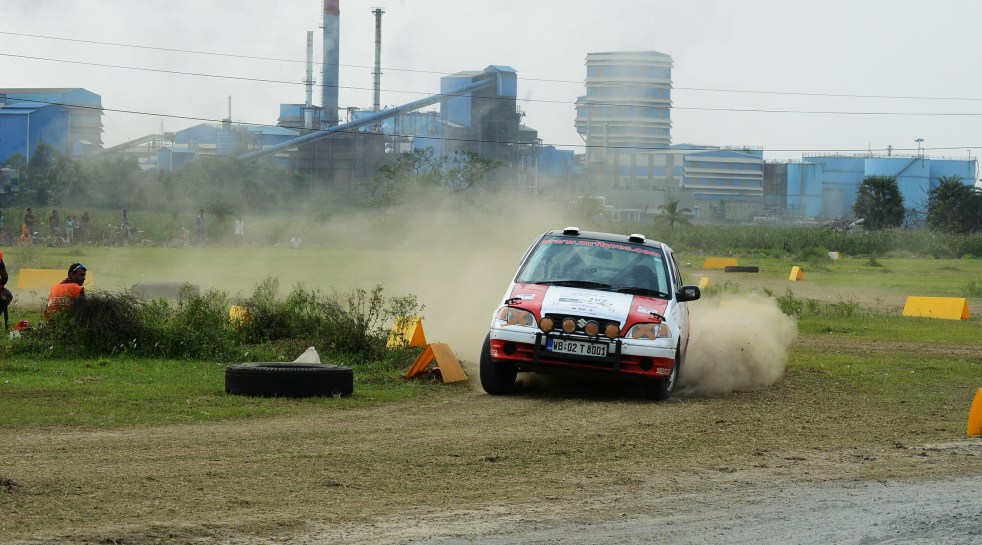
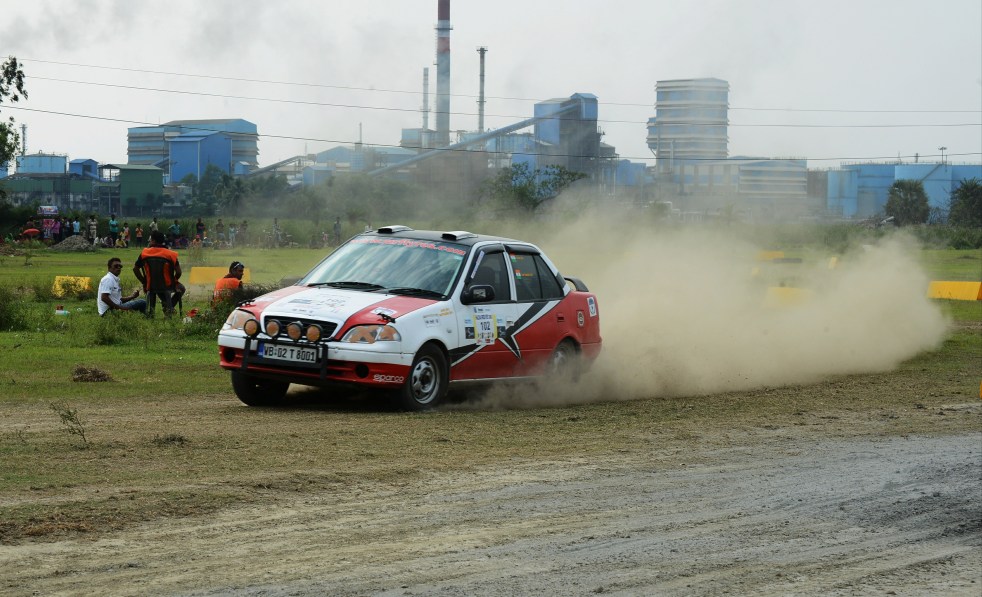
The race for the champion’s position in Biswa Bangla JK Tyre Himalayan Drive 6 got hotter with the duo of Subir Roy and Nirav Mehta lagging behind defending champions Ajgar Ali and Mohammed Musthafa with just one penalty point when the third leg of the rally was flagged off from the periphery of the world-famous Chitwan National Forest in Nepal on Sunday (February 25) morning. While the Ali-Musthafa team picked up 31 penalty points on Day 2 of the rally on Saturday to bring their total score to 85 penalty points, the Roy-Mehta team, champions of Desert Storm, picked up just 24 penalty points to notch up a total score of 86 penalty points, thus very closely narrowing their difference with the defending champions.

At the end of Day 2 of the rally, the only tri-nation TSD (Time, Speed, Distance) from India, the team of Captain Vijaykumar Sharma and Chandan Sen followed at a distant third with 241 penalty points, while the team of Nikunj Toshniwal and Prasenjit Roy scored a total of 367 penalty points, followed closely by Anand Mehta and Sabatullah Khan with 375 penalty points. In the local category, Gagan Sethi and Dhiraj Arrora maintained their lead with a total score of 700 penalty points, followed at a distant second position by Govind Dalmia and Anand Agarwala with 3583 penalty points. The team of Pranjal More and Milindo Paul followed them closely with a total of 3630 penalty points.

The third leg of the rally was flagged off by president of the Nepal Automotive Sports Association, Dasrath Nisal, at 7.30 am Nepal time. The competitors drove through the Lothar river embankment and then down the East-West Highway to enter the Itahari forest for another competitive section that took them over dirt tracks cutting through forests and then a dry riverbed. They then entered India through Kakarvitta and drove through Gajaldoba, which is being promoted by the West Bengal government as a major tourist attraction. The rallyists then crossed Lataguri to reach Murti, located beside the Gorumara National Park, home to rhinos and the white-headed bison.

Sunday’s drive took the rallyists over 609 kilometers and through verdant forests and tea gardens. It was a thrilling drive through many tourist spots.

Biswa Bangla JK Tyre Himalayan Drive 6 Thrills Nepal

DSC_2024

The lush green backdrop of the Chitwan National Park in Nepal provided the perfect setting for the ceremonial flag-off of the second leg of the Biswa Bangla JK Tyre Himalayan Drive 6, the only tri-nation TSD (Time, Speed, Distance) rally of India. Saturday’s 80 kilometre-long rally route traversed through hills, tropical forests, embankments of the Rapti river and dry beds of the Rapti’s many tributaries.

The second leg of the rally was a thrilling one making it the first time a leg of an international rally was staged at Chitwan, a National Park and a World Heritage Site spread over 932 square kilometres. The rallyists drove through the periphery of the national park which is home to a wide variety of flora and fauna, including the Royal Bengal Tiger, the endangered one-horned rhino, sloth bears, elephants, leopards and crocodiles.

DSC_1968

At the end of the first leg of HD 6 on Friday (February 23), defending champions Ajgar Ali and Mohammed Mushafa were leading their class with 54 penalty points in their Mitsubishi Cedia. Following them closely at their heels was the team of Subir Roy and Nirav Mehta with 62 penalty points in their Maruti Gypsy. Captain Vijay Kumar Sharma and Chandan Sen finished the day in third position with 132 penalty points.

In the ‘local category’, media professionals Gagan Sethi and Chandigarh lad Dhiraj Arrora were leading with 545 penalty points, followed by Rajen Bhetiwal and Bishal Chettri in second position with 1861 points. George Khati and Avhishek Lamichaney finished a distant third with 2159 points at the end of the first leg.

DSC_1990

HD 6 was flagged off from City Center in Siliguri (West Bengal) jointly by Siliguri Police Commissioner Sunil Kumar Choudhury and Inspector General of Sashastra Seema Bal (SSB) Srikumar Bandopadhyay on Friday (February 23) morning. Hundreds lined up at the flag-off venue with police and SSB brass and pipe bands playing different and popular tunes. The rallyists drove through Matigara-Kurseong Road, Khaprail Bazar and Panihati before reaching the vast dry bed of the Manja river, a tributary of Teesta river. They then drove through Naxalbari (which incubated the infamous ultra-left Naxal movement) to enter Nepal at Kakarbhitta.

The first leg of the rally took the competitors through dirt and dust tracks inside tea gardens and through lush forests. They also traversed through narrow village roads. At Kakarbhitta, HD6 participants were accorded a warm welcome by the Nepal Automotive Sports Association (NASA). The rallyists then drove 466 kilometres on the busy East-West Highway to reach Chitwan for the night halt. Out of the total 521 kilometres that the competitors travelled on Friday, 74 kilometres was in the competitive section.

On Sunday, the rallyists will travel back to India through the same route and then reach Murti in the Dooars region of northern West Bengal.

Biswa Bangla JK Tyre Himalayan Drive 6 To Be Flagged Off From Siliguri Tomorrow

DSC09160-L

India’s only international TSD (Time, Speed & Distance) rally is all set for a flag-off from Siliguri on Friday, February 23, 2018. The Biswa Bangla JK Tyre Himalayan Drive 6, now in its sixth edition, will cover 1650 kilometres over five thrilling days and traverse through the Dooars and Darjeeling Hills in North Bengal, and various picturesque routes in Bhutan and Nepal.

Being held in association with West Bengal Tourism, this unique rally aims at promoting motorsports, showcasing the enormous tourism potential of North Bengal and the contiguous areas of Bhutan and Nepal, and boosting people to people connect and drive tourism between the three friendly neighbouring countries.

Apart from being the only Tri Nation TSD rally from India, Biswa Bangla JK Tyre Himalayan Drive 6 is also distinct from other TSD rallies since it covers a wide variety of terrain, ranging from tarmac, river beds, dirt tracks, forest roads and mountainous terrain. It will skirt steep slopes that will not only present a tough challenge to the participants, but also a lot of thrill to them as well as spectators.

Around 30 competing cars, including top rallyists from the country, will take off from Silliguri on Friday morning and journey through North Bengal’s lush forests that are home to a rich variety of flora and fauna, including the Royal Bengal Tiger, the one-horned rhino and the Asiatic elephant, as well as picturesque tea gardens before entering Nepal trough Kakarbhitta border hitting the East West highway to the famous jungle paradise Chitwan in Nepal.

February 24 will see the participants journeying to the famous jungle roads on the fringes of the Chitwan Reserve Forest areas through the gravel and dirt tracks before coming back to Chitwan for a well  deserved rest for the participants.

The rallyists drive back from Chitwan through the Dooars on February 25 and after driving through the heart of Terai region in Nepal to enter India through the Kakarbhitta border en route to Murti in the Dooars for the night halt.

The rally participants spend the next day driving through the Dooars region going through serene terrain with it’s tea gardens, jungle tracks and river beds before entering the third country Bhutan at Phuntsholing .

For the fifth and final leg the participants will leave Phuntsholing through most amazing and adventurous hill tracks and climb up the hills to reach Darjeeling, the ‘Queen of Hills’ where the Rally will culminate. The gala prize distribution ceremony will take place at Darjeeling at 10:00 am on February 28.

The Rally draws inspiration from the Chief Minister of West Bengal Mamata Banerjee’s vision of Connecting Bengal to its neighbours and encouraging People to People Connect in the region. The addition of Bhutan & Nepal to the Rally schedule making it a tri-nation event is another step in that direction and towards the aspiration of Biswa Bangla – Connecting Bengal To The World.

The fifth edition of the hugely successful Himalayan Drive Car Rally, which has become a landmark event in India’s motorsports calendar, saw nearly 30 competitors last year. It was for the first time last year that a TSD rally crossed the boundaries of the country to go into a neighbouring country, Bhutan connecting peoples of the two countries through adventure motorsports.

Sending his best wishes to the Rally, Indranil Sen , Minister of State for Tourism, Govt. of West Bengal said ; “The development of North Bengal, especially for tourism, is a priority for the Government. The Rally promises to showcase and unveil the lesser known and yet to be explored areas of North Bengal which, if properly marketed and will surely be one of the most treasured tourist destinations in India in times to come. I thank Just Sportz wholeheartedly for promoting such destinations.”

JK Tyres & Industries Limited, India’s leading tyre manufacturer, has been associated with Himalayan Drive as the Title Sponsor since its inception in 2013. According to Sanjay Sharma, Head – Corporate Communication and Motorsport – JK Tyres & Industries Limited, “We are really excited about the JK TYRE HIMALAYAN DRIVE 6. It is India’s only international rally that goes into two different countries. This is not only a great opportunity for our top rallyists but will also give a huge boost to the sport in all three countries.”

According to Tamal Ghosal, Director , Just Sportz, “The first five Himalayan Drive rallies have unlocked the great prospect of adventure sports in the Eastern Himalayas. Last year by including Bhutan and Nepal and making the event a 5 day event effort was made to make the Rally more adventurous and tested the endurance of the man and the machines. We are certain that the Biswa Bangla  JK Tyre Himalayan Drive 6 will play the role of a catalyst for People to People Connect among friendly neighbouring countries and for encouraging adventure sports, especially motorsports in the region.”

The New Lotus 3-Eleven 430

Lotus_3-Eleven_430_19-02-2018 (1)

The new Lotus 3-Eleven 430 has retaken the title as Lotus’ quickest street-legal sports car – a fitting send off for the company’s legendary road racer.

The most extreme machine that Lotus builds, the new 3-Eleven 430 is the fastest Lotus road car to lap the challenging Hethel circuit, 0.8 seconds quicker than the second place Exige Cup 430, and two seconds quicker than the previous 3-Eleven, delivering a benchmark time of 1 minute 24 seconds.

Upgraded and specifically re-optimised for the 3-Eleven, the supercharged and charge-cooled 3.5-litre V6 engine produces 430 hp and 440 Nm, propelling the 3-Eleven 430 from 0-60 mph in an astonishing 3.1 seconds (0-100 kmph in 3.2 seconds) and a top speed of 180 mph (290 kmph) – up from 3.3 seconds (0-60 mph) (3.4 seconds 0-100 kmph) and 174 mph (280 kmph) for the previous version of the Lotus 3-Eleven.

Lotus_3-Eleven_430_19-02-2018 (2)

Designed to provide enthusiast drivers with the purest and most direct of driving experiences, the 3-Eleven is cut from the same cloth as the most iconic Lotus cars. Remaining true to the company’s edicts, it employs a lightweight carbon-composite body and a bespoke extruded and bonded aluminium chassis. Sculpted part-exposed carbon side panels and striking carbon interior panels all contribute to the exceptional light weight.

Originally unveiled in the summer of 2015 at the Goodwood Festival of Speed, the 3-Eleven was met by rapturous crowds and universal acclaim. Its unashamedly aggressive styling, lightweight design and hypercar-humbling performance set new standards for speed and agility at any price. From remarkable sector times on the famed Nurburgring Nordschleife circuit during its development, the original Lotus 3-Eleven went on to lap the Hockenheimring short circuit in an incredible 1 minute 6.2 seconds at the hands of “Sport Auto Magazine”, setting a production car lap record for the German publication.

As the company enters its 70th anniversary, the new 3-Eleven 430 is a celebration of the company’s legacy of pure performance and intelligent engineering, as it readies its new range of sports cars.

Jean-Marc Gales, CEO, Group Lotus plc commented: “When we first unveiled the Lotus 3-Eleven it heralded a new generation of truly focused, world-class sports cars. It altered perceptions of what was possible at this price category, and today the new 3-Eleven 430 moves the benchmark to remain the ultimate weapon in focused road driving and track work.”

Lotus_3-Eleven_430_19-02-2018 (3)

Historically, Lotus’ ‘Eleven’ nomenclature is reserved for models which bridge the gap between road and track in the most direct way possible. As a result, these open-cockpit specials have become some of the brand’s most collectable – revered for their lack of embellishment or gimmickry.

As production draws to a close, this final evolution of the formidable 3-Eleven raises the bar beyond the reach of aspiring rivals. Packing more power than before, thanks to the development of Lotus’ signature supercharged V6 engine, it’s a suitable send off for such a respected and highly capable sports car.

With new part-visible weave carbon-composite bodywork, the 3-Eleven shows it mettle as the very epitome of lightweight engineering. Revised for the 430 edition, the road car has a dry weight of 920 kg (5 kg less than the previous model), giving a power to weight ratio of a mighty 467 hp per tonne – an increase of 24 hp per tonne.

Lotus_3-Eleven_430_19-02-2018 (4)

With an increased performance envelope, the Lotus 3-Eleven 430 has also evolved its aero accordingly. Already noted for its high levels of downforce, the carefully optimized design integrates a higher mounted straight-cut rear wing (50 mm higher than previous model) with re-profiled end plates, a long front splitter and lip spoiler, and a flat floor with rear diffuser to increase downforce by 44 kg to 265 kg at maximum speed.

The car’s standard specification does little to belie its intentions, with a Torsen-type limited slip differential, Ohlins DFV one-way adjustable dampers and Eibach adjustable front and rear anti-roll bars. In addition, 6-position variable traction control, linked directly to the ECU, with five pre-set traction levels (1%, 3%, 6%, 9%, 12% slip and “off”) allows owners to tune their preferred setup. These features are joined by Lotus’ slick, six-speed manual gearbox and acclaimed open-gate design – precisely engineered for fast and seamless shifts.

The Lotus 3-Eleven 430 employs Michelin Cup 2 tyres (225/40 ZR18 front and 275/35 ZR19 rear) to transfer its considerable power to the road. This mechanical grip, combined with the considerable aerodynamic downforce, allows drivers to tap into the model’s lateral acceleration potential of up to 1.5 g whilst cornering.

The Lotus 3-Eleven relies on AP Racing four-piston callipers front and rear and new, two-piece J-Hook brake discs (332 mm front and rear) which provide improved bite and debris clearance and reduce distortion and vibration. Each corner is finished by Lotus-designed ultra-lightweight forged aluminium wheels, finished either in gloss or satin black.

Launching the new Lotus, Jean-Marc Gales said, “The development of the original 3-Eleven focused our thoughts on a Lotus of pure simplicity and advanced our thinking on the sports cars of the future. The 3-Eleven 430 is the ultimate conclusion of that work, a super car killer and something that we’re all immensely proud of.”

Renault Sport Formula One Team Reveals 2018 Challenger

Motor Racing - Formula One Launch - Renault Sport Formula One Team R.S.18 Launch - London, England

Fans of the Renault Sport Formula One Team were able to get a close-up look of the 2018 season challenger yesterday as the Renault R.S.18 was unveiled. Using specially-created tools, fans could see a stunning hologram projection of the car and spin it through 360 degrees to see its brand-new lines and new black and yellow livery.

The Renault R.S.18 is Renault Sport Formula One Team’s third chassis since its return to Formula 1 as a full works’ entry in 2016. The car is a progression and refinement of the concepts developed during the 2017 season. It includes an improved suspension concept and greater aerodynamic downforce. Noticeably, the R.S.18 also features the mandatory new-for-2018 cockpit protection known as the ‘halo’ and a re-profiled engine cover to comply with the 2018 technical regulations.

The 1.6-litre turbocharged V6 Renault R.E.18 power unit will power the R.S.18. The power unit has realised a very strong programme on the dyno in Viry-Chatillon to maximise performance and improve reliability in preparation for the reduction to just three internal combustion engines (ICE) and two MGU-K and energy stores per season.

Motor Racing - Formula One Launch - Renault Sport Formula One Team R.S.18 Launch - London, England

The R.S.18 is developed jointly by the teams in Enstone, UK, and Viry, France. Significant improvements have been made to the Enstone facility over the past year, with enhancements to the CFD supercomputer, wind tunnel, race team operations room, gearbox dyno, machine shop and an expanded design office. The upgrades have already translated into on-track performance, with Renault Sport Formula One Team finishing the season sixth in the Constructors’ Championship, improving from ninth in 2016.

“Renault Sport Formula One Team’s ambition is clearly to uphold the outstanding record of the past and the 2017 season has confirmed we are on the right track,” says Renault Sport Racing President Jerome Stoll. “We are a team on the rise. We have two very talented drivers who are hungry for results. Enstone is regenerated and the workforce has already increased by more than 35%. Our investment has so far been successfully translated to the track as we rose from ninth to sixth in the Constructors’ Championship in 2017 and ended the year with the fourth fastest car.

“The success of the programme in just two years is testament to the resilient plan laid down early in the creation of the team and the strong job done by Cyril and the entire Renault Sport Racing teams. I am convinced year three will take us one step closer to the long-term aim: winning races and challenging for championships.”

Motor Racing - Formula One Launch - Renault Sport Formula One Team R.S.18 Launch - London, England

Cyril Abiteboul, Renault Sport Racing managing director, echoes: “Last year was successful in many ways. It was the second year in our rebuilding and a further step towards our long-term plans and aims. 2016 was all about recruiting, investing, bringing in new sponsors, new talents and building our brand. Over the past year I’ve seen progression in many areas: ninth to sixth in the standings – in many races we were often the fourth fastest team on the grid. This is a testament to our drive, commitment and adherence to a very ambitious plan. It was a quantified progression towards what we want to become and challenging the top teams.

“We have everything to be positive about this year. We have two very talented and ambitious drivers. Last year Nico gave us exactly what we needed with his experience, knowledge and ability to lead both on and off track. Carlos joined us at the end of the season and he bought something fresh, and he scored points to help us in the Constructors’ battle. Without that we wouldn’t have finished where we finished.

“Our headline target is to show continued progression through results. We want to be able to showcase our progression in every regard; power unit, chassis, operations, drivers. Everything must improve and we must continue to grow. We want to demonstrate this in many different ways, from the teams we will be directly racing against, to the gap to the leaders, including also our fan base and the respect that our team will inspire in our way we behave on and off track.”

Motor Racing - Formula One Launch - Renault Sport Formula One Team R.S.18 Launch - London, England

The Renault R.S.18 will be delivered to drivers Nico Hulkenberg and Carlos Sainz, and both are keen to get to grips with the car at the first test in Barcelona, from 26 February to 1 March.

“When I have visited Enstone and seen everything going on with the development of the R.S.18 I’m very enthused about the season ahead,” comments 30-year-old Nico. “Add that to the news from Viry about the development of the power unit and everything looks and sounds good; it’s all positive and there are exciting times ahead. I’m feeling positive and optimistic in myself. We’re in a good position. For this year we want to build on the good platform of last season. 2017 was about bedding in, now I want to get ready to go. I get a good feeling, we have put the work in over the winter and hard work usually pays off. I’m eager to get out there. Put me in the car.”

Twenty-three-year-old Carlos is similarly eager to get going after joining the team towards the end of the 2017 season. “The general approach is to work harder every day to continue on a positive trend. For sure the main target is to take a step forward, both me as a driver and the whole team. It’s difficult to predict how big that step will be, however, I’m confident as I have been pushing hard during the winter and I know everyone at the factory is giving their very best. I´m convinced this is going to be an exciting season.”

Motor Racing - Formula One Launch - Renault Sport Formula One Team R.S.18 Launch - London, England

Nico and Carlos will be joined this year by Jack Aitken, who steps up to become Third and Reserve Driver. Twenty-two-year-old Jack, who is British-Korean, was one of the founding members of the Renault Sport Academy and will combine his F1 role with competition in the FIA Formula 2 Championship. “It feels amazing to take up the role as Third and Reserve Driver,” says Jack. “It hasn’t quite processed yet, but I’m going to step up my involvement with the team quite a lot. Over the first Barcelona test, it will start to feel real and sink in a little bit more. The role gives me an opportunity to be closer to Nico and Carlos and learn from them, as well as observing the race team, the engineers and how everything operates. Of course, if I’m required, I’d be happy to jump in the car, but I hope it is all fine with Nico and Carlos! At the moment, it will be about continuing my development.”

Artem Markelov will support the team in his new role as Test and Development Driver. The Russian will combine an F2 campaign with development duties in the team’s driver-in-the-loop simulator at Enstone. Artem commented: “I’m really happy to join Renault Sport Formula One Team as Test and Development Driver. Renault is a standout name in Formula 1 so to sign for them is a really significant step in my career. This year will consist of a lot of listening and learning and taking the opportunity when it comes. I’m grateful for the opportunity, and I’ve had a busy winter of preparing for what will be a demanding season of test driving and racing in the FIA Formula 2 Championship with Russian Time. I’m very much looking forward to the start of the season and getting to work.”

The 2018 season starts in earnest in Melbourne, Australia, on 25 March. Prior to the season-opening Grand Prix teams will participate in two four-day test sessions at the Circuit de Barcelona-Catalunya outside Barcelona, Spain.

Jaguar Art Of Performance Tour Thrills Kolkata

5

Set against the backdrop of greenery, the Behala Flying Club airstrip is a sea of calm. But that serenity doesn’t last very long as it is soon obliterated by a loud, ripping, snarling roar that only grows in pitch and amplitude, and what you see is a red blur racing away in the distance.

We were at ‘The Art of Performance Tour’ by Jaguar – a series of dynamic experience events across India that provide an opportunity to witness what it’s like to get behind the wheel of a Jaguar under the guidance of expert drive instructors and that red blur I was  referring to earlier was the prodigious Jaguar F-Type R Coupe.

4

Joining the F-Type Coupe in this event is the rest of Jaguar India’s line-up – the XE, XF, XJ-L, F-Pace, and F-Type S, each of them with design cues typical of the brand including the large chrome grilles, cat-eye headlamps and low-slung silhouettes.

The airstrip has been demarcated to experience three different aspects of capabilities – acceleration, handling and braking.

First up is the acceleration run and here I get to sample the F-Type. Its gorgeous lines are more stunning in flesh, and I see why this is one of the best looking cars in the world. As I strap myself inside, I notice that the exquisite design extends to the interiors as well with its airplane-like cockpit feeling at home on the pilot’s runway. One cool detail on all the Jaguars is the welcome gesture, where turning on the ignition causes the AC vents to revolve open and gear selector dial to rise.

3

Heading towards the start line with both hands on the steering wheel and right foot nursing the gas pedal, I can feel my heart pumping in anticipation. “Go,” says the accompanying instructor – I press pedal to metal and what I experience next is nothing short of mental. I’m pinned to the back of the seat while sprinting from 0 to 100kmph in matter of seconds and with 200kmph fast approaching. All this while, there’s that growling roar of the supercharged 550hp V8 that is music to the ears.

Next we hit the slalom to showcase the handling prowess of Jaguar cars. Here I get to sample the company’s entire line-up of luxury sedans and the F-Pace SUV. Driving the XE and XF through the course is easy as they take the quick direction changes in their stride. However, what’s noteworthy is the performance of the large XJ sedan and the F-Pace SUV as they seem to shrink in size without feeling unsettled as we drive through the slalom. Of course, in the interests of safety, ESP remains on at all times.

The final course turns out to be a driving simulation that emulates an emergency braking situation, and here too, Jaguar’s mainstream line-up proves to be more than able to handle the manoeuvre and panic braking.

All the cars delivers the performance that one expects from a car wearing the Jaguar badge. Overall, it was a thoroughly enjoyable drive experience filled with thrill and adrenaline. Sundays have never been more fun.

Haas First To Reveal 2018 F1 Car

Haas-F1-Car-2018

Want to know what a 2018 F1 car will look like? Then look no further. Haas have become the first team to release images of their latest challenger, with digital renderings of the VF-18 showing just how different this season’s machines will look compared to their predecessors.

Described as an evolution of the team’s second car, the VF-17, which carried the American team to eighth in the constructors’ standings last year, the most obvious visible differences to the VF-18 are the addition of the halo cockpit safety device and the removal of the sharkfin engine cover and T-wing – which have both been outlawed this year.

“The biggest part of the car’s evolution was the addition of the halo,” said Guenther Steiner, Team Principal. “It took quite a bit of study by the aerodynamicists, but the designers had to work hard to modify the chassis so the halo could survive the mandated loads.

“The total minimum weight of the car increased because of the halo, and there’s a higher centre of gravity simply because of the halo’s position. But, everyone is in the same boat.

“The regulations stayed pretty stable between 2017 and 2018, so the VF-18 is an evolution of our car from last year. It’s less about reinvention and more about refinement. You see elements we had from last year on the car this year.

“Our 2017 car was actually pretty good, but we didn’t always get the best out of it, and that’s what we aimed to change in 2018. We got the car as light as possible to carry more ballast. We were able to do a better job of putting the weight where we wanted it.”

Haas-Formula-One-Car-2018

As with previous machines, the VF-18 relies heavily on technology from Ferrari, including power unit and transmission. As such Gene Haas, the American squad’s founder and chairman, says the Italian team will be the benchmark for performance in 2018.

“It’s no secret we use a lot of Ferrari equipment, so we’re using them as our baseline,” said Haas. “We need to be within a half-second of the Ferraris in order for us to be competitive. We weren’t last year. I would say we were a second to a second-and-a-half slower than the Ferraris. Overall, we were maybe two seconds off the pole qualifiers, so we need to knock a second off that if we really want to be competitive.

“We’ve eliminated a lot of the variables where we knew we were weak, and we knew where we needed to focus. We need to be able to go to the majority of races and put the car down on the track and be fast. We’ve focused on what it’s going to take to get the cars to be consistent and to close that gap between the top cars.”

The VF-18, which retains the grey, red and black livery of 2017, albeit in a revised guise, will hit the track for the first time at the opening pre-season test of the year in Barcelona, beginning February 26.

What’s New For 2018 Formula One Seaon?

Formula-One-L

After the rules revolution of 2017 – one that saw F1 cars become wider and faster – this season’s changes are relatively few in number. That doesn’t mean, of course, that they aren’t important – and some will be very obvious indeed.

Technical regulations:

– T-wings and shark-fin style engine covers outlawed
– halo cockpit protection device mandatory
– suspension systems that could alter the car’s aero performance over a lap not allowed

Sporting regulations:
– drivers allowed three rather than four power units per season
– simplified grid penalties for power unit changes
– wider range of dry tyre compounds

Goodbye to T-wings and shark fins

When the teams considered the 2017 regulation changes, as always they were looking for what wasn’t written in the rules – ie the loopholes – as well as what was. The emergence of the extended, shark-finned engine covers, combined with the rather ungainly looking T-wings, was the result of one such loophole – but one that has been closed for 2018.
The blocks in red above show where developments were forbidden – but as you can see the small, central space in between had no restrictions and the teams took full advantage, leading to some extreme solutions. Williams employed a double T-wing, while the likes of Force India (top drawing), Renault and McLaren took things further, experimenting with multiple planes. The purpose of the T-wing was to better direct airflow to the main rear wing, and in some cases to create a little additional downforce.

With the shark fins and T-wings outlawed for 2018, we can expect the rear of this season’s new cars to look more like that tested by Sauber in Austin back in October of last year, illustrated below. The engine cover still features a fin of sorts, but nothing like the huge swathes of carbon fibre we saw in 2017.

Hello to halos

The one change every F1 fan will immediately notice in 2018 is the introduction of the halo – the cockpit protection device designed to further improve driver safety in the event of an accident, and in particular to deflect debris away from the head.

The design of the halo, which we have seen teams trialling in practice and test sessions over the past two seasons, is not dissimilar to the original study carried out by Mercedes at the FIA’s request in 2015, with a central pillar supporting a ‘loop’ around the driver’s head.

Though the halo is mandatory, with its core design dictated by the rules, there will be some scope for teams to modify its surface, so don’t be surprised to see a variety of small aero devices adorning this new addition.

The figures in the drawing above indicate the impact forces, in kilonewtons, that the halo must withstand in each direction to pass the required FIA static load tests. This is an area which has occupied a lot of the teams’ time, not least because they would ideally like to keep the mountings as low-weight as possible.

The overall minimum weight of cars has gone up by 6kg to 734kg to compensate for the introduction of the halo, but it’s estimated that the actual impact of the device plus the mountings could be as much as 14kg, which will leave teams with less room to play with when it comes to performance ballast – and also put heavier drivers at a potential disadvantage…

Trick suspension outlawed

Another small, but potentially important directive issued by the FIA ahead of the 2018 season relates to trick suspension systems which could be used to improve a car’s aerodynamic performance.

Last year teams including Red Bull (above) and Ferrari (below) tried set-ups with a small link in the front suspension connected to the upright, believed to cleverly allow the ride height of the car – a key factor in aero performance – to be varied over the course of a lap depending on steering angle. The FIA has since decreed such systems will not be allowed.

Three engines per season

In a bid to make F1 power units even more reliable – and further reduce costs – this season each driver must make do with just three engines for the 21-race campaign. That compares with four engines last year (when, incidentally, the calendar featured one less Grand Prix).

The exact impact this has remains to be seen, though treading the fine line between performance and durability will certainly be tougher than ever: go too conservative and you’ll fall off the pace; go too aggressive and you risk costly failures and grid penalties – though those too have been changed for 2018.

One less engine per season will also mean one less chance per season for teams to introduce significant power unit upgrades – meaning those who best manage their development programme over the course of the year could stand to reap even bigger rewards.

Simpler grid penalties

One less engine per driver could mean more grid penalties in 2018. However, there will be far less confusion for fans over how those penalties impact the starting order.

Under the previous system, drivers changing multiple power unit elements could rack up multiple grid drops, often in excess of the number of cars at the event.

Now, any driver who earns a grid penalty of 15 places or more will have to start from the back of the grid. If more than one driver receives such a penalty they will be arranged at the back of the grid in the order in which they changed elements. That should mean less headaches for fans – and those at the FIA tasked with deciding the grid!

Wider range of tyre compounds

As in 2017, official F1 tyre suppliers Pirelli will make three dry-weather compounds available to teams at each Grand Prix. However, for 2018 those three will be selected from a broader range of compounds, which now includes the new, pink-marked hypersoft at one end of the spectrum and the orange-marked superhard at the other.

It means in total there will be seven, rather than the previous five, slick tyre compounds, all of which are a step softer than in 2017, making them the fastest tyres in Formula 1 history. Reports based on initial data suggest they could immediately mean cars going a second per lap quicker.

Also new for 2018 is the ice blue colour of the hard compound. This frees up orange to be used on the aforementioned superhard, denoting it as the very hardest choice available in Pirelli’s range. The 2018 range in full is: hypersoft (pink), ultrasoft (purple), supersoft (red), soft (yellow), medium (white), hard (blue), superhard (orange).

Depending on how Pirelli choose to select compounds, the general move towards softer rubber should make 2018’s racing even more exciting, with more pit stops and fewer one-stop Grands Prix.

Special McLaren 570S Spider Commissioned To Honour Saint Valentine

McLaren 570S
Surrey, England
9th February 2018. 
Photo: Drew Gibson

This one-of-a-kind McLaren 570S Spider, commissioned in honour of Saint Valentine by an incurable romantic, will take to the road on the saint’s special day, February 14.

Hand-assembled in Woking, England, the two-seat 570S Spider brings supercar attributes such as carbon fibre construction, a mid-mounted V8 engine and extreme performance to the luxury sports convertible market. Choosing Vermillion Red paint from the McLaren Elite colour palette, matching it with a By McLaren Designer Sport Interior in red and black leather and specifying further red enhancements adds true romance to the exotic sportscar recipe.

McLaren 570S
Surrey, England
9th February 2018. 
Photo: Drew Gibson

The combination of Apex Red and Jet Black Nappa Leathers and Carbon Black Alcantara trim material is complemented by carbon fibre components on the doors and centre tunnel. MSO Defined Extended Sill Finishers in the same material and featuring McLaren branding further individualise the interior, with Indian Red seatbelts – also by McLaren Special Operations (MSO) – and a steering wheel with Apex Red leather trim completing the St Valentine’s Day look inside the car. Outside, red brake calipers and personalised ‘Color Edition’ P ZERO tyres from McLaren technical partner, Pirelli, add to the sense of occasion.

The sophisticated cabin blends exceptional levels of craftsmanship, quality and technology, hand-stitched leathers sitting side-by-side with a 10-inch TFT main instrument cluster and centrally-mounted, 7-inch IRIS touchscreen through which climate control and infotainment are managed.

McLaren 570S
Surrey, England
9th February 2018. 
Photo: Drew Gibson

Aluminium bodywork shrink-wrapped around a powerful mechanical package gives the 570S Spider an athletic appearance, with instantly recognisable McLaren styling cues such as a teardrop-shaped cabin; unique-in-class dihedral doors; and distinctive LED lighting front and rear, the Daylight Running Lights recreating the signature McLaren Speedmark badge.

The two-piece retractable hardtop is constructed of lightweight composite panels that are significantly more weather- and fade-resistant than fabric; the roof of this bespoke car is in optional Dark Palladium grey rather than body colour. Stowed beneath a beautifully crafted carbon fibre tonneau cover – another feature on this car from the MSO Defined range – the convertible roof is electrically operated from the driver’s seat using one simple control and can be opened or closed in just 15 seconds, at vehicle speeds of up to 40kmph (25mph).

McLaren 570S
Surrey, England
9th February 2018. 
Photo: Drew Gibson

When the 570S Spider’s retractable roof is closed, its lines mirror those of the 570S Coupe, giving a flowing, uncluttered appearance. With the roof open the silhouette is equally dramatic, additional attention being drawn to the two distinctive buttresses that taper into the bodywork either side of the engine. The one-off Saint Valentine’s Day 570S Spider features numerous exterior carbon fibre body enhancements from the MSO Defined range of options, including door inserts; front splitter; rear deck; rear bumper and rear spoiler.

A 3.8-litre, twin-turbocharged McLaren V8 engine gives the 570S Spider acceleration from standstill to 100kmph (62mph) in 3.2 seconds and to 200kmph (124mph) in just 9.6 seconds. Top speed is 328kmph (204mph) with the roof closed – identical to the 570S Coupe – and even with the roof lowered, the new Spider can reach 315kmph (196mph).

McLaren 570S
Surrey, England
9th February 2018. 
Photo: Drew Gibson

Driving with the roof down is an even more immersive and exhilarating experience than with it raised. A glazed wind deflector can be electrically closed or lowered at the push of a button, providing further versatility by reducing wind-buffeting when the roof is down or by allowing additional sound and fresh air into the cabin with just the glass lowered.

The McLaren 570S Spider employs racecar-style, double-wishbone suspension all-round, with the same suspension and steering settings as 570S Coupe models to ensure exceptional body control and a particularly pure and rewarding drive. The 570S Spider is also extremely comfortable, as befits a sophisticated, luxurious convertible; a driver can choose from Normal, Sport or Track chassis modes for progressively softer or firmer suspension that best suits prevailing conditions.

Rolls-Royce’s New High-Bodied Vehicle To Be Named Cullinan

RRMC_RR31 Snow_4

Three years ago in the pages of The Financial Times, Rolls-Royce announced to the world that it would create an all-new, high-bodied car that would redefine luxury travel by making it effortless, everywhere. Since that day the world has waited, anticipating the arrival of this mould-breaking new Rolls-Royce.

Today, the wait is almost over as Rolls-Royce confirms that its new motor car will be called Cullinan.

RRMC_RR31_Snow_2

“The name Cullinan has been hiding in plain sight since we revealed it as the project name some years ago,” comments Torsten Muller-Otvos, Chief Executive Officer of Rolls-Royce. “It is the most fitting name for our extraordinary new product. Cullinan is a motor car of such clarity of purpose, such flawless quality and preciousness, and such presence that it recalibrates the scale and possibility of true luxury. Just like the Cullinan Diamond, the largest flawless diamond ever found, it emerges when it is perfect and exists above all others.”

The story of how this new Rolls-Royce came to be named Cullinan is itself one of the pursuit of perfection. Like the diamond, the Rolls-Royce Cullinan has undertaken a fascinating journey. From the searing deserts of Africa and the Middle East to the freezing snows of the Arctic Circle; from the grassy glens of the Scottish Highlands to the towering canyons of North America, the designers, engineers, craftspeople and artisans of the house of Rolls-Royce have shaped, tested and polished this unique motor car to eliminate any flaw and make it effortless, everywhere.

RRMC_RR31 Snow_3

“We were inspired by the epic processes, over many millennia, which went into the creation of the Cullinan Diamond. The name embodies the many facets of our new motor car’s promise. It speaks of endurance and absolute solidity in the face of the greatest pressures; it tells of rarity and preciousness and it alludes to the pioneering, adventurous spirit of The Hon. Charles Rolls and the engineering innovation of Sir Henry Royce; and, of course, it speaks of absolute luxury, wherever you venture in the world” continued Muller-Otvos.

Cullinan is the second Rolls-Royce to sit atop the company’s recently announced all-new proprietary aluminium spaceframe ‘Architecture of Luxury’. Unique and unequalled in its brilliance, every facet of the Rolls-Royce Cullinan scintillates.

Muller-Otvos concludes: “Quite simply, the name Cullinan is perfect and brilliant.”

RRMC_RR31 Snow_1